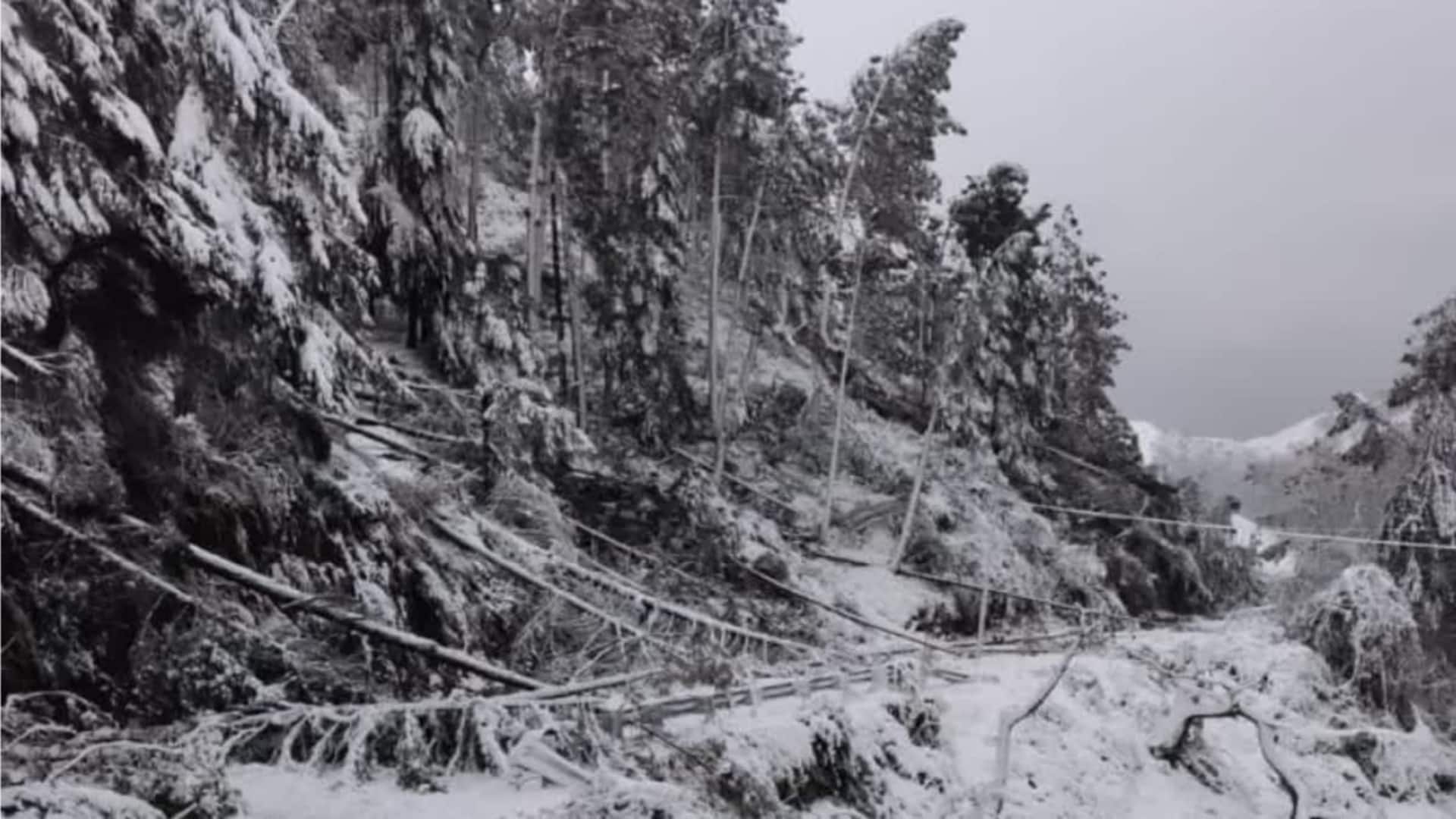
Western disturbance triggers avalanche alert in Uttarakhand
What's the story
The mountainous regions of northern India are bracing for another bout of severe weather as a strong western disturbance moves through the western Himalayas. The India Meteorological Department (IMD) has predicted light to moderate rain and snowfall across Jammu and Kashmir, Ladakh, Himachal Pradesh, and Uttarakhand till January 28. Some areas may witness heavy snowfall with thunderstorms and strong winds, increasing the risk of avalanches and landslides.
Weather warning
IMD issues yellow alert for Delhi-NCR
However, the western disturbance's impact will be felt in the plains of north-west India, including Punjab, Haryana, Chandigarh, and Delhi-NCR.
The IMD has issued a yellow alert for Delhi-NCR on Tuesday, predicting rain, thunder, and strong winds from morning till afternoon.
Wind speeds could reach 40-50km/h with gusts hitting 60km/h in some areas.
Disruptions reported
Heavy snowfall disrupts life in Himachal Pradesh
Himachal Pradesh has already been hit hard by heavy snowfall and rain, with over 1,250 roads closed across the state. This has severely impacted transport and daily life.
Power supply has also been affected as 1,942 distribution transformer regions (DTRs) are non-functional.
Shimla district was the worst affected with 789 DTRs down, followed by Sirmaur, Mandi, Kullu, and Chamba.
Avalanche warning
Avalanche alert issued in Uttarakhand
Meanwhile, in Uttarakhand, authorities have issued a high avalanche alert for several high-altitude districts.
The Defence Geospatial Information Research Establishment (DGRE) has issued a bulletin indicating varying threat levels across the state.
Snowfall has led to the closure of six national highways and 66 other roads in Uttarakhand.
District administrations are on high alert, and rescue teams are prepared for emergencies after a warning from the Snow and Avalanche Study Establishment (SASE).
Weather forecast
Meteorologists predict gradual improvement post-January 28
Meteorologists have predicted that another western disturbance may affect north-west India from January 30 night, bringing more rain and snowfall.
However, weather conditions are likely to improve gradually after January 28.
The IMD has predicted a rise of 3-5 degrees Celsius in minimum temperatures across north-west India after this spell, indicating a slow warming trend.