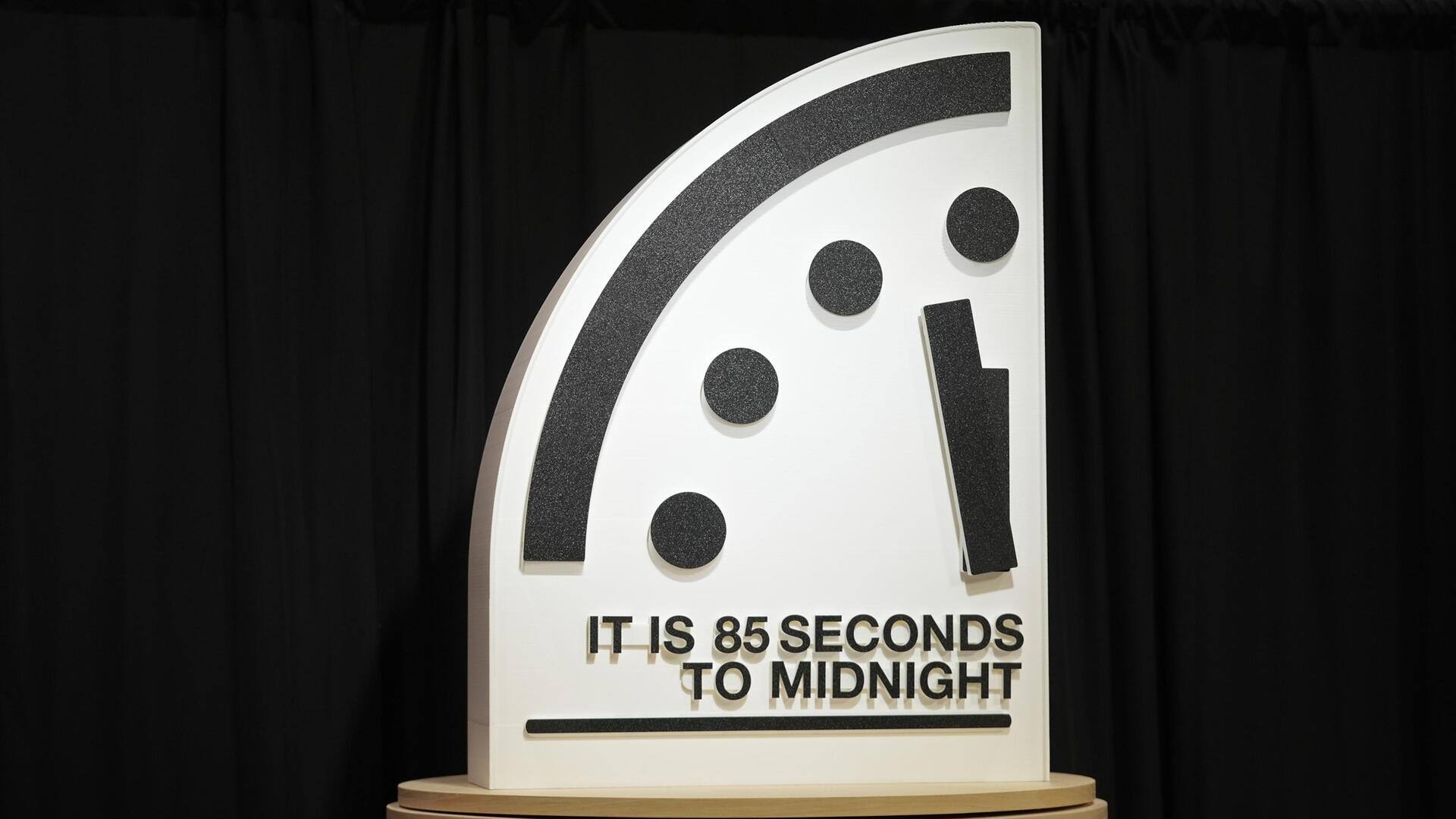
'Doomsday Clock' edges closer to catastrophe amid global risks
What's the story
The Bulletin of the Atomic Scientists has moved its "Doomsday Clock" closer to midnight, now standing at 85 seconds. The clock symbolizes how close humanity is to global catastrophe. This year's adjustment comes as a reaction to heightened tensions among major powers like Russia, China, and the United States. The group cited risks of nuclear war, climate change, potential misuse of biotechnology, and unchecked artificial intelligence as reasons for the alarming update.
Rising tensions
Global cooperation crumbles, power competition intensifies
The Bulletin of the Atomic Scientists also noted that "hard-won global understandings are collapsing."
This has led to a fierce competition among world powers and undermined international cooperation necessary to mitigate existential risks.
The group expressed concern over escalating conflicts between nuclear-armed nations, citing the ongoing Russia-Ukraine war and tensions between India and Pakistan as examples.
Trust issues
International trust and cooperation vital for global stability
Daniel Holz, chair of the group's science and security board, stressed on the importance of international trust and cooperation.
He said if the world adopts an "us-versus-them, zero-sum approach," it would only increase the chances of a global catastrophe.
The group also highlighted climate-related disasters like droughts, heatwaves, and floods as major threats to humanity's survival.
Timeline
Historical perspective on the Doomsday Clock
The Doomsday Clock, first introduced in 1947, has been a symbol of humanity's proximity to self-destruction.
During the Cold War, it came as close as 17 minutes to midnight.
However, in recent years due to rapid global changes, the group has shifted from counting down minutes till midnight to counting seconds.
The clock could be reset if global leaders and nations unite against existential risks.