
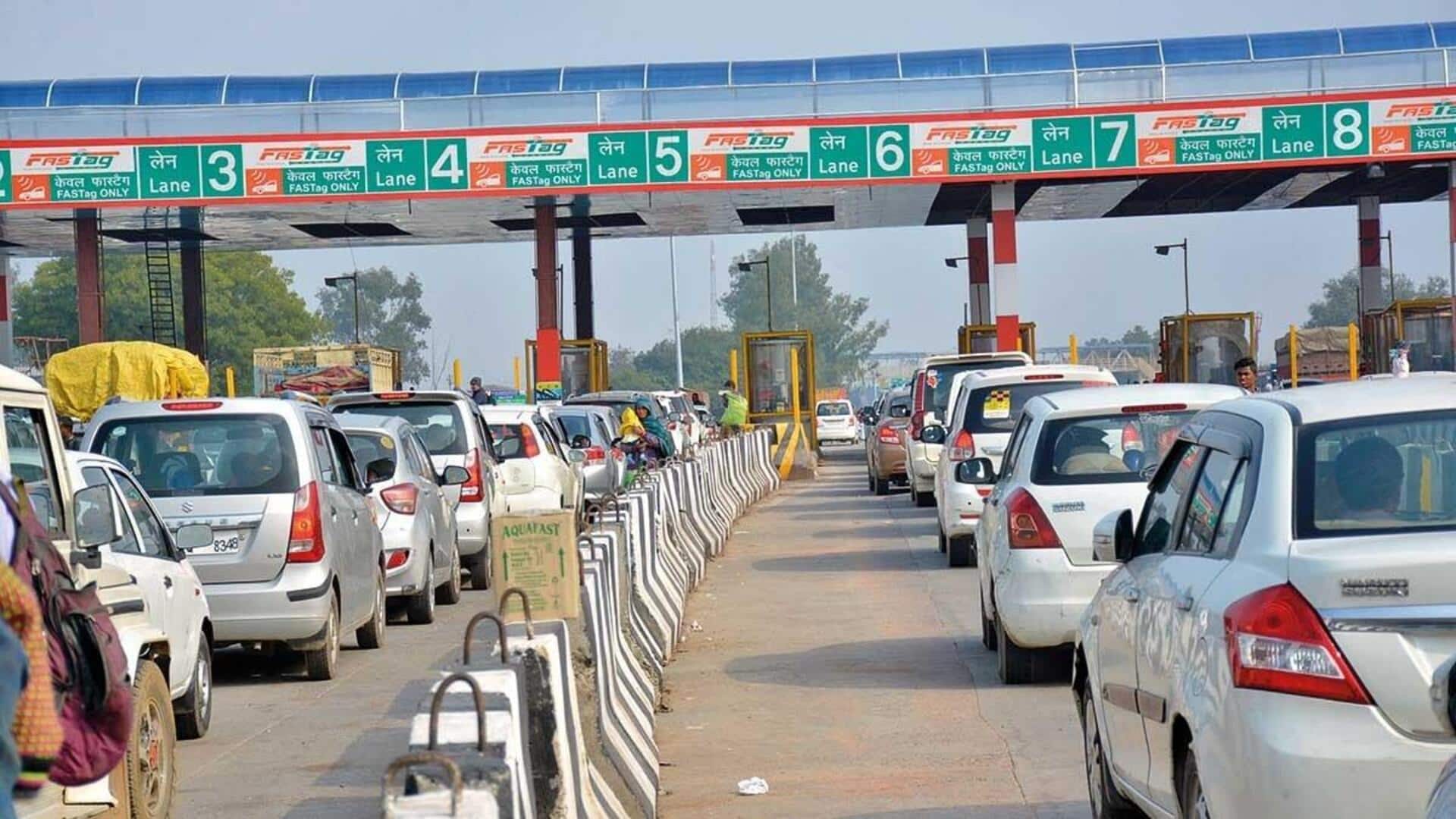
SC suggests closing Delhi toll booths to check pollution
What's the story
The Supreme Court has asked the National Highway Authority of India (NHAI) to consider relocating or closing nine toll collection booths operated by the Municipal Corporation of Delhi (MCD). The move is aimed at reducing traffic congestion and air pollution in the National Capital Region (NCR). The bench, chaired by Chief Justice of India Justice Surya Kant, directed the MCD to make a decision within a week, according to PTI news agency.
Revenue sharing
SC suggests revenue-sharing model for toll booth relocation
The SC has suggested that the toll booths could be shifted to NHAI-managed locations. This would help ease traffic jams at border entry points into Delhi. The court also proposed that some of the toll revenue from these sites could be shared with the MCD to offset any temporary losses. "A portion of the toll collected at such sites can then be diverted to the MCD to compensate for the perceived loss arising from the temporary suspension," the bench suggested.
SC
Vehicles stuck for hours, court told
The bench passed the order after it was told that vehicles were stopped on the border for hours, contributing to air pollution. "MCD is directed to cooperate on the issue and to consider suspending operations at these nine toll plazas for a temporary period. A decision in this regard shall be taken within one week and placed on record," the court ordered. The NHAI had moved the court alleging congestion at the borders due to the toll collection by MCD.
Pollution critique
SC criticizes short-term measures for pollution control
On the subject of air quality, the Supreme Court verbally stated that authorities' efforts to control pollution in Delhi-NCR had been a "total failure." It stressed that meaningful improvement requires long-term planning instead of ad-hoc or short-term measures. The bench also heard petitions related to pollution's impact on children but refused to intervene in interim policy decisions like school closures or hybrid classes.
Schools
'Courts cannot function as super specialists'
Senior Advocate Menaka Guruswamy informed the bench that the closure of the schools would disproportionately affect the poor, who would be deprived of midday meals. She also questioned the decision's rationale, wondering how schoolchildren contributed to pollution. In response, the CJI stated that courts cannot function as "super specialists" and pass judgment on the choices made by experts. He also noted that the shutdown is only for a few days, as schools are already closing next week for winter holiday.