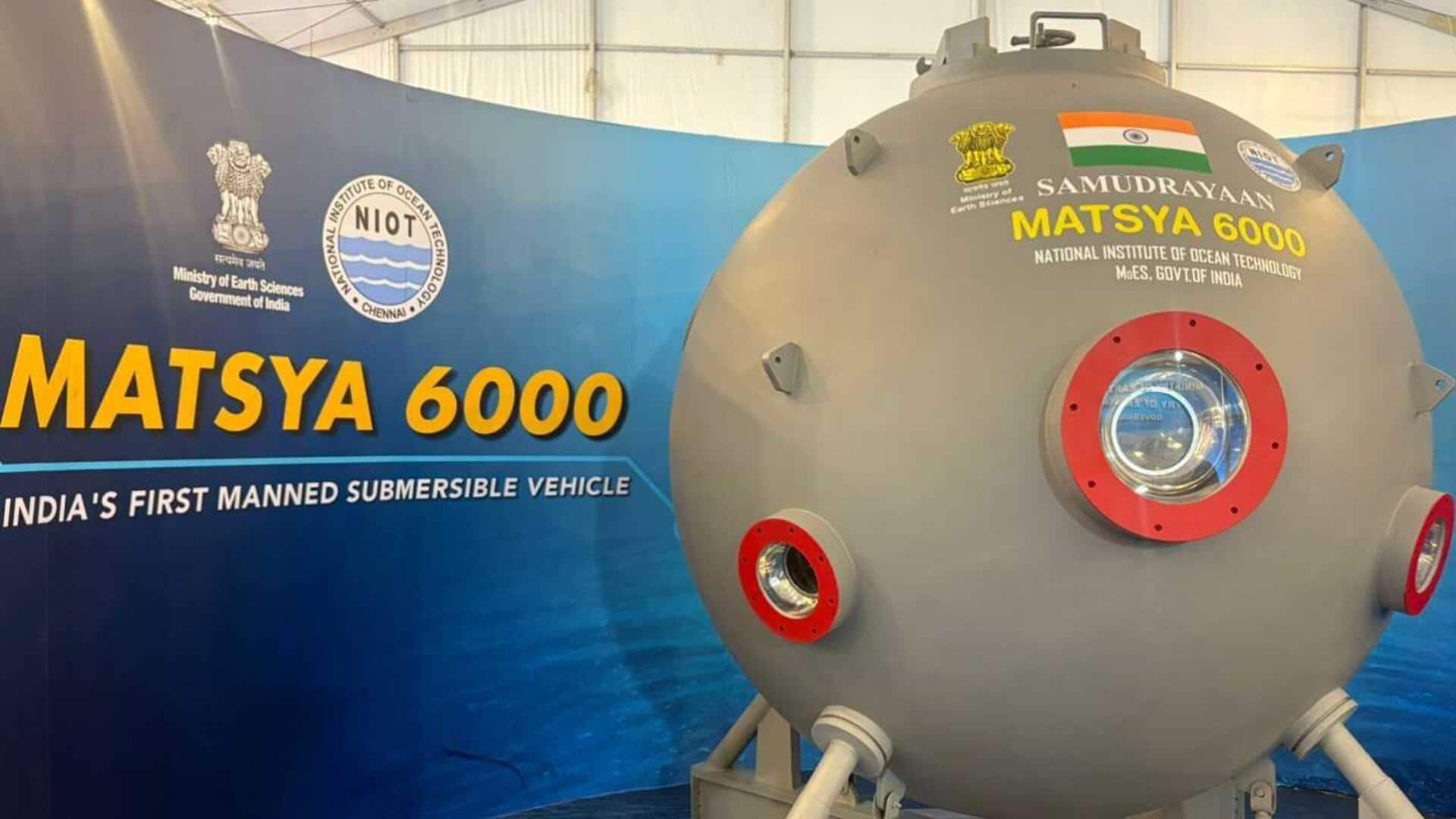
Meet Matsya 6000, India's 1st manned deep-sea submersible
What's the story
India has unveiled Matsya 6000, its first-ever crewed deep-sea submersible. The project was announced by Union Minister of State for Science and Technology Jitendra Singh on X. He said the initiative is part of India's plan to join a select group of nations capable of ultra-deep sea exploration. The submersible will be showcased at the India International Science Festival (IISF) 2025 in Panchkula.
Goals
Matsya 6000's ambitious exploration timeline
The Matsya 6000 submersible is expected to conduct its first manned dive of 500 meters by 2026 and a more challenging dive of up to 6,000 meters by 2027.
The project is part of the Indian government's Deep Ocean Mission initiatives.
It was developed by the National Institute of Ocean Technology under the Ministry of Earth Sciences as part of the Samudrayan Project.
Technical specifications
Design and capabilities
The Matsya 6000 submersible can carry three people to a depth of 6,000 meters.
It comes with a range of scientific instruments and exploration tools for extensive deep-sea research.
The submersible can operate for 12 hours and last up to 96 hours in an emergency.
It also features advanced equipment like high-density Li-Po batteries, underwater acoustic telephones, bio-vests for crew safety and health monitoring, as well as drop-weight emergency escape mechanisms.
Exploration impact
Role in marine exploration
The Ministry of Earth Sciences has said that the Matsya 6000 is a major attraction at IISF 2025.
It highlights India's progress in marine exploration, allowing scientists to study some of the ocean's deepest regions.
Ramesh Raju, a member of the Indian Ocean Science and Technology team at IISF, said only four countries have equipment which can dive deeper than 6,000 meters. India is one of them, capable of transporting explorers to such depths with Matsya 6000.