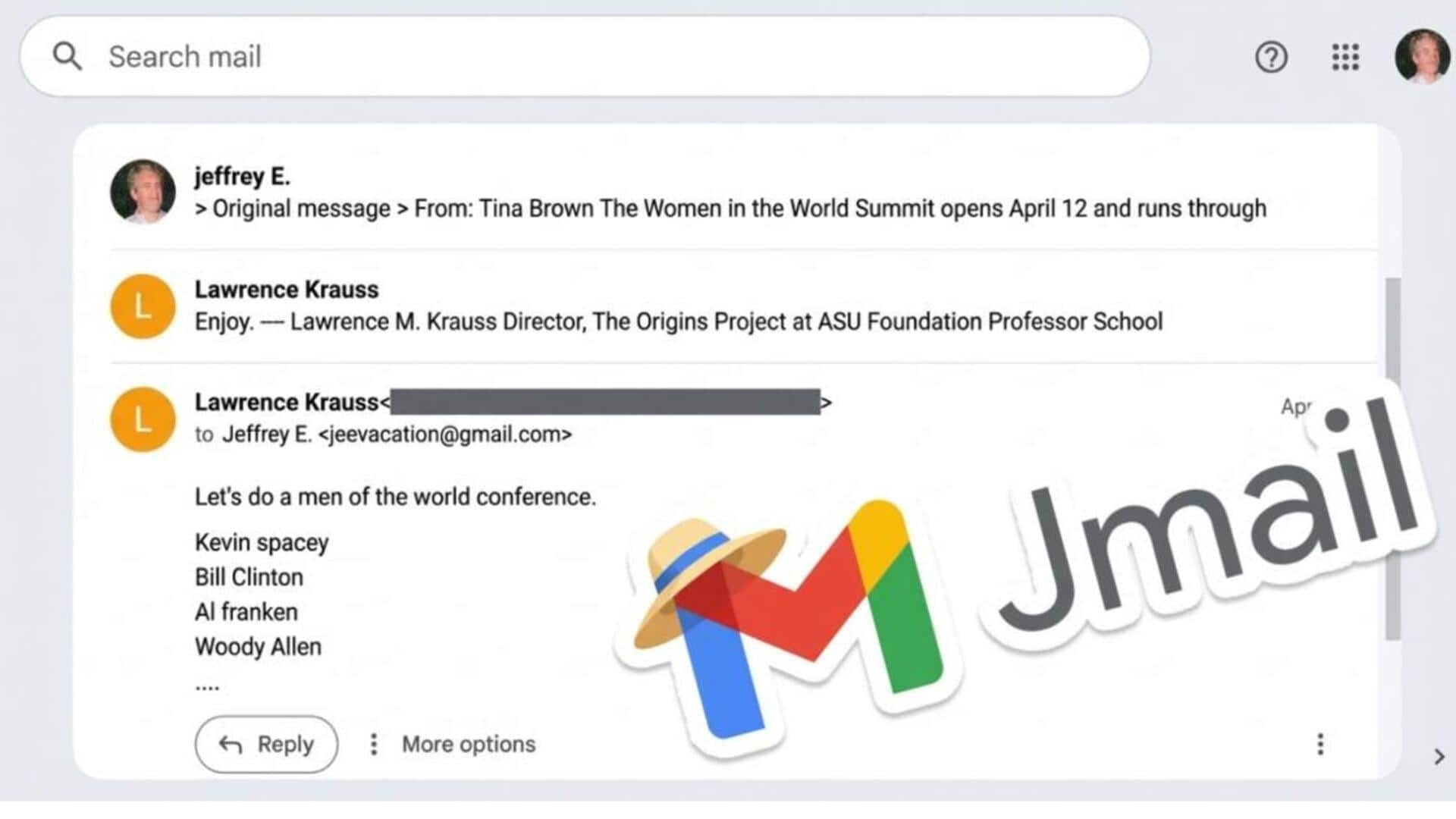
'Jmail' organizes Epstein court documents into email-like threads
What's the story
A new web platform called Jmail is providing a new way to access Jeffrey Epstein's court documents. The tool, created by developers Riley Walz and Luke Igel, doesn't release any new documents but reorganizes existing ones released by the US Department of Justice. It uses artificial intelligence and optical character recognition technology to convert scanned court PDFs into readable, searchable text.
Innovative design
Restructuring scanned documents
The Epstein-related files released over the years have largely been in scanned document form, making them hard to navigate.
Jmail changes that by restructuring these records into threads like an email inbox.
This way, users can filter by sender, subject line or keyword.
The developers say their aim is accessibility rather than revelation as all content shown on Jmail comes from publicly available court filings and disclosures.
User-friendly platform
Tool comes as Epstein's network is back in the spotlight
Jmail is designed to make it easier for journalists, researchers, and the general public to trace timelines, identify communication patterns and cross-reference names.
The tool comes at a time when Epstein's network is back in the spotlight with more court documents being released in recent years.
News organizations have reported on the scale of these disclosures including flight logs, email exchanges and contact lists linked to Epstein and his associates.
Efficiency boost
Jmail presents records in familiar inbox format
The challenge with these documents is that they are often fragmented across multiple court cases and filings, making it time-consuming to track connections.
Jmail solves this by presenting the records in a familiar inbox format.
Users can click through conversations, search for specific individuals, and view documents chronologically—features that are hard to replicate when dealing with hundreds of static PDFs.
Changing trends
Reflects a larger trend of how public records are consumed
Legal experts say tools like Jmail reflect a larger trend of how public records are consumed.
With more court documents being released digitally, independent developers are using automation and AI to organize them for efficient analysis.
However, the creators of Jmail stress that the platform doesn't introduce any new evidence and shouldn't be mistaken for an official government database.
It merely repackages material already in the public domain into an easier-to-navigate format.