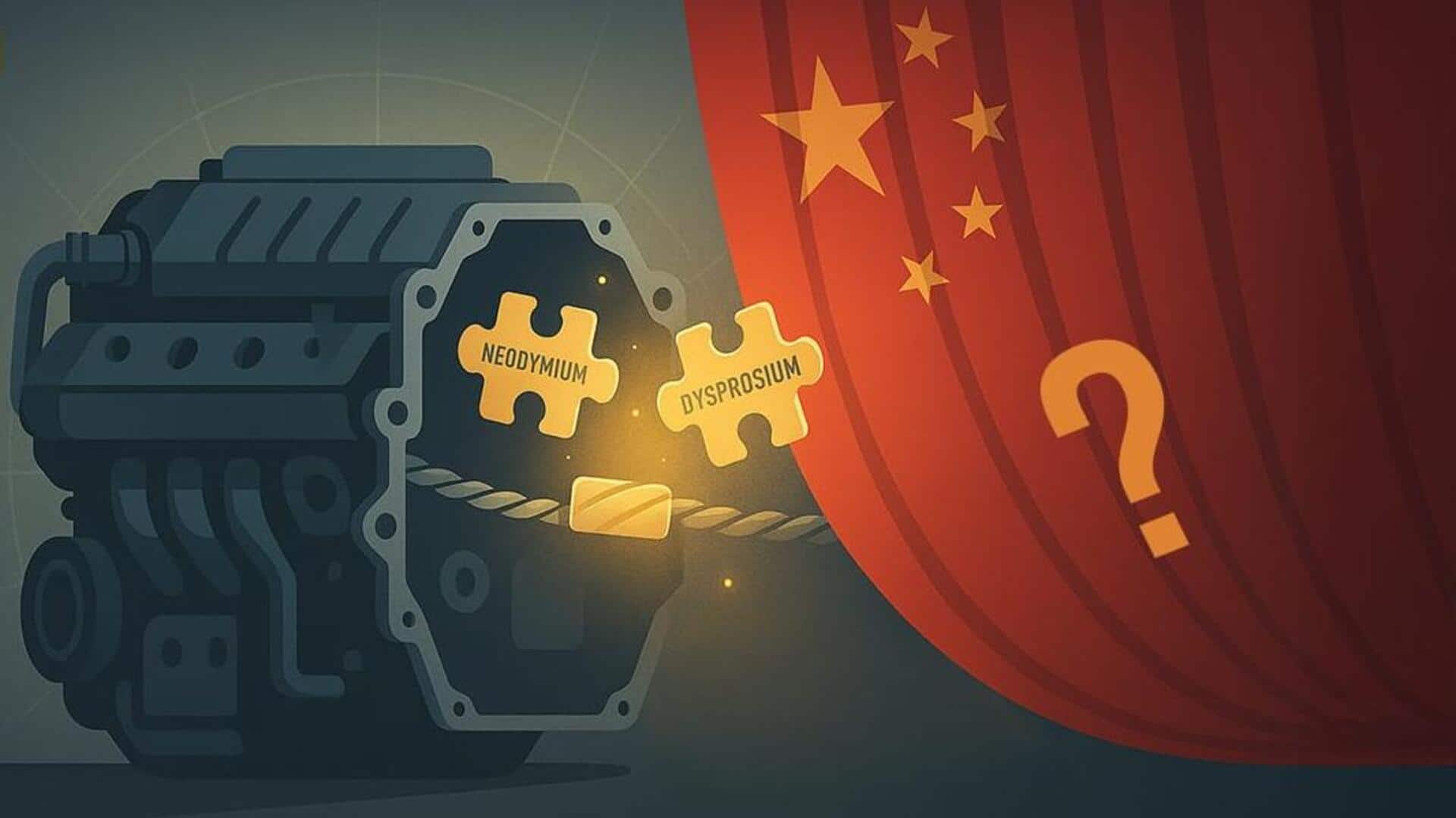
How Chinese rare-earth dealers are bypassing Beijing's export restrictions
What's the story
Chinese manufacturers of rare-earth magnets are finding ways to circumvent their government's stringent export restrictions. The companies are modifying magnet compositions to eliminate the use of certain restricted rare-earth elements. They are also using other methods, such as embedding these powerful magnets in motors, to keep sales flowing to Western buyers without violating Chinese laws.
Adaptations
Strategies to maintain exports amid restrictions
The new strategies, while legal, aren't flawless and the new magnets sometimes behave differently than traditional ones.
However, with their massive magnet-making capacity, Chinese companies are determined to find legal ways to keep exports flowing.
This is part of a long-standing battle between China and the US over rare earths. These materials are essential for producing everything from cars and wind turbines to jet fighters.
Trade implications
China's new export-licensing regime and its impact
Earlier this year, amid a trade war with the Trump administration over US tariffs on Chinese goods, Beijing introduced a new export-licensing regime.
This has restricted the supply of rare earths and hurt Western businesses.
In an October deal with the US, China agreed to delay some upcoming restrictions. However, Western businesses are still concerned that supply may be insufficient.
Innovation drive
Technical innovations and new magnet development
To circumvent these restrictions, Chinese magnet companies are racing to develop better magnets without heavy rare earths.
They are making such magnets more heat-resistant by grinding the material until it is extremely fine.
This process requires specialized machinery and increases costs significantly.
The resulting magnets can operate at temperatures of up to 150 degrees Celsius, which is enough for many home appliances.
Market response
Chinese companies are marketing magnets without restricted elements
Several Chinese companies, including Yonjumag, Anhui Hanhai New Material, Zhaobao Magnet and X-Mag, are marketing magnets free of the regulated heavy rare earths.
X-Mag has even published detailed charts showing its progress in developing new heat-resistant magnets that don't require export licenses.
Despite concerns over their effectiveness compared to traditional ones, many Western companies are buying these alternative products.
Compliance efforts
Alternative strategies and compliance measures by Chinese companies
Along with modifying magnet compositions, some Chinese companies are also working with local parts manufacturers.
They deliver motors and other parts with embedded magnets to Western clients.
Despite the political sensitivity surrounding rare earths, these firms are careful to comply with the law.
In recent months, Beijing has cracked down on smuggling of critical minerals like rare earths.