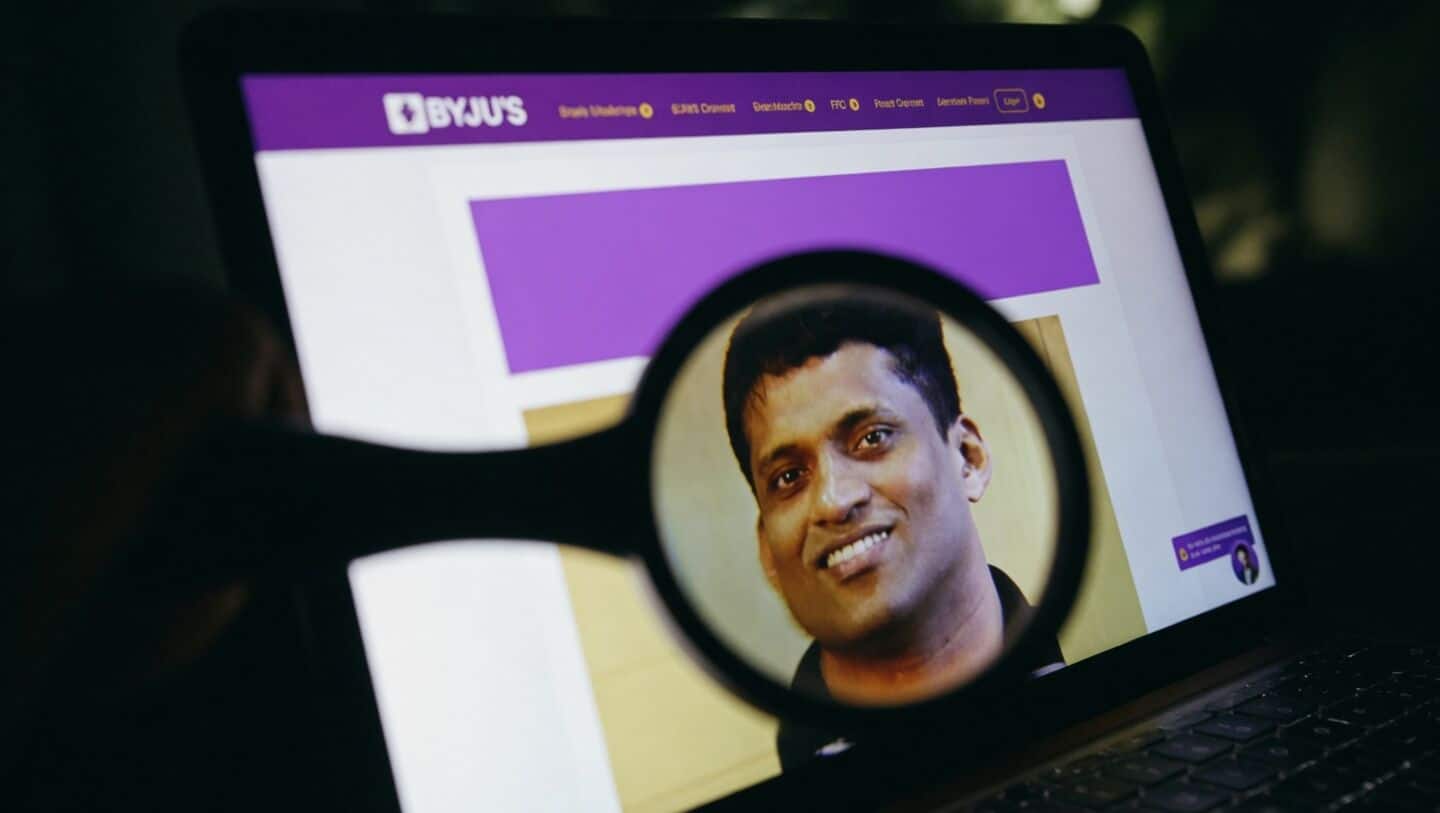
How Byju Raveendran lost a $22B empire
What's the story
Byju Raveendran, the founder of India's largest edtech company BYJU'S, has been sentenced to six months in prison by a Singapore court. The ruling comes after Raveendran was found guilty of contempt for failing to comply with multiple court orders since April 2024. The case stems from Qatar Holdings' attempt to enforce a $235 million arbitration award issued through the Singapore International Arbitration Centre (SIAC).
Court orders
Raveendran ordered to surrender, pay legal costs
Along with the prison term, the Singapore court also ordered Raveendran to surrender, pay S$90,000 (around $70,500) in legal costs and provide documents proving his ownership of Beeaar Investco Pte.
The entity is a corporate entity used to hold shares in a related corporate structure.
Growth strategy
BYJU'S growth story and challenges
BYJU'S rapid growth was fueled by aggressive expansion, debt-fueled acquisitions, and a "growth-at-all-costs" culture.
The company's strategy relied heavily on large acquisitions financed through venture capital and debt. However, integrating these businesses proved difficult and expensive.
Several acquired companies struggled with operational integration and high cash burn rates.
Meanwhile, reports emerged alleging that BYJU'S employees used aggressive sales methods to persuade families into purchasing costly educational packages financed through long-term loans and automatic EMI deductions.
Investor confidence
Governance concerns and financial mismanagement allegations
Governance concerns deepened as BYJU'S delayed submitting audited financial statements to Indian authorities.
The delay reportedly extended beyond 18 months, raising red flags among investors and regulators.
When the FY21 financial results were finally disclosed in late 2022, they revealed significantly larger losses than previously understood.
Questions also emerged regarding revenue recognition methods used for multi-year software and subscription packages, damaging investor confidence and triggering scrutiny of the company's financial management practices.
Market shift
Shift back to physical learning after COVID-19 pandemic
As schools reopened across India and other countries in 2022 and 2023, many students returned to physical learning environments. This shift slowed demand for purely online educational products sharply.
BYJU'S, burdened by acquisitions, high operational expenses, and mounting debt obligations, struggled to adapt to the changing market environment.
By 2023, the company's financial distress became increasingly visible with major investors slashing their internal valuations of the company.
Legal disputes
Legal battles and bankruptcy proceedings in US courts
The $1.2 billion Term Loan B secured by BYJU'S Alpha Inc in 2021 became a focal point after the company allegedly failed to meet interest payment obligations.
Lenders represented by GLAS Trust Company initiated legal proceedings and accused company executives of moving $533 million through an obscure hedge fund structure.
The dispute intensified inside US courts, particularly in Delaware bankruptcy proceedings where judges issued strong observations against the company and its leadership.
Corporate crisis
NCLT insolvency proceedings initiated over unpaid sponsorship dues
The Board of Control for Cricket in India (BCCI) initiated insolvency proceedings over unpaid sponsorship dues of ₹159 crore.
The dispute pushed Think & Learn Pvt Ltd (parent firm of BYJU'S) into Corporate Insolvency Resolution Process (CIRP) before National Company Law Tribunal (NCLT).
Shareholders also moved against Raveendran during this period, with investors voting to remove him as CEO in 2024.
Attempts were made to settle some disputes privately but India's Supreme Court intervened following objections raised by US lenders.