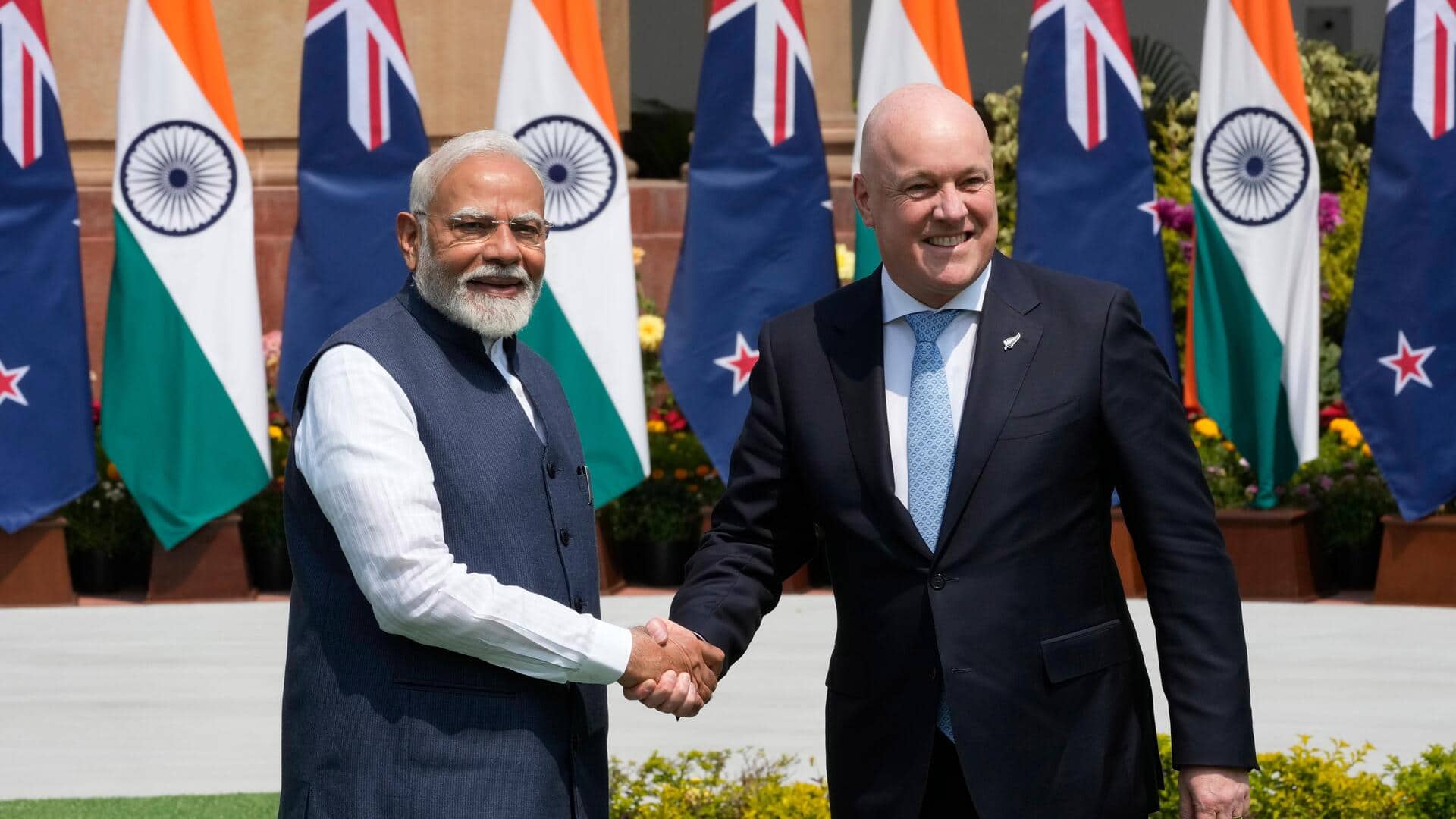
India, New Zealand finalize free trade agreement: Key points
What's the story
India and New Zealand have finalized a free trade agreement (FTA) to strengthen their economic ties and improve market access for exporters. The deal is expected to make it easier for New Zealand companies to export goods and services to India, which has the world's largest population and an economy projected at NZ$12 trillion ($7 trillion) by 2030. Under the FTA, tariffs on around 95% of New Zealand's exports to India will be cut or reduced.
Export growth
FTA to boost New Zealand's exports to India
New Zealand Prime Minister Christopher Luxon confirmed the FTA, saying he had spoken with Indian Prime Minister Narendra Modi after the agreement was reached.
"The FTA reduces or removes tariffs on 95% of our exports to India. It's forecast that NZ exports to India could increase $1.1B to $1.3B per year over the coming two decades," Luxon said in a post on X.
Economic impact
It will create jobs and increase wages in New Zealand
Luxon emphasized that the FTA would create jobs and raise incomes in New Zealand.
"Boosting trade means more Kiwi jobs, higher wages, and more opportunities for hard-working New Zealanders," he said.
The Prime Minister also stressed that this deal builds on the strong relationship between India and New Zealand.
"The agreement builds on the strong friendship between our two countries," Luxon said.
Market access
FTA opens access to 1.4 billion Indian consumers
Luxon also highlighted the market potential that the FTA opens up for New Zealand businesses.
"India is one of the fastest-growing economies in the world, and this gives Kiwi businesses access to 1.4 billion Indian consumers," he said.
The deal comes after Trade Minister Todd McClay's recent visit to India and has been a key goal for Luxon's government since his election victory in 2023.
Negotiation hurdles
Addressesing challenges in accessing India's market
The FTA aims to improve New Zealand's access to India's market, addressing past challenges, especially in sectors like dairy products.
In June, Vangelis Vitalis from New Zealand's foreign affairs warned that agricultural tariffs posed "colossal barriers" to trade talks.
He noted that India had never given access to dairy or apples in any of its agreements with other countries.