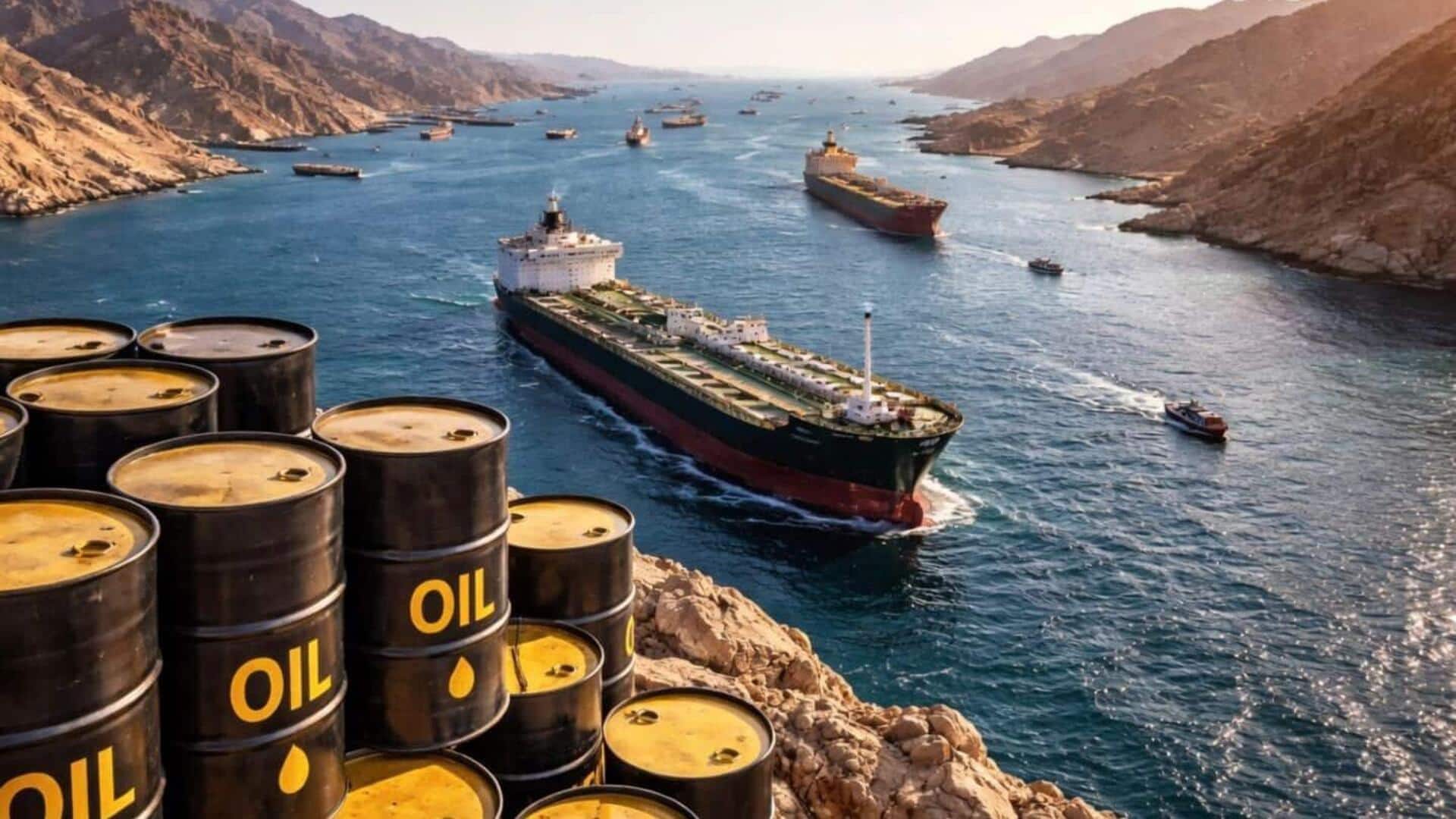
Oil nears $100 as Hormuz disruption outweighs US-Iran ceasefire
What's the story
Oil prices have surged toward $100 per barrel amid uncertainty over the US-Iran ceasefire. Maritime data from global ship tracking firm MarineTraffic shows that 22 ships have crossed the Strait of Hormuz since the ceasefire was brokered. The waterway, a key passage for global oil trade, is currently operating as a "high-risk" exclusion zone despite remaining functionally open.
Price fluctuation
Oil prices fell on ceasefire announcement
The announcement of the ceasefire initially led to a drop in oil prices. Brent crude for June delivery and WTI for May delivery fell to the mid-$90s per barrel, along with a decline in refined product prices.
However, analysts at Standard Chartered have warned that this correction could be too deep and any escalation could lead to a sharp rise in prices.
Market prediction
All major oil indices are on the rise
Standard Chartered's second-quarter forecast predicts Brent Crude at around $98 per barrel and WTI Crude at $92.50 per barrel.
As of April 10, all major oil indices are on the rise, hovering between $97 to $99 per barrel.
The Strait of Hormuz accounts for 20% of global oil trade with a majority being oil, chemical and gas tankers (59%).
Geopolitical dynamics
Gulf nations may concede to clear backlog of tankers
Analysts believe that Gulf countries may not be comfortable with Iran's influence on the global energy supply.
However, they may temporarily concede to clear the backlog of tankers stranded in the Strait.
As of now, around 426 tankers are stuck in this vital waterway.
OPEC nations may take considerable time to restore their production capacity if no further damage is done to infrastructure.
Energy shift
US dominance in global energy markets
Further damage to oil production capacity in the Gulf and Russia's war with Ukraine could push consumers toward the US.
The country has newly acquired reserves in Venezuela, which could strengthen its dominance in the short term.
Countries holding US debt would then be dependent on it for their energy needs, further consolidating America's position in global energy markets.