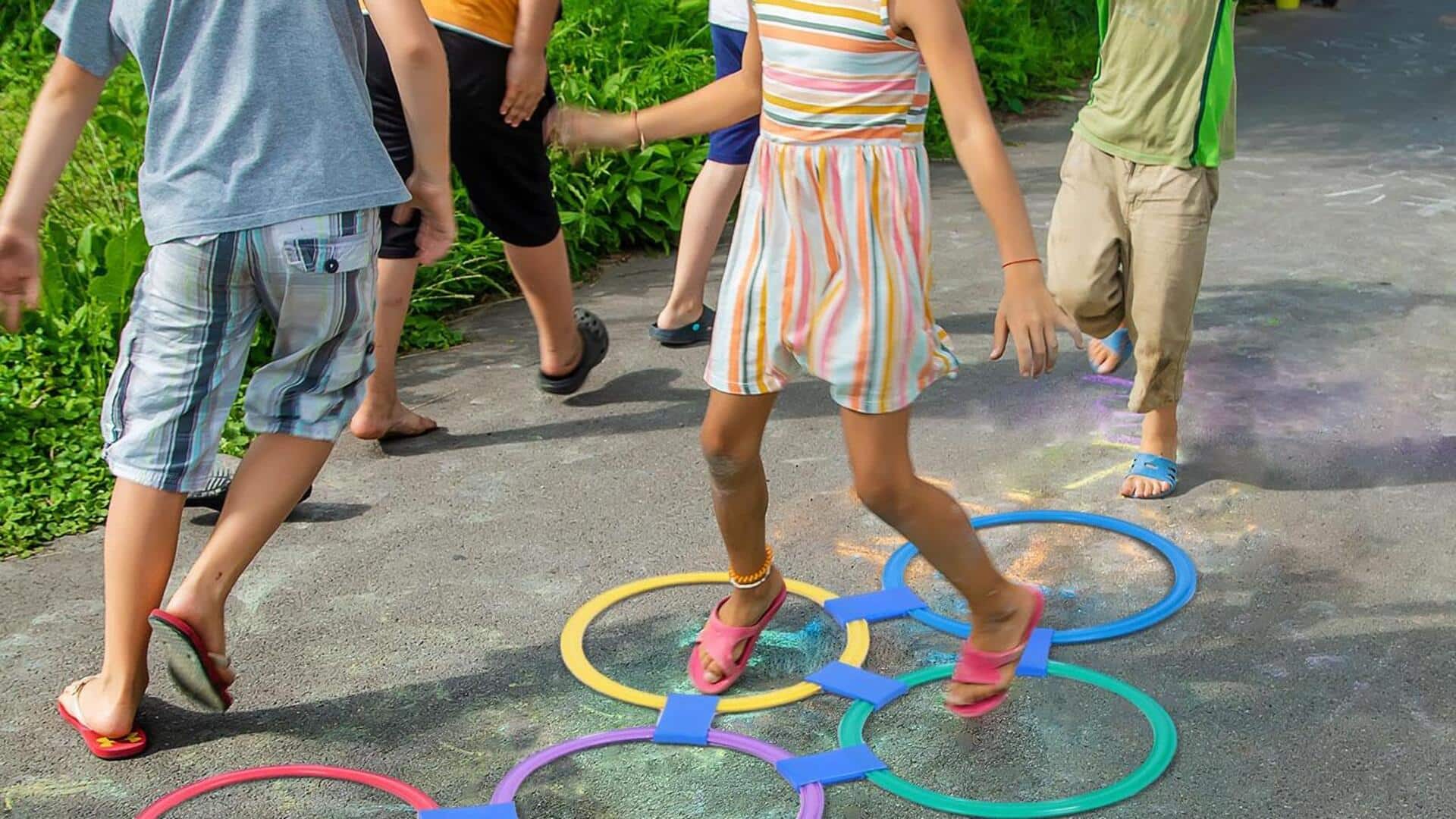
Footbag or hopscotch: Which improves coordination better?
What's the story
Footbag and hopscotch are two popular activities that promise to improve your coordination. While both are fun and engaging, they work on different aspects of your motor skills. Knowing how each activity improves coordination can help you pick the right one for your needs. Let's take a look at the different ways footbag and hopscotch improve coordination, and how they can be a part of your fitness routine.
#1
Balance and stability in footbag
Footbag requires players to keep their balance while kicking a small bag with their feet.
This constant need to balance improves core stability and proprioception, the body's ability to sense movement and position.
As players try to keep the footbag in the air with precise kicks, they develop better control over their body movements.
This makes footbag an excellent choice for improving balance-related coordination skills.
#2
Timing and rhythm in hopscotch
Hopscotch is all about timing and rhythm as players jump between squares drawn on the ground.
The activity requires quick thinking and precise timing to land correctly in each square without losing balance or stepping outside lines.
This repetitive pattern helps develop a sense of rhythm, which is essential for improving overall coordination.
By practicing hopscotch regularly, individuals can enhance their timing skills significantly.
#3
Agility enhancement through footbag play
Playing footbag also improves agility as players have to react quickly to keep the bag airborne.
The fast-paced nature of this activity demands quick foot movements and sharp reflexes, which contribute to improved agility over time.
As players become more adept at anticipating the bag's trajectory and adjusting their movements accordingly, they experience enhanced agility-related coordination benefits.
#4
Spatial awareness development in hopscotch
Since hopscotch involves navigating through a defined space on the ground, it greatly improves spatial awareness.
Players need to judge distances accurately while jumping from one square to another, all while maintaining balance throughout each turn.
This spatial awareness is key to many daily activities requiring precise movement planning within confined spaces or during complex tasks involving multiple elements simultaneously.