Rare interstellar comet to light up skies after 170,000 years
What's the story
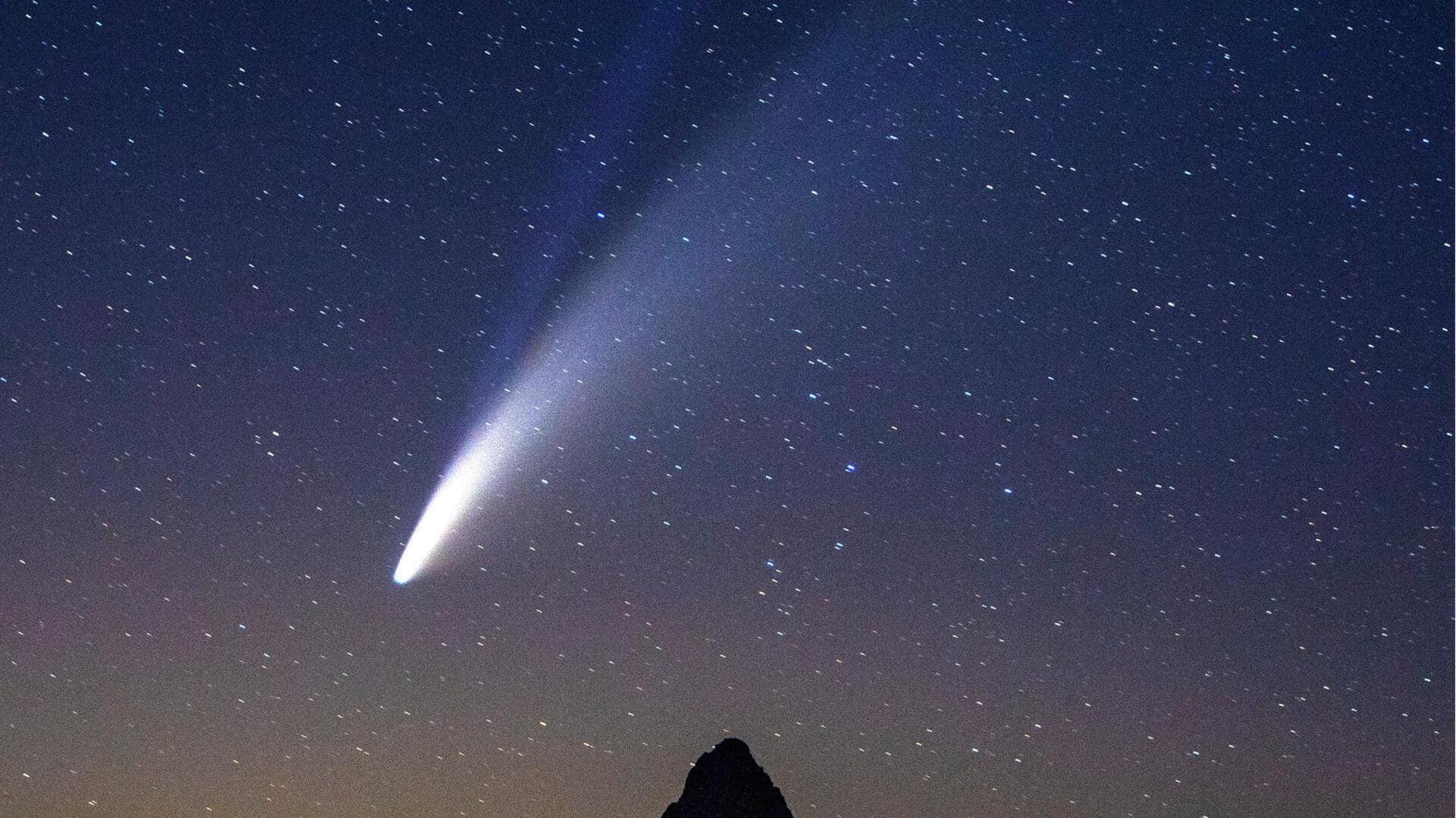
A rare interstellar visitor, Comet C/2025 R3 (Pan-STARRS), is set to make its first appearance in our solar system in 170,000 years. Discovered on September 7, 2025, by the Pan-STARRS survey at Haleakala, Hawaii, this icy celestial body completes an orbit around the Sun once every eons. The comet will brighten over the next few days as it nears perihelion, the point of its closest approach to the Sun, on April 19.
Celestial trajectory
Closest approach to Earth on April 27
The comet will make its closest approach to Earth on April 27, when it is expected to be at its brightest.
However, observers in the Northern Hemisphere will not be able to see it.
The comet will pass about half an astronomical unit (AU) from the Sun, which is roughly the distance between Earth and the Sun.
Observation tips
Best time to spot comet in Northern Hemisphere
The best time to spot the comet in the Northern Hemisphere is now until April 20, when it will be visible in the predawn sky.
The ideal viewing time is about 90 minutes before sunrise, when the comet rises above the eastern horizon.
Observers should look low in the eastern sky within the constellation Pegasus, where it is currently passing near a diamond-shaped pattern of four bright stars known as The Great Square of Pegasus.
Viewing aids
Binoculars recommended for better visibility
While the comet may be visible to the naked eye in very dark skies, dawn twilight can make it difficult to spot.
Therefore, astronomers recommend using 10x50 binoculars or similar optics for better visibility.
Current brightness estimates suggest that the comet could reach magnitude +2 to +3, making it one of the brightest comets seen in recent years.