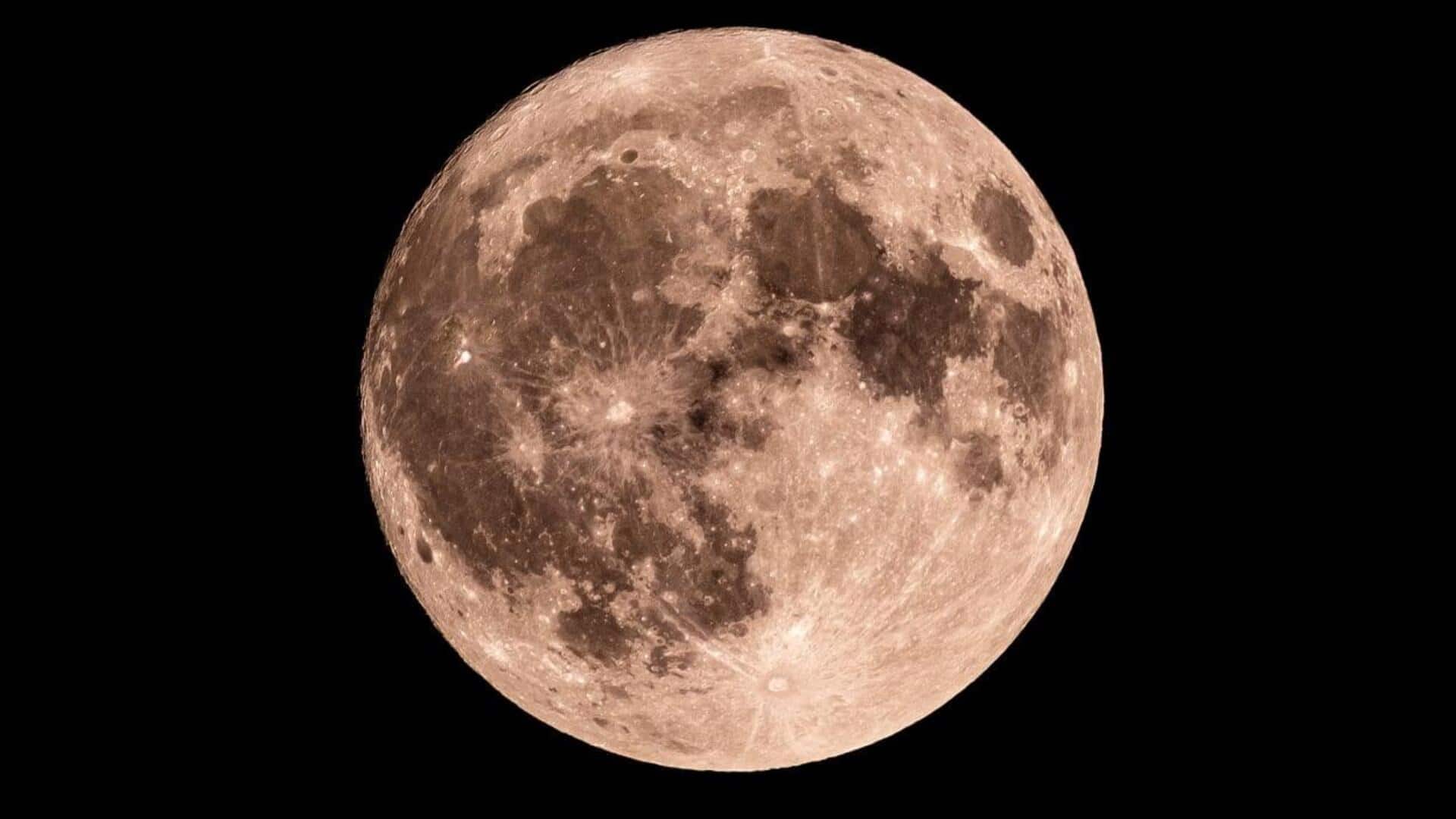
Moon is eating our atmosphere over billions of years
What's the story
A recent study has revealed that the Moon has been "eating" molecules from Earth's atmosphere for billions of years. The research, published in Nature Communications Earth & Environment, shows how particles from our planet's atmosphere have been carried into space by solar wind and deposited on the lunar surface over time. The findings offer a new understanding of a long-standing mystery dating back to the Apollo missions.
Apollo discoveries
Lunar samples revealed presence of water, carbon dioxide, helium
Lunar samples brought back by the Apollo missions contained traces of water, carbon dioxide, helium, and nitrogen embedded in the regolith.
This led to early studies speculating that these substances may have originated from the Sun or Earth's early atmosphere before it developed a magnetic field about 3.7 billion years ago.
However, this new study challenges those assumptions and suggests a different scenario altogether.
New theory
Earth's magnetic field may have aided transfer
The new research proposes that Earth's magnetic field may have actually assisted in the transfer of atmospheric particles to the Moon, a process that is still ongoing.
"This means that the Earth has been supplying volatile gases like oxygen and nitrogen to the lunar soil over all this time," said Eric Blackman, co-author of the study and professor at University of Rochester in New York.
Implications
Findings could aid future lunar exploration
The presence of useful elements like oxygen and hydrogen on the Moon's surface could be beneficial for future lunar exploration.
Blackman said, "Lunar missions, and ultimately lunar colonies that might potentially arise someday, would likely have to have self-sustaining resources that do not need to be carried from Earth."
This opens up possibilities for processing water from lunar regolith and extracting hydrogen and oxygen for fuel.
Validation process
Researchers used computer simulations to validate findings
The scientists used computer simulations and tested two scenarios: one with strong solar wind and no magnetic field around Earth, and another with weaker solar wind but a strong magnetic field.
The modern Earth scenario was most effective at transferring atmospheric fragments to the Moon.
They validated these results against data from lunar soil analysis in previous studies using samples brought back by Apollo 14 and 17 missions.
Influence
Earth's magnetic field plays a crucial role
Earth's magnetic field, generated by electrical currents from molten iron and nickel in the planet's outer core, extends far into space.
It creates a shield that deflects much of the solar wind, preventing atmospheric erosion.
The interaction between the magnetic field and solar wind forms a magnetosphere. It is an elongated structure with a compressed front and long tail.
This explains why some atmospheric particles are stripped away and directed into space.
Direct path
Magnetotail directs atmospheric material to Moon
When the Moon is in its full phase, it enters a region called the 'magnetotail' where Earth's magnetic field opens a channel for atmospheric material.
This provides a more direct route for particles to reach the lunar surface.
The study highlights this interaction as an important chemical record of the Earth's ancient atmosphere that could be contained in lunar soil samples.