Neuralink rival completes first human brain implant
What's the story
Paradromics, a start-up competing with Elon Musk's Neuralink, has achieved a major milestone by successfully implanting its Connexus brain-computer interface (BCI) in a human patient. The procedure was performed on a Michigan woman who has trouble speaking due to motor neuron disease. The operation was part of an FDA-approved clinical study at the University of Michigan Health and lasted for around four hours.
Innovative device
Connexus BCI enables communication for people with severe motor impairments
The Connexus BCI, developed by Paradromics, is designed to enable people with severe motor impairments to communicate through a computer.
The device works by detecting neural activity when a person tries to speak and uses specialized software to convert those signals into text or synthesized speech.
This revolutionary technology offers an alternative way of communication for those who have lost their ability to speak due to physical impairments.
Implant details
The implant is about the size of a dime
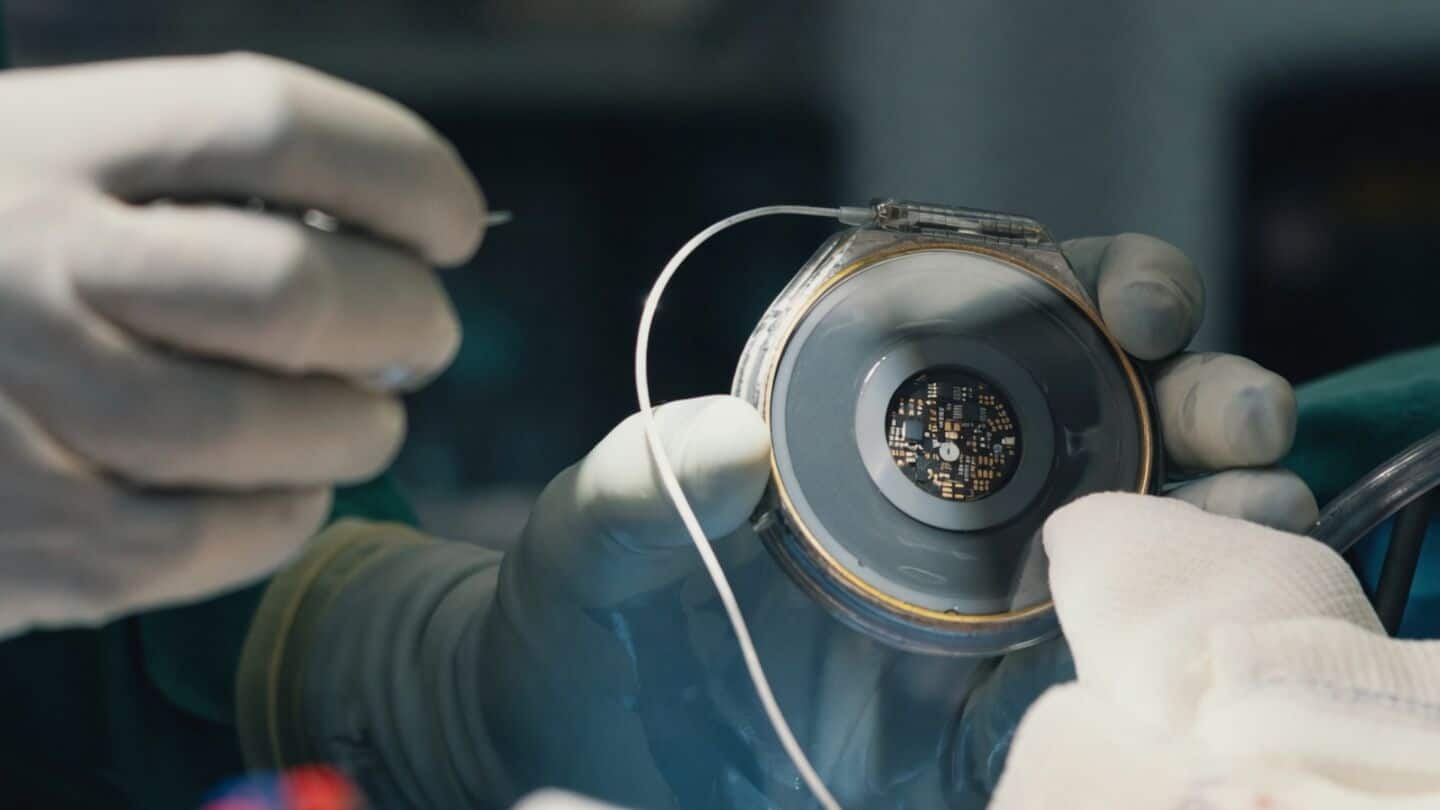
The Connexus implant is a small brain interface, about the size of a dime, that sits on the surface of the brain.
It has 421 platinum-iridium microwires that penetrate into brain tissue, each wire being thinner than half a human hair.
The system also includes extension leads running under the skin along one side of the neck to a transceiver implanted below one collarbone.
This chest-mounted device communicates wirelessly through skin with an external receiver.
Monitoring strategy
Paradromics to monitor patient for next 6 years
Paradromics plans to monitor its first implant recipient for the next six years, with the first year focused on collecting safety and performance data.
Researchers will look at factors such as communication speed, vocabulary size, and how much information the device can get from brain signals during conversations.
This long-term study will help assess the effectiveness and safety of this groundbreaking technology in real-world scenarios.
Future applications
Future applications and risks of the technology
While the current focus of the technology is on helping people with severe disabilities regain their communication abilities, Paradromics envisions future applications could extend to advanced prosthetics, direct AI interaction, and treatments for neurological and mental health conditions.
The company also acknowledged that like any procedure involving implanted medical devices, there are risks associated with the technology such as infection and complications from surgery.