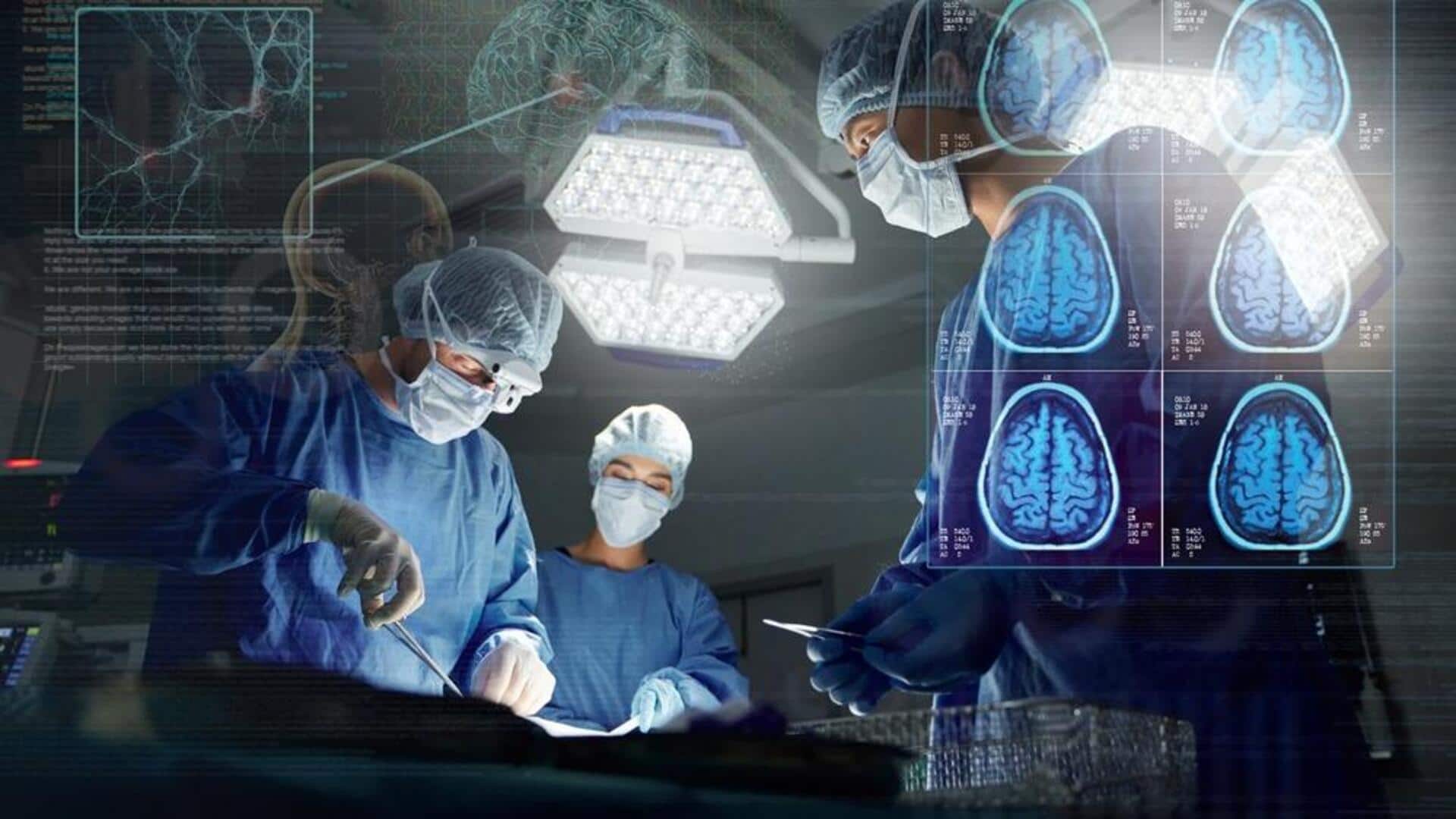
AI helps surgeons perform world's first brain tumor surgery
What's the story
Rhys Hibbert (48), a Bedfordshire resident, has become the first person in the world to undergo an artificial intelligence (AI)-assisted brain surgery. The groundbreaking procedure was performed at University College London Hospital and successfully removed an 11mm non-cancerous tumor from Hibbert's pituitary gland. The innovative use of AI during the operation played a crucial role in identifying and avoiding critical blood vessels and nerves in the brain.
Technological assistance
The AI tool provided real-time advice to surgeons
The AI tool provided real-time advice to the surgeons, helping them safely remove as much of the tumor as possible.
"From a patient safety perspective, I can see absolutely the benefit. There are no road signs inside our head," said Hibbert, highlighting how critical this technology was for his operation.
Health struggles
Hibbert's journey to becoming first AI-assisted surgery patient
Before the surgery, Hibbert had been healthy and active. However, an incident during a routine walk led to his diagnosis with a non-cancerous tumor on the pituitary gland.
The growth started pressing on his optic nerves, narrowing his peripheral vision and causing severe fatigue and dizziness.
Despite these challenges, Hibbert chose to be the first patient to undergo this revolutionary AI-assisted operation.
Surgical precision
How the AI tool helped in the surgery
The surgery involved inserting an endoscope through the nose to reach the base of the skull, where the tumor was located.
The AI tool played a vital role in marking areas where blood vessels and nerves were most likely to be.
This ensured maximum safety during its removal, reducing the risk of complications significantly.
AI evolution
The AI system was trained on numerous surgical videos
The AI system was trained on hundreds of videos of pituitary tumor removals, learning to recognize important anatomical structures.
"It is trained on more operations than most surgeons see or do in a lifetime and can act like an expert second pair of eyes," said Prof Hani Marcus, who assisted in the procedure.
The long-term goal is to develop a kind of surgical ChatGPT for real-time advice during surgeries.
Recovery journey
Hibbert's vision dramatically improved after the operation
After the surgery, Hibbert experienced a dramatic improvement in his vision.
"When I opened my eyes after the operation it felt like I had got 360-degree vision - I hadn't seen that clearly for a year," he said.
The team behind this innovative technology is now working on a larger trial to further test their AI tool in real-life surgery.