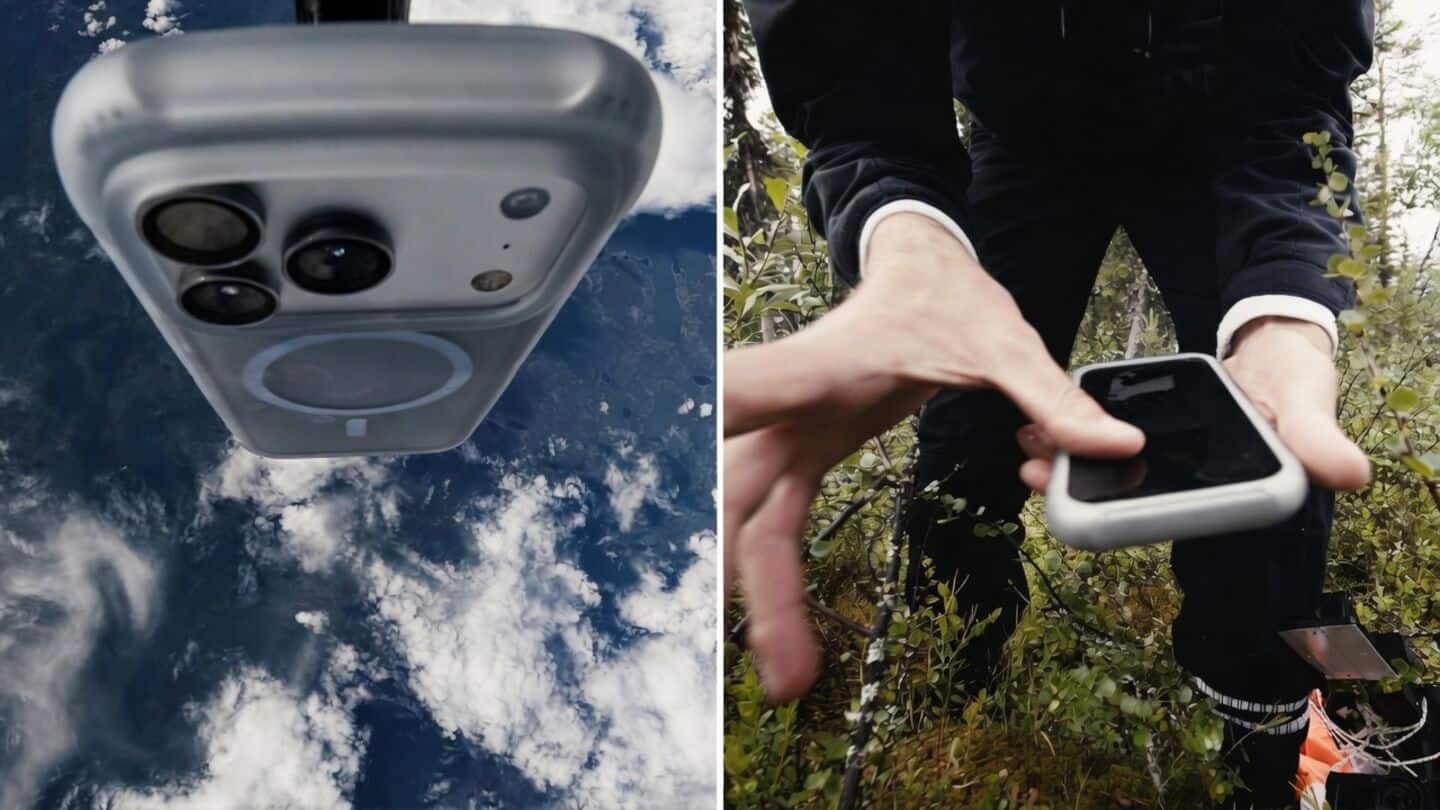
Smartphone survives 30km fall from stratosphere, sets Guinness World Record
What's the story
A smartphone has survived a fall from the stratosphere, earning a new Guinness World Records title. The device was released over Kiruna, Sweden, on June 24, 2026. It fell from an altitude of 30,607m but was recovered intact and still working. The feat was accomplished by RHINOSHIELD and UK-based Sent Into Space using a high-altitude balloon to carry the phone more than 30km above Earth before remotely releasing it.
Achievement
Phone dropped from 30,607 meters
The stunt earned RHINOSHIELD a Guinness World Records title for the highest drop of a mobile phone in a phone case onto natural landforms.
The experiment was more of a durability test than an actual space mission, but it yielded an incredible result.
A phone was taken to the edge of the stratosphere, dropped from 30,607 meters high, and brought back ready for another call.
Protection
Phone protected by special case
The key to the phone's survival was the AirX protective case, developed by RHINOSHIELD.
The case is designed to absorb and disperse impact energy, protecting the phone's internal components during a fall.
After recovery, the device was still operational and could make calls and take photographs with its exterior intact.
Descent challenges
Extreme temperatures and atmospheric pressure
The smartphone was subjected to extreme conditions on its way down.
Temperatures at that altitude can plummet to around -40°C to -60°C, while atmospheric pressure is only about 1% of sea-level pressure.
Despite these harsh conditions and a potentially destructive landing, the phone managed to survive the fall.
Altitude clarification
Not a space drop, but a near-space drop
It's important to note that the phone was dropped from the stratosphere, not outer space.
The altitude exceeded three times higher than the cruising altitude of most passenger aircraft but remained below the 100-kilometer Karman line, often considered as space's edge.
This makes it a near-space drop scientifically more accurate than an actual space drop.
Twitter Post
Official post from Guinness
A mobile phone case company put their product design to the ultimate test by dropping a phone from SPACE and recovering it completely unscathed 😳https://t.co/OzlXCHVOe4
— Guinness World Records (@GWR) August 26, 2026