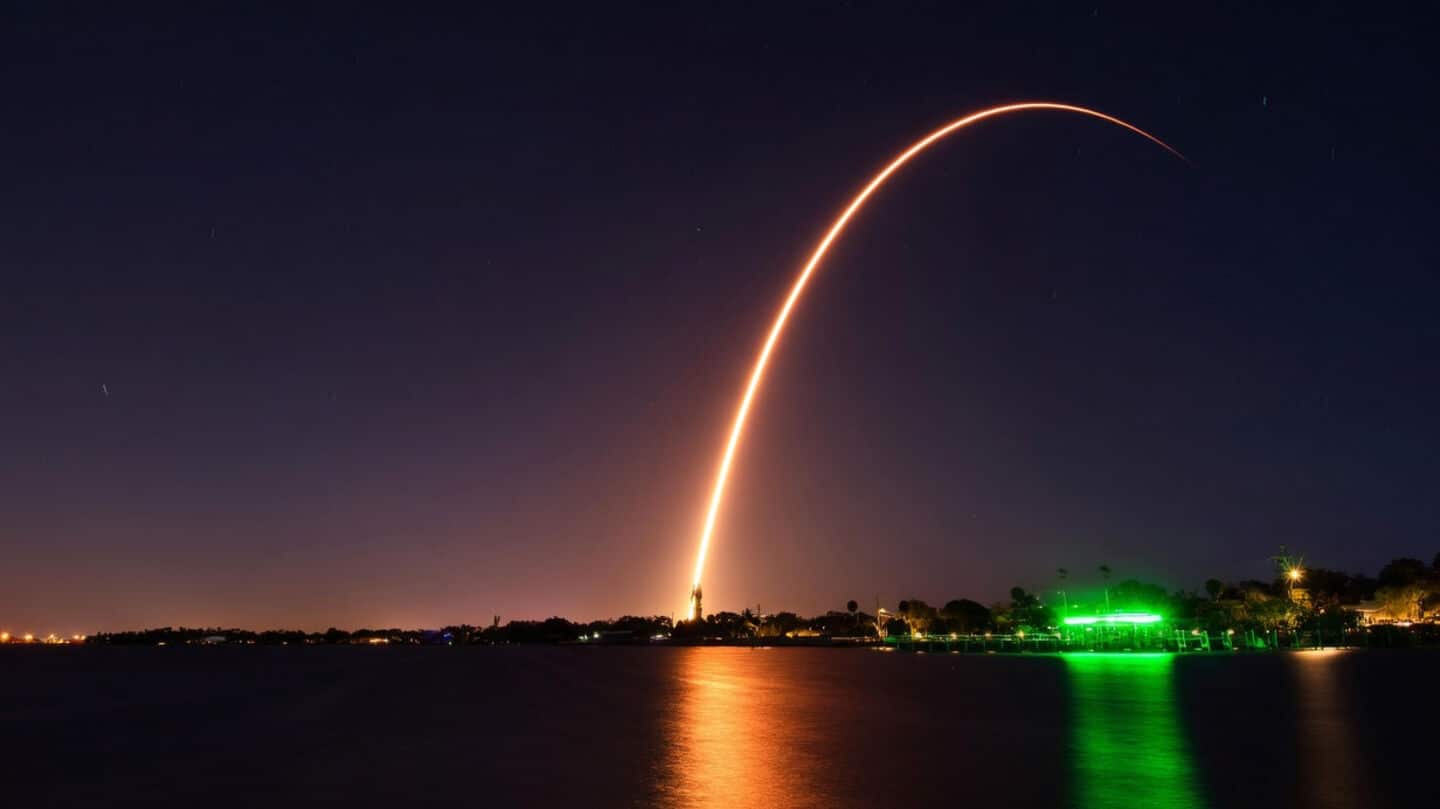
Why didn't Artemis II go straight up after launch?
What's the story
As NASA's Artemis II mission roared to life earlier today, spectators noticed something: shortly after clearing the tower, the massive Space Launch System (SLS) rocket began to tilt. Instead of piercing a straight line into the sky, it leaned over, tracing a long, graceful arc toward the horizon. To the untrained eye, it looks like a steering error. But actually it is a precision maneuver known as a "gravity turn."
Efficiency strategy
Pitch-over maneuver to transition from vertical to horizontal
During the first 10-20km, a rocket must push through Earth's dense atmosphere and strong gravity.
Simply going straight up isn't enough, as it would burn fuel quickly and gravity would pull it back down.
Instead, rockets perform a pitch-over maneuver. After a brief vertical climb at lift-off, they tilt to begin a curved "gravity turn."
This allows them to use Earth's gravity to help build horizontal speed and reach orbit more efficiently with less fuel.
Orbital mechanics
Horizontal speed must be carefully managed
About a minute into flight, as the rocket reaches the thinner upper atmosphere, it accelerates beyond 1,600km/h.
This horizontal speed must be carefully managed. Gaining speed too quickly at lower altitudes, where the air is denser, increases drag and stress on the vehicle.
On the other hand, accelerating too slowly can also create aerodynamic strain. Maintaining the right balance ensures the safety of astronauts and protects sensitive payloads during the rocket's climb to orbit.
Twitter Post
Footage filmed by airline passengers show rocket's curved trajectory
WATCH 🚀: Stunning footage filmed by airline passengers flying over Florida, capturing the precise moment the Artemis II mission launches—sending four astronauts on a historic journey around the Moon.
— ZEEZ 🌚 (@Swaggzeez1) April 2, 2026
pic.twitter.com/0jR5KJolUt
Speed requirement
Rockets also use Earth's rotation for efficiency
To stay in a stable orbit, a rocket's cargo has to hit speeds of 28,000km/h. This is about 8km every second.
The rocket also takes advantage of Earth's eastward rotation. Launching east from equatorial regions gives a 'free' energy boost of some 1,600km/h from our planet's rotation speed.
This reduces the need for extra fuel and increases payload capacity by 15-20%.