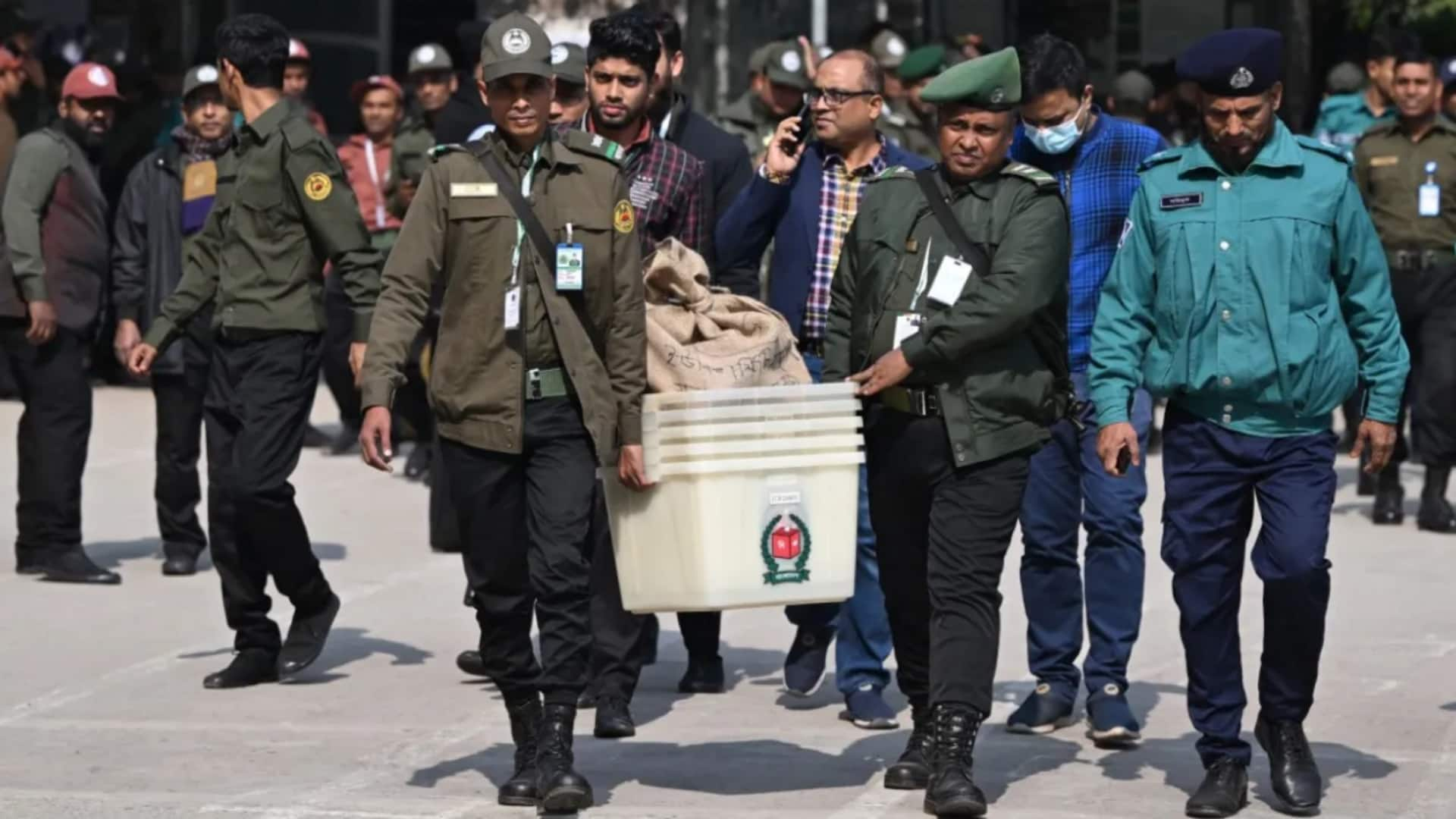
Bangladesh's 127M voters to cast twin ballots in post-uprising election
What's the story
Bangladesh is gearing up for its most significant election since the August 2024 student-led uprising that led to the ouster of Sheikh Hasina. The election will be held on February 12, 2026, with over 127 million voters eligible to cast their ballots. The upcoming polls will decide the next prime minister and government of Bangladesh. Notably, this will be the first time voters will use a dual-ballot system, voting for parliamentary representation and a constitutional referendum on the same day.
Polling details
Polling hours extended to accommodate complex voting process
The Bangladesh Election Commission has extended polling hours from 7:30am to 4:30pm to accommodate the complex voting process. The election will be held in 42,761 polling centers across Bangladesh, with around 244,739 polling booths. To maintain law and order during this crucial period, Dhaka has deployed a record number of military personnel, 92,500, the largest since 1971.
Reform proposals
Constitutional referendum to include major reforms
The constitutional referendum will include proposals for major reforms, such as limiting prime ministerial terms to two and establishing a permanent judicial appointments commission. The interim government led by Muhammad Yunus has proposed these changes under the July Charter. The Awami League is suspended from the electoral process, making way for a largely bipolar race between established opposition forces and newer political movements.
Party dynamics
BNP most established contender in upcoming polls
The Bangladesh Nationalist Party (BNP), led by Tarique Rahman, is the most established contender. The BNP's campaign focuses on economic recovery and social protection. An 11-party alliance, including the National Citizen Party (NCP) and Bangladesh Jamaat-e-Islami, is also in the fray. The NCP's campaign centers on ending cyclical power-sharing between the Bangladesh Nationalist Party (BNP) and the Awami League.
Representation issues
Women underrepresented in upcoming elections
Despite an increase in female candidacy, women remain underrepresented in this election. A record 78 women are contesting parliamentary seats, yet they make up less than four percent of all candidates. For the first time, Bangladeshi expatriates can vote from abroad through postal ballots. The "No Vote" option has also been reintroduced for constituencies with only one candidate.
Election oversight
Ban on laminated plastic posters
Environmental concerns have led to a ban on laminated plastic posters, with candidates now required to use digital displays or biodegradable materials. The European Union has sent a 150-member observation mission for the election, while the US-based NGO Carter Center is providing technical assistance related to ballot integrity. Although the United Nations will not deploy observers without a formal mandate, its Dhaka office may offer technical support if approved separately.