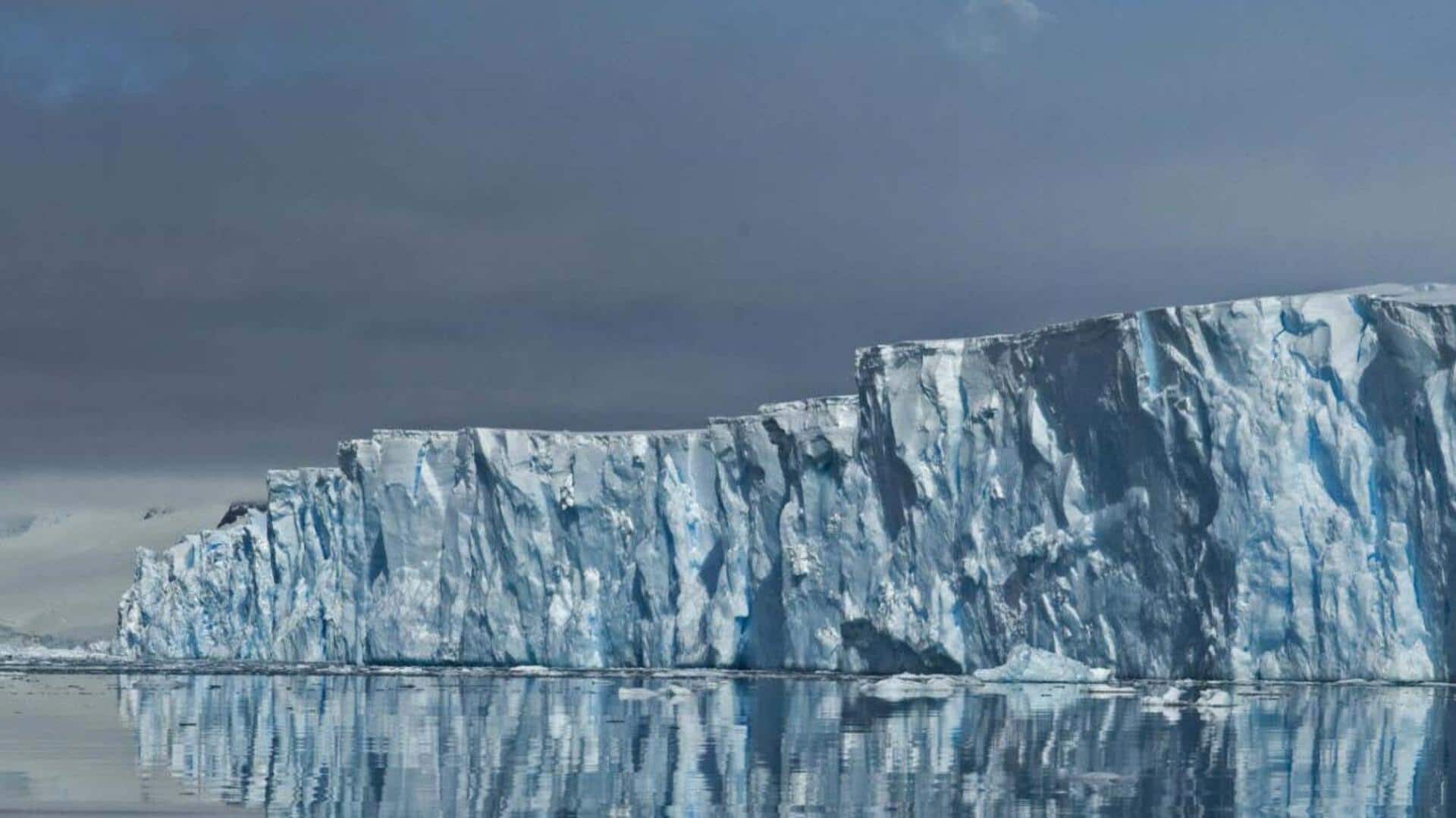
'Doomsday Glacier': Hundreds of earthquakes strike Antarctica's Thwaites Glacier
What's the story
The Thwaites Glacier, also known as the Doomsday Glacier in Antarctica, has been rocked by hundreds of glacial earthquakes over the last 13 years. A new study published in Geophysical Research Letters reveals that out of 362 recorded glacial earthquakes in Antarctica, 245 occurred at this glacier. These seismic events have mostly gone undetected due to their low-frequency seismic waves and were only discovered by a seismologist, Thanh-Son Pham, from the Australian National University, using local seismic stations.
New discovery
Glacial earthquakes: A new threat to Antarctica's stability
Glacial earthquakes, first detected in 2003, are a new class of seismic events that produce low-frequency waves with a magnitude of around five. They are primarily caused by large icebergs collapsing.
While most recorded glacial earthquakes have been found along Greenland's coast, the largest icecap in the northern hemisphere, detecting them in Antarctica has been difficult due to their lower magnitude.
Ongoing mystery
Unexplained seismic events near Pine Island Glacier
The study by Pham also found that the rate of ice flow from Thwaites has doubled over three decades, contributing to global sea-level rise.
The remaining glacial earthquakes were detected near the Pine Island Glacier, which is one of Antarctica's largest ice streams.
These events occurred 60 to 70km from the waterfront and are not likely caused by capsizing icebergs.
The study notes that "the nature of earthquakes in Pine Island Glaciers remains puzzling and warrants further investigation."
Research recommendation
Urgent need for further research on glacial earthquakes
The rocking seismic events seem to take place in parallel with a period of accelerated flow of the glacier's ice tongue toward the sea.
Pham recommends further research on these newly cataloged glacial earthquakes to understand their driving causes and impact on glacier instability.
The discovery of these seismic events raises new questions about the stability of Antarctica's melting glaciers, which could have catastrophic consequences if they collapse completely.