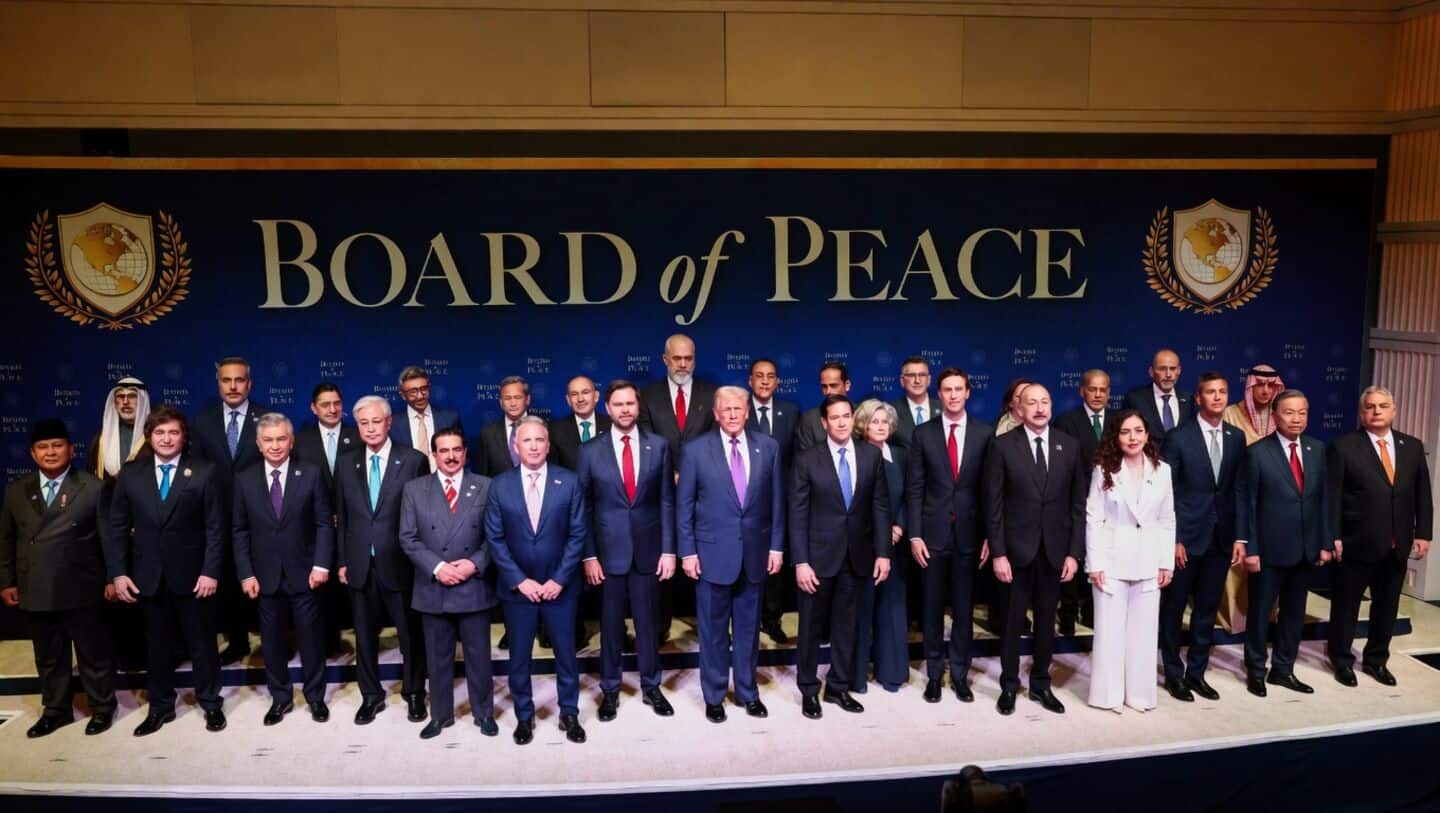
Trump's 'Board of Peace' receives zero cash 4 months post-establishment
What's the story
The "Board of Peace," an international body set up by United States President Donald Trump to oversee the postwar administration and reconstruction of the Gaza Strip, is facing a financial crisis. Four months after its launch, the World Bank-managed fund remains empty. Despite initial pledges of $7 billion for a Gaza relief package from member states and an additional $10 billion in direct US funding, no donor dollars have been deposited into the fund, the Financial Times reported.
Official
'Zero dollars have been deposited'
"Zero dollars have been deposited," one source told the paper.
The board has received donations, but they have been transferred directly into its JPMorgan account, according to a spokesperson.
"A number of options were established to receive funding," a board official said. "At this point, contributors have opted to use other options."
Unlike the World Bank, the JPMorgan account is not required to report its position to contributors and board members, according to the Financial Times.
Funding status
Small contributions have kept operations running
Morocco has contributed approximately $20 million to help fund the office of Nickolay Mladenov, the "high representative" for postwar Gaza, as well as salaries for the Palestinian technocratic committee constituted by the board to govern Gaza.
Furthermore, the United Arab Emirates contributed $100 million to train a new police force in Gaza, but the funds have been frozen and the program has yet to begin, according to two persons familiar with the matter.
Aid reallocation
US State Department attempts to reallocate existing aid
The United States State Department has attempted to reallocate $1.2 billion in existing aid to projects aligned with the board's agenda.
However, none of this money is being utilized by the Board of Peace itself.
Congressional aides have confirmed that Washington is unwilling to release even a $50 million operational grant directly to the board until stringent financial controls are established.
Governance issues
Governance structure raises eyebrows
A major part of the international skepticism toward the organization stems from its unusual governance structure.
Under the Board of Peace charter, Trump is named "Chairman for Life," with complete power over budgets and appointments.
Moreover, Trump mandated a $1 billion "lifetime membership" fee for countries seeking permanent board seats, a move that has alienated traditional Western allies such as France and Spain.
Reconstruction
Continued Israeli military actions threaten reconstruction efforts
Reconstruction efforts are further complicated by continued Israeli military actions in Gaza.
An Al Jazeera analysis found that Israel is moving the ceasefire-established Yellow Line, expanding its control to 59% of the Gaza Strip.
With 85% of Gaza's infrastructure destroyed, donors fear their investments could be targeted again, as was the case during the second Intifada, a massive Palestinian uprising against Israeli occupation in the early 2000s.
Records
US record on disbursements
In the Palestinian context, the gap between pledges and actual disbursements isn't new, but the US has a particularly poor record.
After the 1993 Oslo Accord, only 70% of international commitments were met. The US-brokered agreement led to the creation of Palestinian Authority, which governs the occupied West Bank.
The US was third in disbursements at that time, behind the EU and Arab nations.
Similarly, after the 2014 Gaza war, only 46% of pledged funds were disbursed three years later.