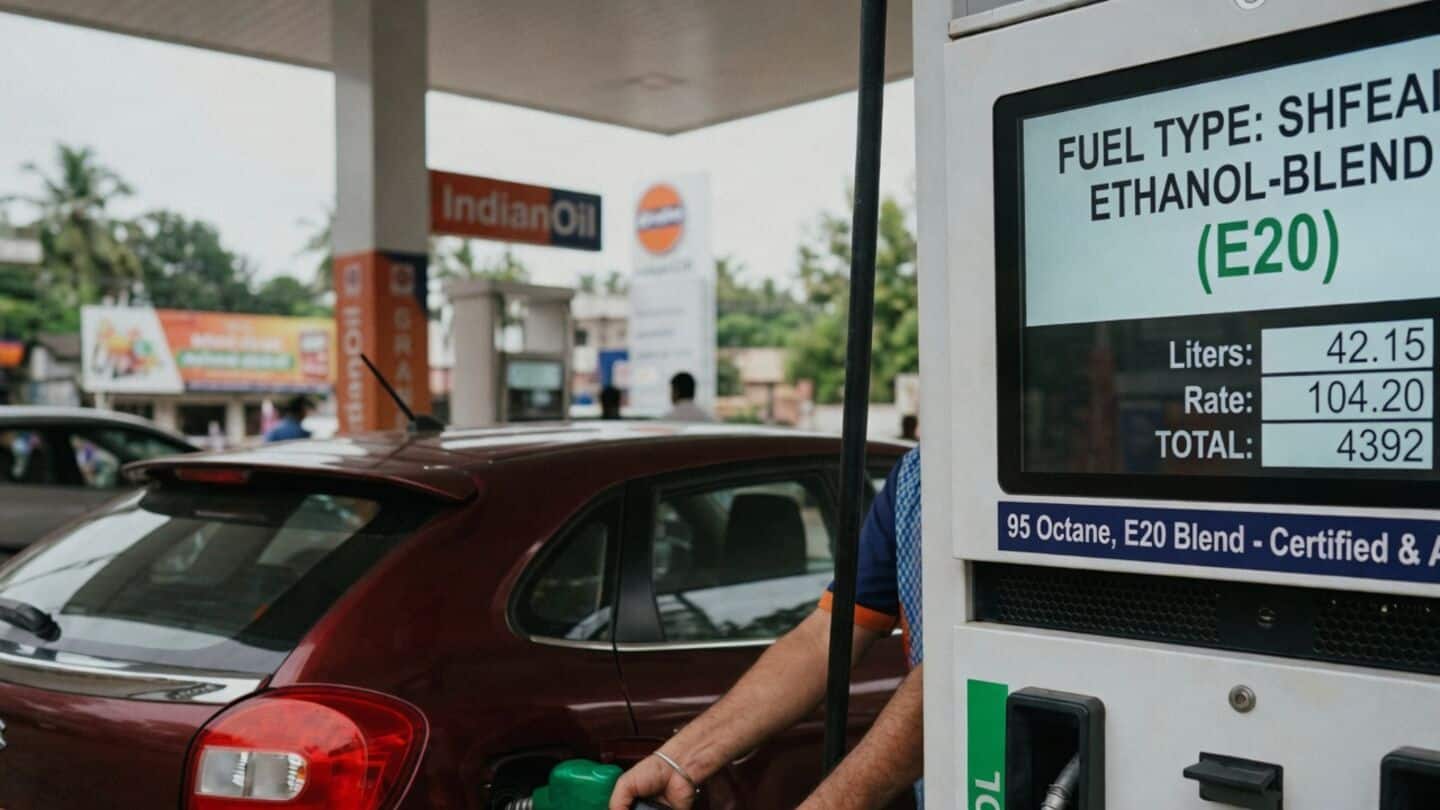
No moisture or high chloride contamination in E20 petrol: OMCs
What's the story
State-run oil marketing companies (OMCs) have said that their nationwide tests found no evidence of high chloride contamination or moisture in E20 petrol. The companies, Indian Oil Corp. Ltd, Bharat Petroleum Corp. Ltd, and Hindustan Petroleum Corp. Ltd, conducted the tests to address concerns over the quality of this new fuel blend. They also said that the quality of fuel remained within prescribed limits across the supply chain.
Enhanced monitoring
OMCs ramp up monitoring efforts
In a joint statement, the OMCs revealed that they have stepped up their monitoring efforts.
They are now conducting water ingress and density tests eight to 12 times a day at every retail outlet.
This is part of their commitment to ensure the quality of E20 petrol remains within prescribed limits across the country.
Test results
Samples from refineries show chloride levels at or below 1ppm
The OMCs' statement also revealed that over 100 petrol samples from refineries showed chloride levels at or below one part per million (ppm).
Ethanol samples from 80 distilleries were also tested, with the chloride content being less than three ppm.
These findings are a testament to the quality control measures implemented by these companies in ensuring the purity of E20 petrol.
Testing initiative
Union Minister announces rigorous testing of E20 fuel
Union Petroleum Minister Hardeep Singh Puri has announced that OMCs are now rigorously testing some 2,000 samples of E20 fuel across the country every day.
This comes after media reports flagged concerns over possible contamination in this new fuel blend.
The minister said these tests cover the entire Ethanol Blended Motor Spirit supply chain and reaffirm that its quality remains consistently well within prescribed limits.
Compliance checks
Quality consistently maintained throughout supply chain
The OMC's statement also highlighted that chloride monitoring is being done at various points in the supply chain.
These include refineries, distilleries, depots, or terminals, and retail outlets across the country.
This ensures that quality is consistently maintained throughout the supply chain.
Ethanol supplied by distilleries, the main blending component, has also consistently recorded chloride levels significantly below the prescribed specification, reflecting robust quality control mechanisms at the production stage.
Sample inspections
Task force checks ethanol samples from distilleries
A dedicated task force comprising members of OMCs and the Centre for High Technology (CHT) has checked ethanol samples from 80 distilleries across the country over the last 10 days.
All samples had chloride content less than three ppm.
Under an intensified monitoring program, more than 160 samples have been analyzed for chloride content in recent days, with levels ranging between zero and three ppm.
Contamination cases
Only 2 isolated instances of elevated chloride levels detected
The surveillance system identified only two isolated instances where elevated chloride levels were detected.
These were suspended immediately, followed by a detailed root-cause analysis and implementation of appropriate corrective measures before restoration of supplies.
The OMCs also revealed that about 90,000 retail outlets have begun mandatory inspection and monitoring of underground storage tanks, with no water ingress detected so far.