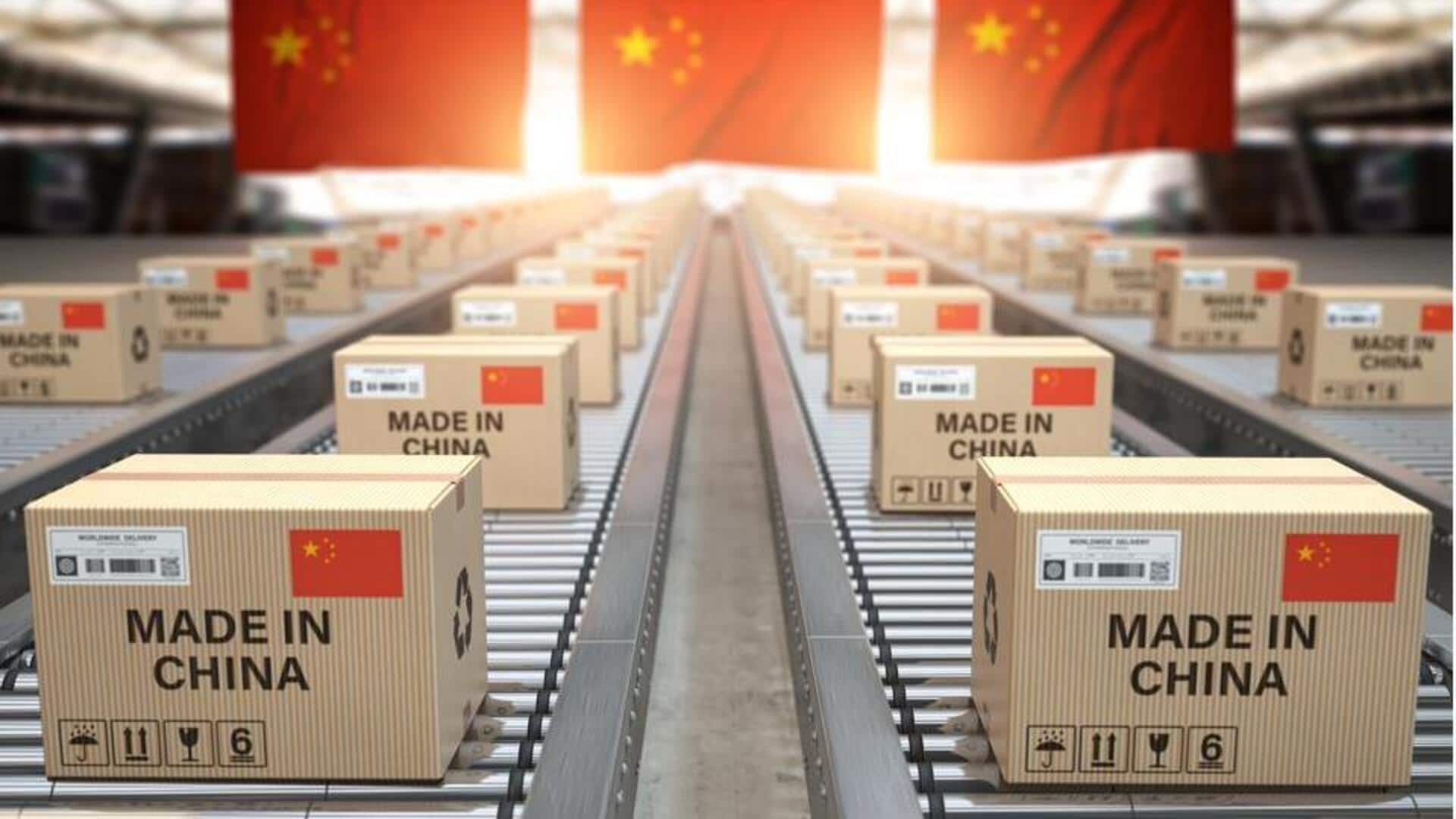
China's trade surplus hits record $1.1 trillion despite US tariffs
What's the story
China has posted a record trade surplus of $1.189 trillion in 2025, defying the renewed tariff pressures from the US under President Donald Trump. The country's export sector has remained resilient, driven by strong auto and electric vehicle exports. The data was released on Wednesday and indicates that China's full-year trade surplus is now comparable to the GDP of a top-20 global economy like Saudi Arabia.
Strategic shift
China's export sector adapts to US tariff pressures
In response to the renewed tariff tensions, Chinese firms are pivoting their focus toward Southeast Asia, Africa, and Latin America. This strategic shift is aimed at offsetting US duties.
The move comes as Beijing looks to exports to counter a prolonged property slump and sluggish domestic demand.
However, this record-breaking surplus could further unsettle economies worried about China's trade practices and overcapacity.
Trade balance
China's export growth and import increase
China's outbound shipments grew by 6.6% in value terms year-on-year in December, beating economists' expectations of a 3% increase.
Imports also rose by 5.7%, exceeding the forecast for a 0.9% uptick.
Monthly export surpluses exceeded $100 billion seven times last year, partly driven by a weakened yuan, indicating that Trump's actions have had little impact on China's trade with the wider world despite curbing US-bound shipments.
Industry impact
China's auto industry and global market share
China's auto industry, a key player in the country's industrial ambitions, saw overall exports jump by 19.4% to 5.79 million vehicles last year. Pure EV shipments also rose by an impressive 48.8%.
Despite Trump's tariffs, economists expect China to continue gaining global market share this year due to Chinese firms setting up overseas production hubs that provide lower-tariff access to the US and EU markets as well as strong demand for lower-grade chips and other electronics.
Policy changes
China's response to trade imbalances and export restrictions
In light of its record-breaking surplus, China has begun moderating its industrial exports.
The leadership has been increasingly aware of imbalances in the economy and the image problem caused by outsized exports.
Last week, Chinese Premier Li Qiang called for "proactively expanding imports and promoting the balanced development of imports and exports."
The country also scrapped subsidy-like export tax rebates for its solar industry, a long-standing point of friction with EU states.