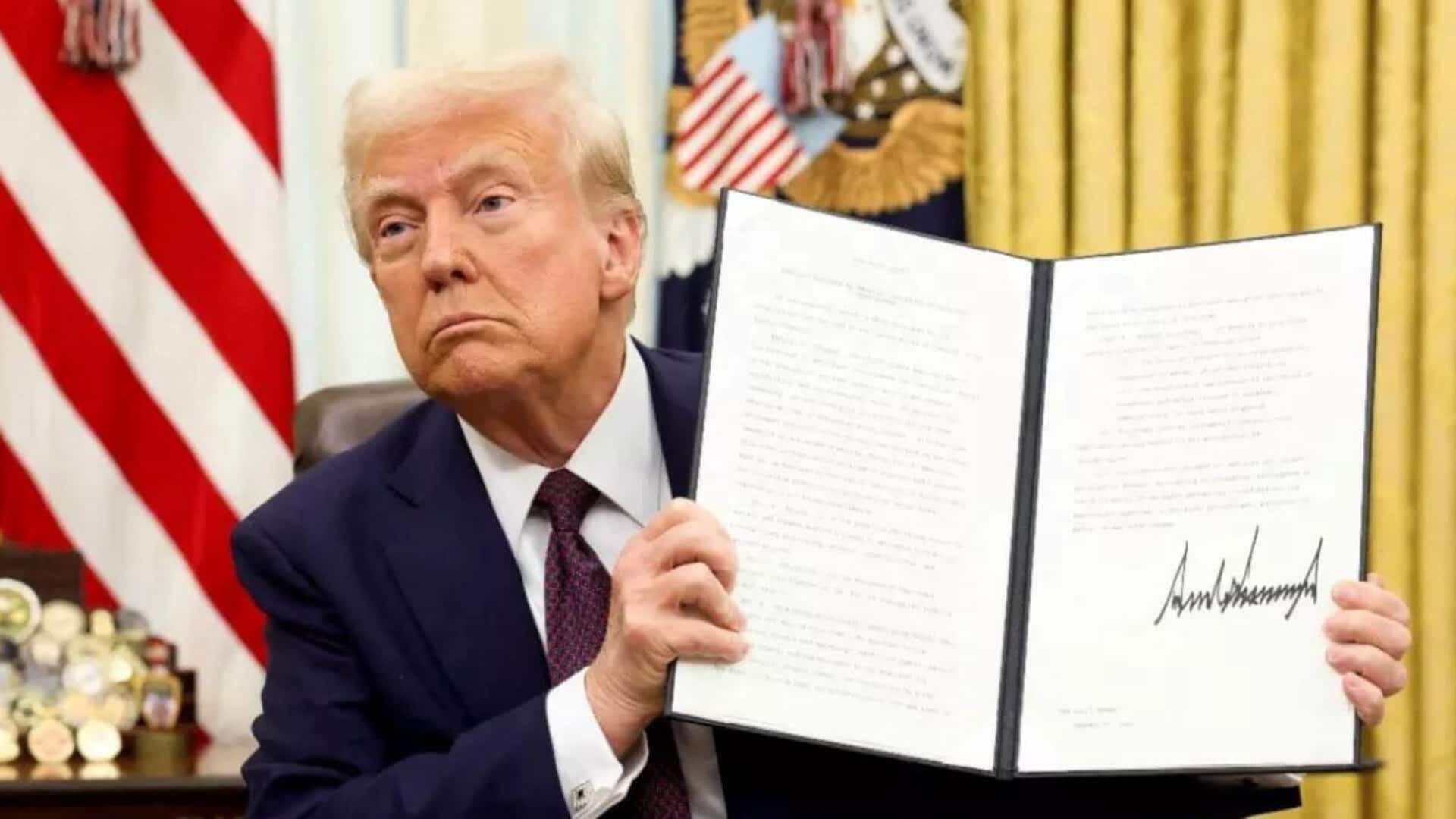
Trump imposes 15% tariff on polysilicon to counter China
What's the story
The Trump administration has announced a 15% tariff on polysilicon products, a key component in the manufacturing of semiconductors and solar panels primarily produced by China. The move is aimed at strengthening domestic supply chains for these critical technologies. The new trade protections will come into effect from December 4 this year. Price floors have also been set for polysilicon ingots, wafers, cells and modules as part of this initiative.
Strategic move
Plan to ensure commercial viability of US production
President Donald Trump's proclamation under Section 232 of the Trade Expansion Act of 1962, is aimed at bolstering domestic chip and solar supply chains.
The White House said the plan will "help ensure the commercial viability of United States production of polysilicon and its derivatives."
This is crucial for meeting economic and national security requirements amid competition with China in artificial intelligence and energy sectors.
Supply chain
Polysilicon at beginning of semiconductor and solar manufacturing supply chains
Polysilicon, a highly pure form of silicon, is at the beginning of semiconductor and solar manufacturing supply chains.
Manufacturers convert silicon wafers into solar cells and then assemble them into panels for solar projects.
However, American solar factories have accused their Chinese counterparts of dumping panels in the market, receiving unfair government subsidies, and shifting production to other countries to avoid US tariffs over the past decade.
Industry response
US companies with solar factories welcome Trump's move
US companies with solar factories, including T1 Energy, First Solar and Qcells, have welcomed Trump's move.
"This is a decisive win for advanced American manufacturing and investment in domestic energy supply chains," said Dan Barcelo, CEO of T1 Energy.
The trade protections will come into effect on December 4, the White House said.
Trade attorney's warning
Trade attorney warns of surge of imports in coming months
Tim Brightbill, a trade attorney with Wiley Rein who has filed several trade cases against Chinese solar companies, warned that the delayed implementation could lead to a surge of imports in the coming months.
Companies that purchase solar panels have argued this delay is necessary to adjust supply contracts to higher prices.