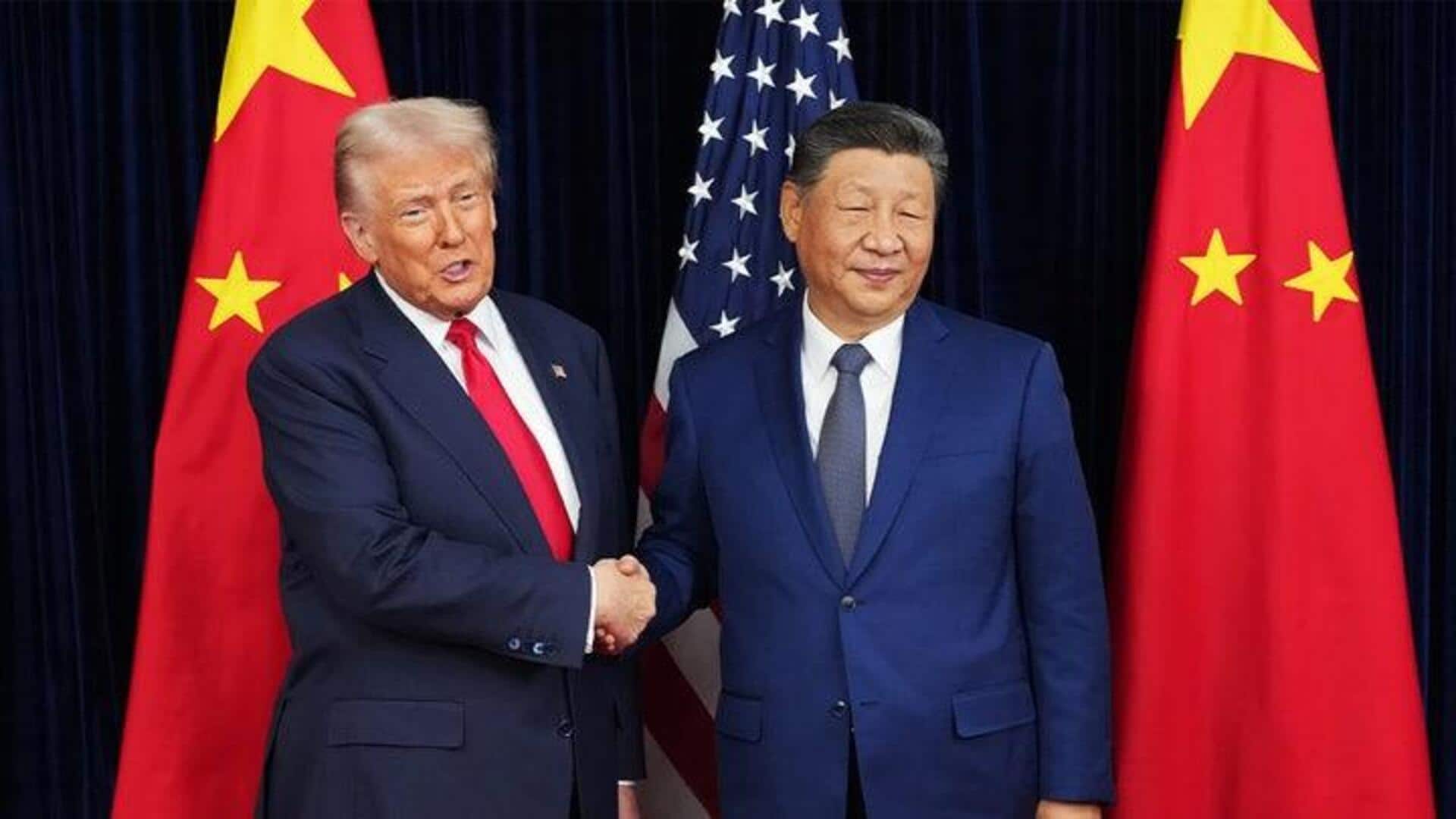
US-China trade deal: What did Trump and Xi agree on?
What's the story
US President Donald Trump and Chinese President Xi Jinping have reached a major agreement to de-escalate the ongoing trade war between their countries. The deal is said to include a number of key elements, such as tariff reductions and resumption of Chinese purchases of American soybeans. Also, it averts Trump's proposed 100% tariff on Chinese goods and prolongs the fragile trade truce between the world's two largest economies for roughly a year.
Tariff reduction
US to halve tariffs on Chinese goods
As part of the deal, the US has agreed to halve its 20% tariff on Chinese goods linked to fentanyl opioid precursor chemicals.
The reduction will bring down the overall US tariff rate on Chinese imports from 57% to around 47%.
This includes duties imposed during Trump's first term and a reciprocal tariff introduced in April.
Export controls
China agrees to pause new export controls on rare earths
China has agreed to a one-year pause on new export controls on rare earth minerals and magnets.
These materials are crucial for cars, planes, and weapons. Rare earth minerals have emerged as Beijing's strongest bargaining tool in its trade war with Washington.
The White House said that this move is equivalent to "the de facto removal of controls China imposed in October 2022."
Tariff suspension
Beijing will suspend all retaliatory tariffs announced since March 4
China has also agreed to suspend all retaliatory tariffs announced since March 4.
This includes duties on US chicken, wheat, corn, cotton, sorghum, soybeans, pork, beef, aquatic products, fruits, vegetables, and dairy products.
The White House said Beijing will also suspend or remove all retaliatory non-tariff countermeasures taken against the US since March 4, such as listing certain American companies on the Chinese government's end-user and unreliable entity lists.
Export pause
US agrees to 1-year pause on expanded Commerce Department blacklist
The US has agreed to a one-year pause on an expanded Commerce Department blacklist of companies prohibited from buying American technology goods. This includes semiconductor manufacturing equipment.
The move is aimed at preventing subsidiaries and other firms from circumventing export controls.
The expanded blacklist would have automatically included firms more than 50% owned by companies already on the list, affecting thousands of Chinese firms.
Purchase commitment
China commits to purchase at least 12 million metric tons
China has committed to purchasing at least 12 million metric tons of US soybeans in 2025 and at least 25 million metric tons each year for the next three years.
The country also agreed to resume purchases of US sorghum and hardwood logs.
These commitments are expected to bring China back to its previous levels of US purchases, which were disrupted by the pandemic.