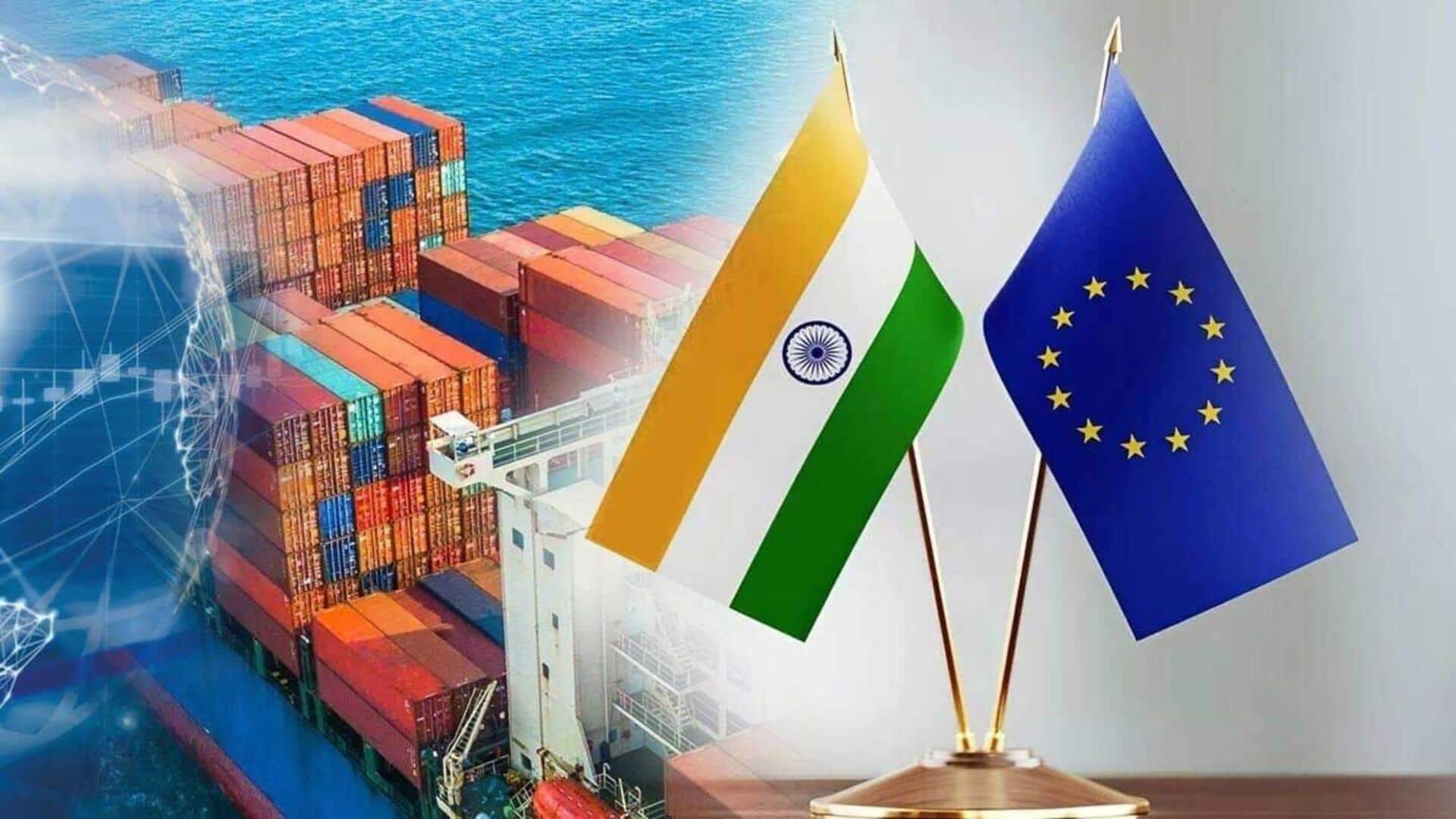
Why agriculture, autos and steel stayed off India-EU trade deal
What's the story
India and the European Union (EU) have signed their largest-ever trade agreement, a deal that will drastically reduce tariffs and open up markets on both sides. The deal is expected to give Indian exporters near-zero duty access to the EU for most of their exports over the next seven years. However, three sensitive sectors—automobiles, steel, and agriculture—have been excluded from this tariff-free list.
Tariff reduction
EU to eliminate tariffs on Indian goods
The EU has agreed to eliminate tariffs on Indian goods across most sectors in phases over seven years.
This will provide long-term certainty and easier access to one of the world's largest consumer markets for Indian exporters.
The tariff elimination will cover almost all goods except autos, steel, and agriculture—areas that remain sensitive on both sides due to their domestic industry size, employment implications (in case of autos and steel), food security concerns (agriculture).
Sectoral gain
Indian sectors to benefit from EU market access
The trade deal will allow Indian marine and leather products, chemicals, plastics, rubber, textiles and apparel, base metals as well as gems and jewelry to enter the EU market at zero duty.
These are labor-intensive and export-heavy sectors for India that are likely to grow faster with reduced costs and improved competitiveness.
In return for these concessions by the EU, India will reduce its tariffs on EU goods over a period of 10 years.
Tariff commitment
India to reduce tariffs on EU goods
Under the trade pact, India has committed to reducing its tariffs on EU goods to zero on 93% of the bilateral trade value over a decade.
The EU has also agreed to open up 96.8% of its tariff lines while India will open 92.1% under this agreement.
European Commission President Ursula von der Leyen hailed the deal as a historic moment for both sides, saying it deepens their partnership and creates a free trade zone for two billion people.
Trade expansion
India's recent trade agreements and future plans
In 2025, India signed free trade agreements with the UK, Oman, New Zealand, and the European Free Trade Association (EFTA).
The EFTA deal promises $100 billion investment into India by 2040 and one million jobs.
Since 2021, India has been focusing on comprehensive trade agreements that include broader economic cooperation beyond tariffs.
Bilateral trade remains central to the India-EU relationship with total trade crossing $190 billion in 2024-25.