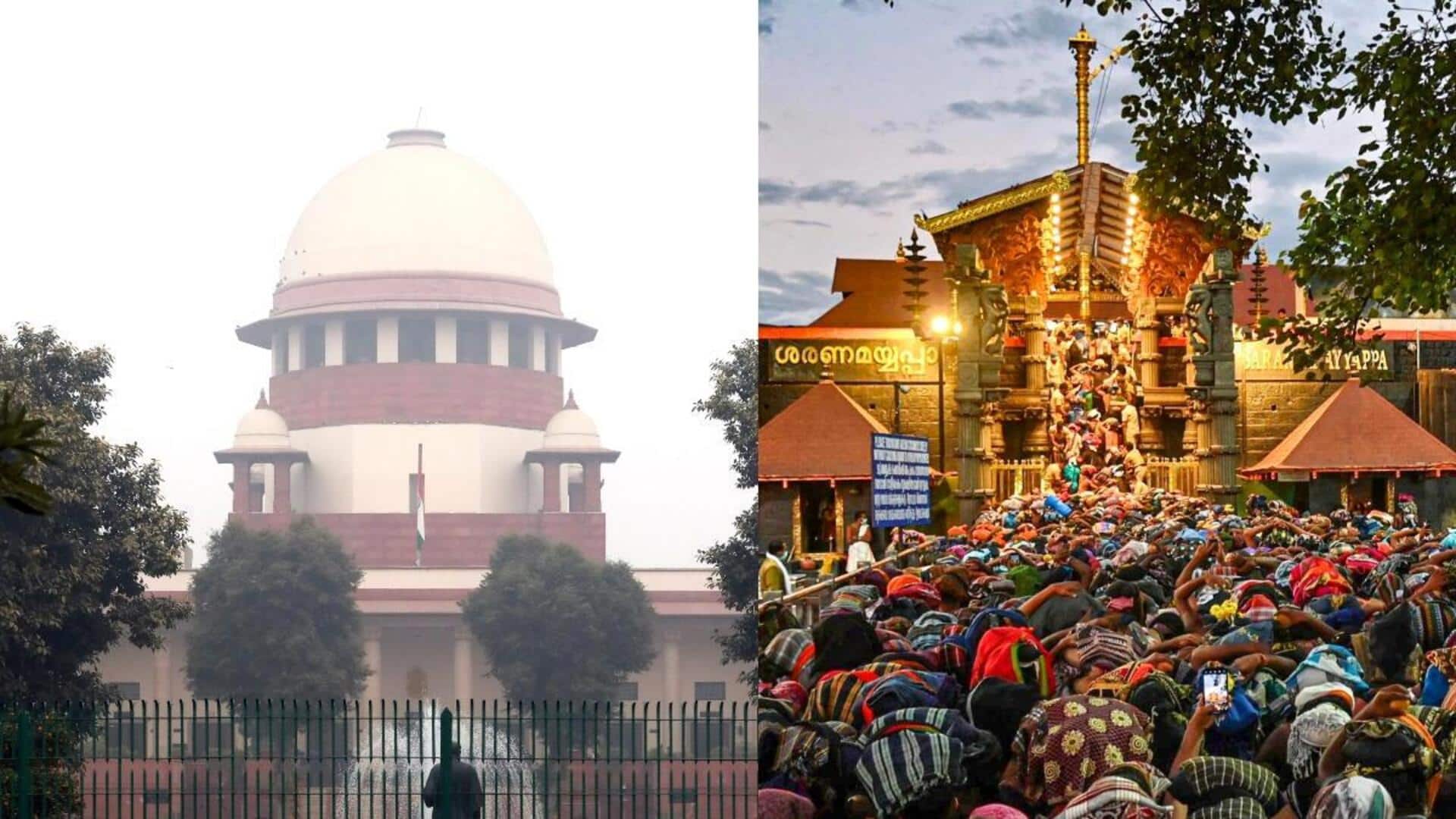
Can't accept 'WhatsApp university' information: SC judge during Sabarimala hearing
What's the story
During the Sabarimala reference hearing on Thursday, Justice BV Nagarathna quipped that information from "WhatsApp University" can't be accepted. The remark came after Senior Advocate Neeraj Kishan Kaul argued that knowledge should be welcomed from any source. He cited an article by Dr. Sashi Tharoor, advocating judicial restraint in matters of religious relief. Chief Justice of India Surya Kant, however, noted that while all eminent authors are respected, the article was a personal opinion, and "personal opinion is personal opinion."
Arguments
'No harm in drawing from all sources'
"There is no harm in drawing from all sources. If knowledge and wisdom come from any source, any country, any university, they should be welcomed. We are far too rich as a civilization not to accept all forms of knowledge and information," Kaul said.
Justice Nagarathna replied, "But not from WhatsApp University."
"I am not getting into that...... The point is simply that wherever knowledge and information come from, they must be accepted," Kaul replied.
Knowledge acceptance
Kaul argues for harmonious interpretation of Articles 25 and 26
Kaul is representing the Dawoodi Bohra community head in a writ petition against the excommunication practice.
He contended that Article 26(b) rights aren't always subject to social reform legislation under Article 25(2)(b).
Kaul advocated for a harmonious interpretation of Articles 26(b) and 25(2)(b), which Justice Nagarathna agreed with.
Justice Nagarathna clarified that rights under Article 26(b) are subject to public order, morality, and health when legislation is enacted under Article 25(2)(b). Kaul agreed with this statement.
Rights clarification
What are the other key points discussed?
Kaul further argued that 'morality' in Articles 25 and 26 shouldn't be interpreted as 'constitutional morality.'
"If constitutional morality is read into morality, then we are bringing in lot more than what has been envisaged," Kaul warned.
This was in response to a question from Justice Amanullah about why constitutional morality can't be applied in these articles since it was an evolving and dynamic concept.