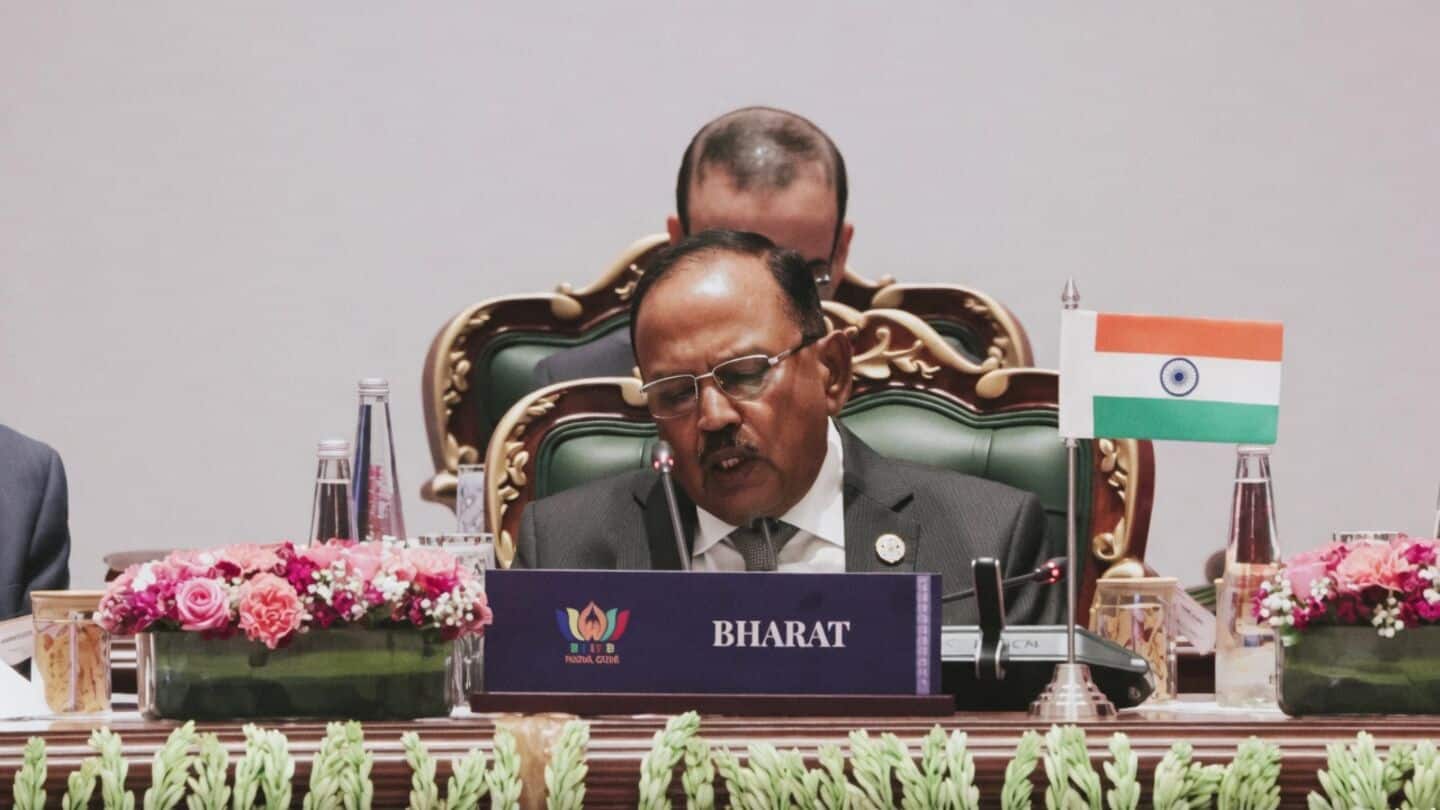
'Multilateralism declining': Ajit Doval warns BRICS partners about security challenges
What's the story
National Security Advisor (NSA) Ajit Doval opened the 16th BRICS National Security Advisers' Meeting in New Delhi on Tuesday. He cautioned that global diplomacy is deteriorating and traditional institutions are unable to tackle rising global volatility. "We are meeting at a very tumultuous time," Doval said in his opening remarks, adding that the world is plagued by military conflicts and complex security issues.
Global challenges
BRICS countries have different backgrounds: Doval
"Not only....the threats are compounding, but the instruments and institutional mechanisms are increasingly finding themselves to be inadequate to resolve or mitigate these conflicts. Multilateralism is on the decline," he said.
Doval also said that as a grouping with very diverse experiences, "we have got a very special role to play in this world, which appears to be in turmoil...appears to be changing...What role we as a grouping can play is a matter that is important for us to ponder."
Security focus
New-age vulnerabilities focus of summit
The summit in New Delhi is focused on new-age vulnerabilities, moving away from traditional military conflicts to asymmetric and borderless threats.
Doval emphasized the need for member states to quickly adapt to evolving risks, which will be a key focus of the summit.
He said, "We need to be cognizant of the new security threats and challenges."
These include cyber threats, innovative disruptive technologies, and more sophisticated forms of terrorism in an increasingly digitized world.
Summit goals
Need for global governance reforms
The summit will also discuss joint frameworks on counter-terrorism and securing Information and Communication Technologies (ICTs). The aim is to create a more resilient, multipolar security model.
Doval also welcomed the Memorandum of Understanding signed between the US and Iran, saying India viewed the development with cautious optimism and hoped it would contribute positively to regional and global stability.
"The opening of the Strait of Hormuz is a very welcome development. It will remove supply chain bottlenecks," he said.