Over 1L schools have only 1 teacher: Niti Aayog Report
What's the story
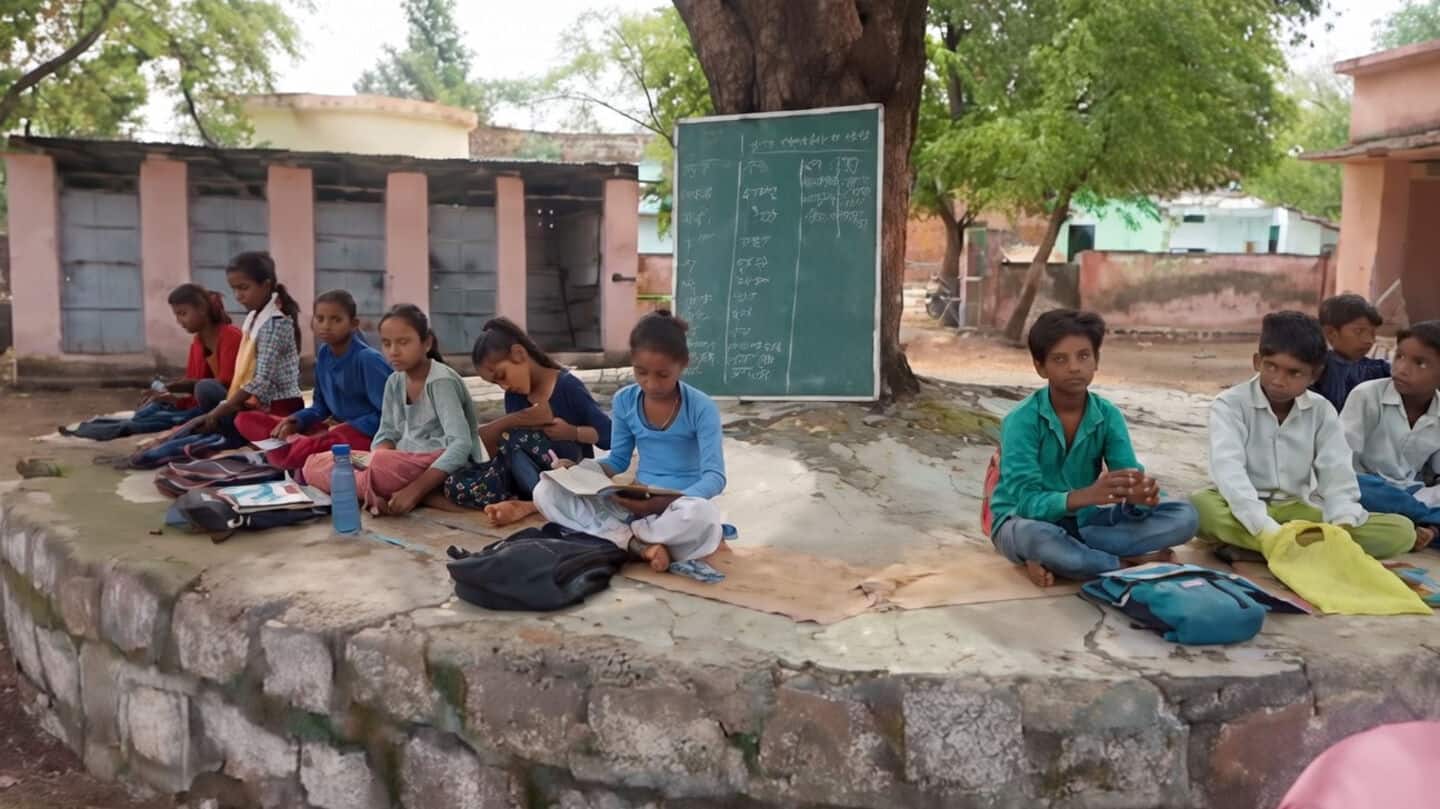
Thousands of government schools in India are functioning without basic facilities such as toilets, water supply, and electricity. The startling revelations were made in a report by Niti Aayog titled School Education System In India. The report highlights that over one lakh schools have only one teacher and notes a high pupil-teacher ratio in some states. It also points to low teacher competency, with only 2% scoring above 70% in mathematics assessments.
Infrastructure deficit
98,592 schools lack functional girls' toilets
The report was released on Thursday and presents national and state-level data on school infrastructure, staffing, enrollment, and learning indicators.
Despite high overall toilet coverage percentages, it highlights that 98,592 schools lack functional girls' toilets.
Additionally, 61,540 schools don't have any usable toilets.
Electricity access has improved from 55% to 91.9% over the past decade, but still leaves 1.19 lakh schools without functional electricity.
Staffing challenges
Teacher competency major issue
The report also highlights that there are 1,04,125 schools in India with only one teacher, most of which are located in rural areas.
Jharkhand's government secondary schools have a pupil-teacher ratio of 47:1.
The report also notes that only 51.7% of government secondary schools have science laboratories.
Teacher competency is another major issue, with only 2% scoring above 70% in Mathematics assessments and an average score of just 46%.
Enrollment concerns
High drop-out rates from secondary schools
The report also highlights high drop-out rates from secondary schools, with a national average of 11.5%. States like West Bengal, Arunachal Pradesh, Karnataka, and Assam have higher drop-out rates than the national average.
In Bihar and Uttar Pradesh, secondary drop-out percentages have increased significantly.
The report also points out that India spends only 4.6% of its GDP on education, which is lower than several other countries, such as the UK (5.9%), the US (5.9%), Germany (5.4%), and France (5.4%).
Regional disparities
Parakh-based outcome mapping
The report also mentions Parakh-based outcome mapping, which shows poor performance in Jharkhand, Gujarat, and Jammu-Kashmir. In contrast, Punjab, Himachal Pradesh, Odisha, Maharashtra, and Rajasthan performed better.
Parakh (or Performance Assessment Review And Analysis of Knowledge for Holistic Development) is a national assessment regulator set up in 2023 under the National Council of Education Research and Training (NCERT) as per the National Education Policy 2020.