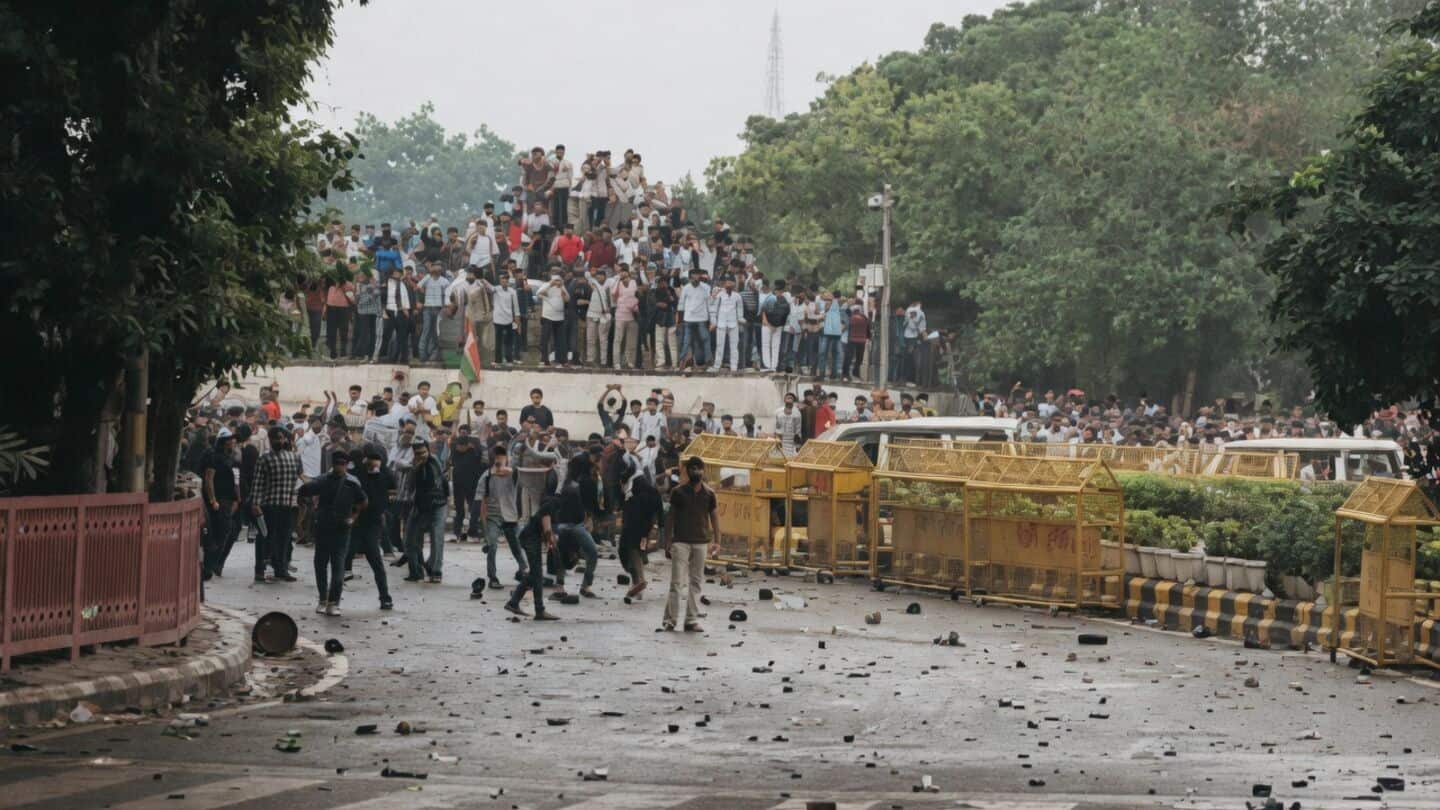
Stone-pelting by CJP protesters persisted post-Parliament march: Report
What's the story
Violence during the protests over the alleged paper leak in the NEET-UG examination continued even after a violent clash on July 20, security officials have said. The protests were led by the Cockroach Janta Party (CJP) at Jantar Mantar. Despite severe aggravation, law enforcement agencies managed to contain the violence with restraint, officials said.
Damage report
Violence spread across multiple locations
The violence was not limited to a single location but spread across key roads and intersections near Parliament, Hindustan Times reported, citing officials.
The flashpoints included Gol Dak Khana, Tolstoy-Janpath Crossing, Rafi Marg barricade near Rail Bhawan, Jantar Mantar, and Outer Circle near LIC Building in Connaught Place.
Stone-pelting incidents were reported at all these locations.
Property loss
Government property damaged during protests
The protests also caused extensive damage to government property.
The document accessed by HT revealed that 110 barricades and 171 ropes were either damaged or went missing.
Operational equipment such as a wireless set, a body-worn camera, 10 handheld metal detectors (HHMDs), two public address systems, 15 loudhailers, 10 fire extinguishers, four wire cutters, and an X-ray baggage scanner were also affected.
Casualty report
Injuries and damage to vehicles
Protective gear, including 355 helmets, 285 body protectors, 54 shields, 10 torches, 24 first-aid boxes and 12 blankets, was also reported missing or damaged, according to HT.
The violence left 244 police personnel and 209 civilians injured, who were recorded as Medico-Legal Cases (MLCs).
The document also detailed damage to official vehicles, including cars, buses, motorcycles, and tempos.
A water tanker and a DTC bus were among the public vehicles affected during the protests.
Technology use
Facial recognition technology used to identify suspects
An internal Delhi Police report revealed that facial recognition technology was used to identify over 100 people facing serious charges during the CJP's march.
The report also noted that many of those identified were accused in murder, robbery, sexual offenses, Arms Act, and narcotics cases, highlighting how advanced surveillance methods were employed in response to the protests that turned violent.