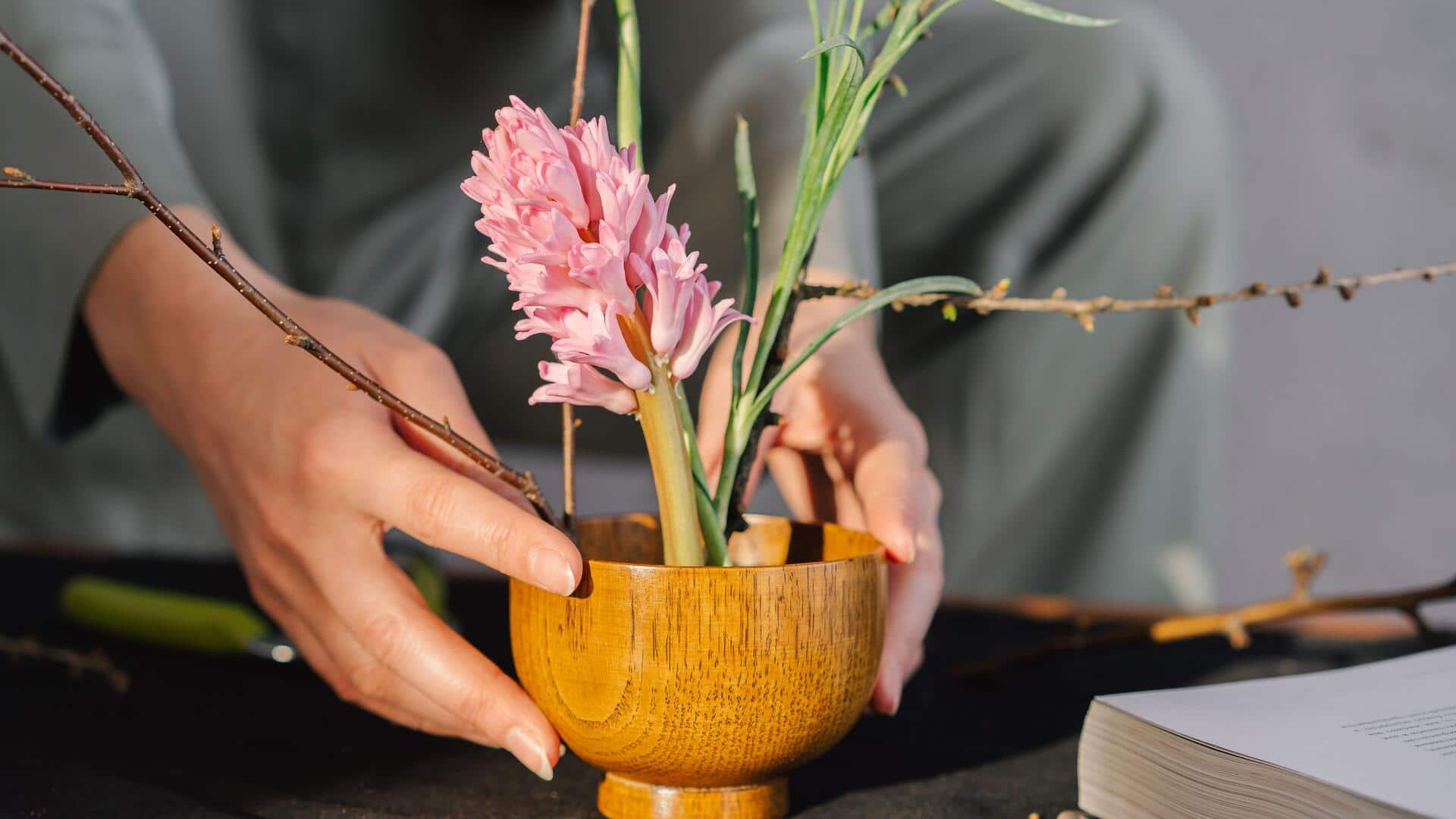
Ikebana: The Japanese art of floral arrangement
What's the story
Ikebana is the traditional Japanese art of flower arrangement, which is much more than just aesthetics. It focuses on harmony, balance, and simplicity. Unlike Western floral arrangements, which are mostly about volume and color, ikebana emphasizes line, balance, and harmony with nature. This ancient art form encourages mindfulness and appreciation for natural beauty in its most understated form.
#1
Principles of Ikebana
Ikebana is based on a few principles that guide the arrangement process.
The most important ones are asymmetry, balance, and minimalism.
Asymmetry ensures that the arrangement is dynamic and interesting to look at without being chaotic.
Balance is achieved by distributing visual weight evenly across the arrangement.
Minimalism encourages using fewer elements to highlight their beauty.
#2
Tools used in Ikebana
The tools used in ikebana are simple yet effective in creating beautiful arrangements.
A kenzan or flower holder is used to keep stems in place without hiding them from view.
Scissors are important for trimming stems at angles that promote water absorption.
A shallow vase or container is often used to symbolize purity and simplicity.
#3
Types of Ikebana arrangements
There are several styles of ikebana, each with its own unique characteristics.
The rikka style focuses on vertical lines and represents nature's grandeur.
The nageire style allows for more freedom with curved lines and organic shapes, while moribana emphasizes layered compositions in shallow containers.
#4
Practicing Ikebana at home
To practice ikebana at home, start with basic materials like twigs, leaves, and flowers from your garden or local market.
Choose a simple container that complements your chosen elements without overpowering them.
Focus on creating an arrangement that reflects balance through careful placement of each component, while maintaining an overall sense of harmony within the space you have chosen for display purposes.