
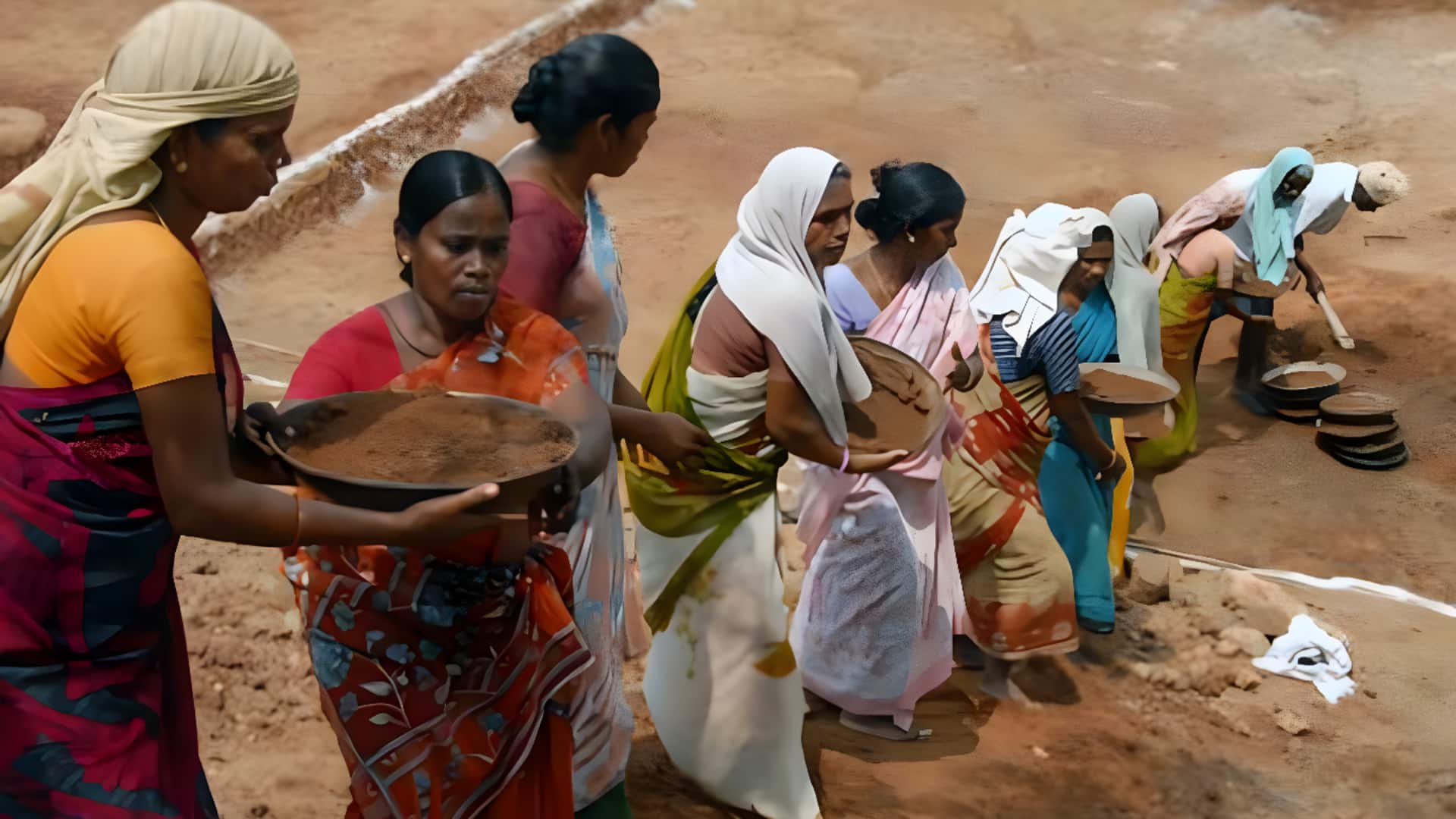
President Droupadi Murmu gives assent to VB-G RAM G Bill
What's the story
President Droupadi Murmu has approved the Viksit Bharat—Guarantee for Rozgar and Ajeevika Mission (Gramin) (VB-G RAM G) Bill, 2025. The new law replaces the two-decade-old Mahatma Gandhi National Rural Employment Guarantee Act (MGNREGA), 2005. Its chief guarantee is at least 125 days of wage employment per rural household per financial year, up from the previous 100-day guarantee under MGNREGA.
Funding shift
New law introduces cost-sharing and employment pause provisions
The VB-G RAM G Bill also changes the funding model from a Centre-heavy approach to a 60:40 cost-sharing pattern between the Centre and states, except for northeastern and Himalayan states, which retain a 90:10 model. This replaces the earlier models of 90:10 for northeastern and Himalayan states, and 75:25 for others. The new law allows employment to be paused for up to 60 days during peak agricultural seasons to ensure farm labor availability.
Employment focus
VB-G RAM G Bill focuses on specific areas of work
The VB-G RAM G Act narrows down the scope of permissible works to four key areas: water security, core rural infrastructure, livelihood-related assets, and climate resilience. This is aimed at improving the quality and durability of assets created under the scheme. The Rural Development Ministry said the move is aimed at strengthening livelihood security and advancing inclusive growth.
Criticism and defense
Opposition criticizes new law, government defends it
While the government has defended the new law as a step toward its Viksit Bharat at 2047 vision, opposition parties have slammed it. Congress leaders Rahul Gandhi and Priyanka Gandhi Vadra objected to Mahatma Gandhi's name being dropped from the legislation. They argued that the Bill dilutes MGNREGA's rights-based core, centralizes decision-making, and weakens workers' entitlements.
Other criticisms
Economist Jean Drèze questions move
Speaking to The Indian Express, development economist Jean Drèze said that the Centre's discretionary power to decide where and when the scheme is to be implemented is the most contentious provision behind the bill. He pointed out that since the introduction of the GST regime, "states are not in the best shape fiscally," while adding that a mere 2% of rural households are getting 100 days of work in any case.
Unions' view
Activists, union leaders raise alarm
According to CNBC TV18, Nikhil Dey, founder member of the Mazdoor Kisan Shakti Sangathan (MKSS) and the National Campaign for People's Right to Information, described the Bill as effectively dismantling the rights-based framework that defined MGNREGA. "For most states, even the labour component will now need state funding," he was quoted as saying, adding, "There is no reason states may want to do this, and the ultimate sufferer will be the worker."