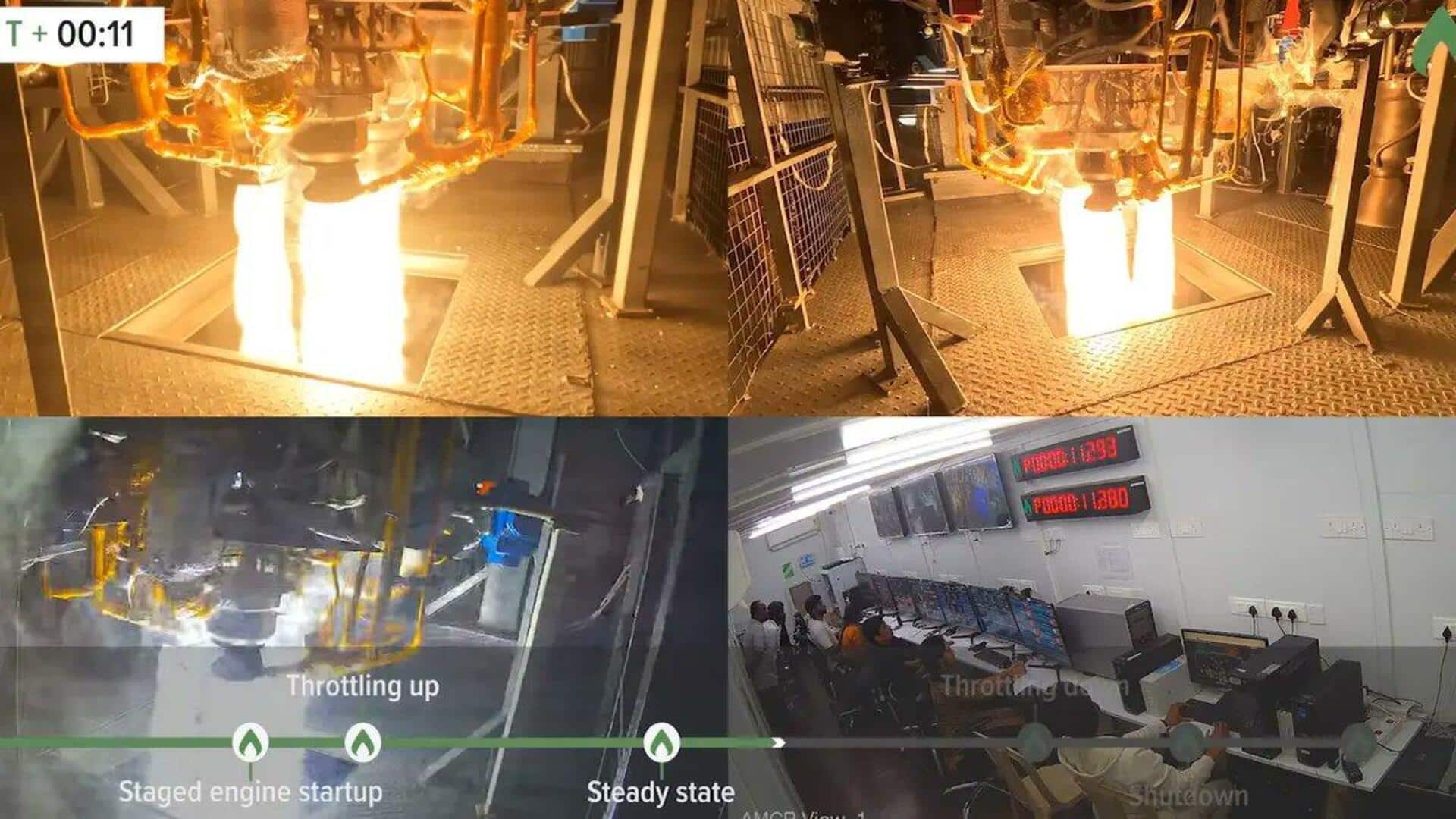
First-in-India: Private firm Agnikul cluster fires 3 rocket engines
What's the story
Chennai-based start-up Agnikul Cosmos has made a major breakthrough in India's private space sector. The company has successfully test-fired three semi-cryogenic rocket engines together, in a clustered configuration. This is the first time such a feat has been achieved by any Indian private firm. The engines were fired together as an integrated propulsion system, marking a major advancement in indigenous rocket technology and advanced manufacturing.
Importance
Why cluster testing is critical?
Unlike conventional tests where engines are evaluated individually, Agnikul's engines were fired together in perfect synchronization.
This cluster testing is critical for increasing thrust in future orbital launch vehicles, enabling rockets to carry heavier payloads into space.
The successful ignition not only highlights India's growing capability to design and manufacture complex propulsion systems, but also its potential to control them within the private sector.
Innovation
Engines tested are 'Made in Bharat'
The engines tested by Agnikul Cosmos are proudly labeled "Made in Bharat," highlighting the focus on indigenous development.
Each engine was entirely 3D-printed as a single piece, eliminating the need for assembling multiple complex components.
Cluster firing required precise calibration of six pumps, synchronized with six electric motors.
Engineers carefully tuned the engines using advanced speed-control algorithms to ensure uniform ignition and stable performance throughout the test.
Progress
Semi-cryogenic engines typically use liquid oxygen as oxidizer
The successful test firing marks a major leap in India's rapidly evolving space landscape. The engines are designed to power future launch vehicles capable of placing satellites into orbit.
Semi-cryogenic engines typically use liquid oxygen as the oxidizer, offering improved efficiency and higher performance than traditional solid propulsion systems.
By clustering three engines together, engineers significantly increase total thrust.