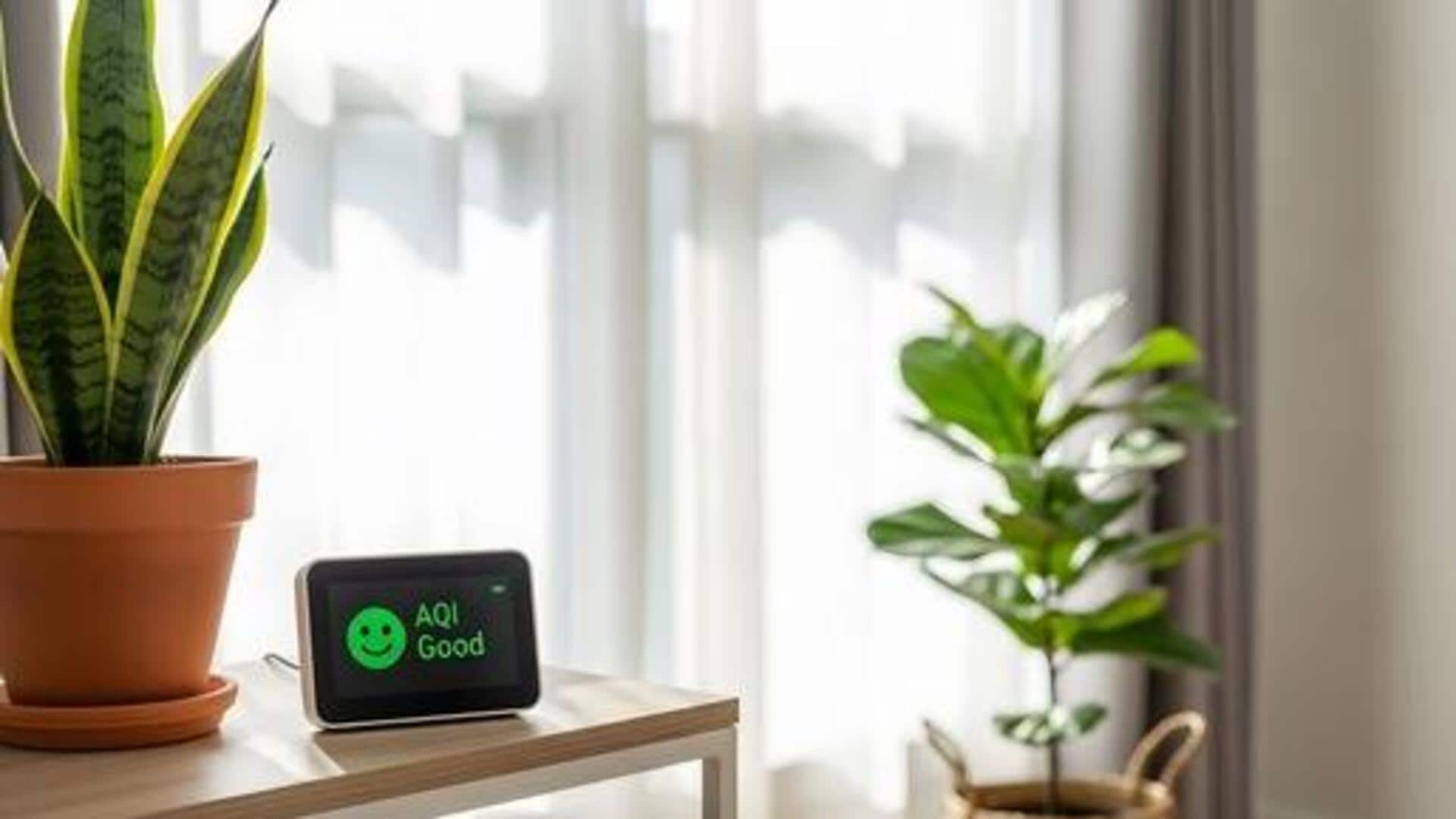
Monitor your indoor air quality using these AI tools
What's the story
Indoor air quality is critical for health, considering indoor environments are much worse than outdoor ones. AI-powered tools are transforming the way we monitor and optimize indoor air with real-time data, predictive analytics, and automated adjustments to pollutants like PM2.5, CO2, humidity, and temperature. Here are five specific AI tools for 2026 that make indoor environments better.
Tool 1
BrainBox AI Aria: Optimizing HVAC systems
Commercial buildings' HVAC systems are optimized by BrainBox AI Aria using machine learning. It adjusts their operations based on occupancy, weather conditions, and energy demand.
This tool not only improves air quality but also reduces energy use and emissions.
It provides real-time insights and predictive maintenance capabilities to ensure building systems run efficiently.
Tool 2
Infogrid: Comprehensive monitoring platform
Infogrid is an AI platform that monitors temperature, humidity, and air quality in real-time. It integrates seamlessly with building systems to optimize HVAC and lighting operations.
With its predictive analytics capabilities, Infogrid helps prevent potential issues before they arise, ensuring healthier indoor spaces and reducing energy costs by maintaining optimal environmental conditions throughout the building.
This proactive approach also boosts overall comfort and efficiency for occupants.
Tool 3
PGX Super Indoor Environment Monitor: Multi-parameter tracking
The PGX Super Indoor Environment Monitor tracks as many as 12 parameters, from CO2 levels and PM2.5 concentrations to PM10 particles, temperature variations, and humidity levels.
It also integrates AI for Air Quality Index insights, along with interactive data curves and predictive alerts.
This makes it easier to manage indoor environments proactively by providing detailed insights and timely notifications for maintaining optimal air quality conditions.
Tool 4
AI Empathetic Bot: Human-like alerts system
The AI Empathetic Bot uses large language models with real-time sensors to deliver human-like alerts on air quality changes.
For example, it recommends turning on an air purifier when PM2.5 levels significantly increase.
This way, it keeps you engaged with relatable communication, making environmental control measures more effective and ensuring indoor air quality remains optimum for you at all times.
Tool 5
Awair monitors: Smart home integration devices
Awair monitors are smart devices that measure CO2 concentrations, PM2.5 particles, VOCs, temperature fluctuations, and humidity levels.
They integrate with smart home systems like Google Home to automate actions like activating air purifiers.
This way, you can be sure of optimal indoor conditions without having to do anything at all, bringing living standards up a notch through advanced tech solutions available today and projected for future growth across sectors benefiting from these cutting-edge technologies.