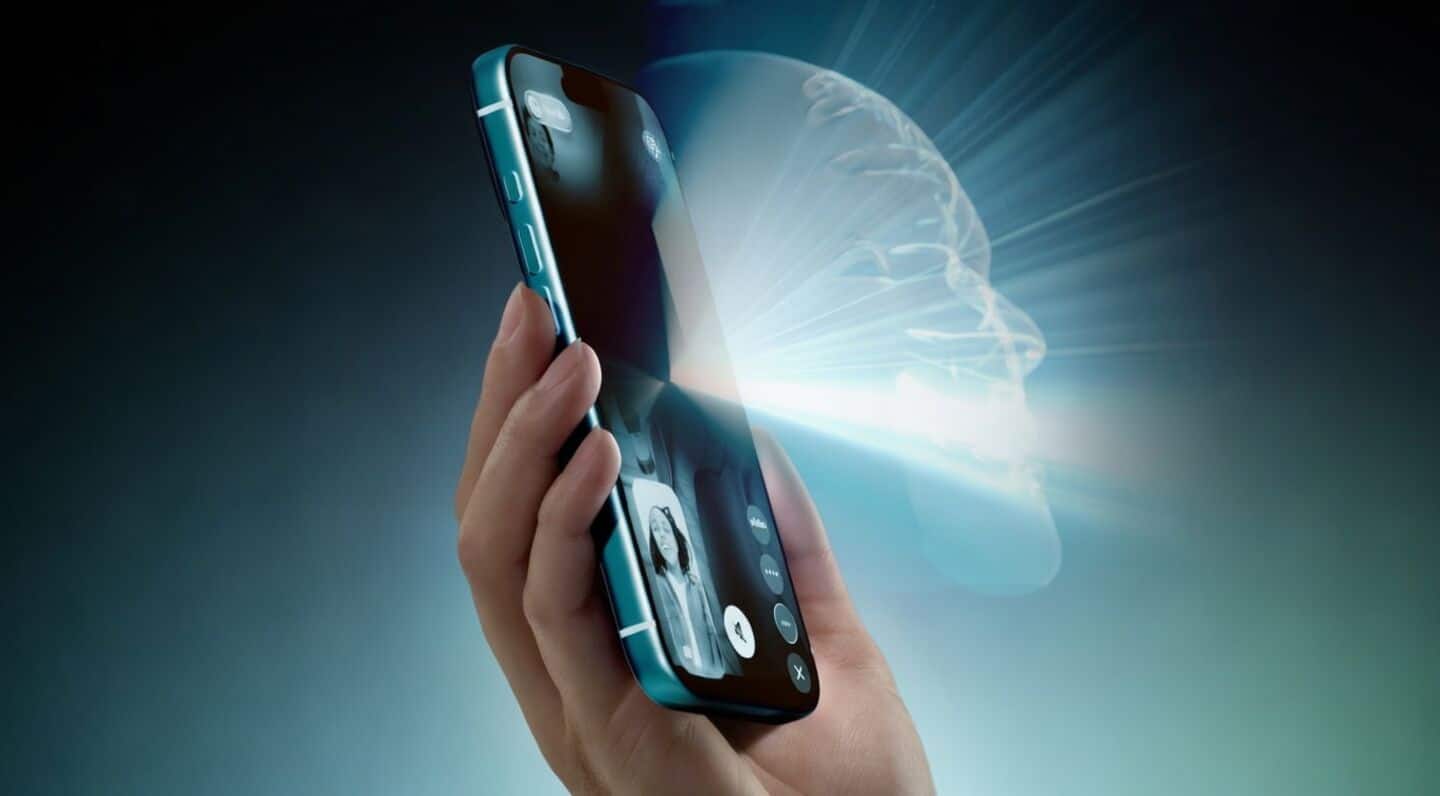
Is Apple working on a 'Spatial iPhone' with holographic display?
What's the story
Samsung is said to be working on a holographic smartphone display for a rumored "Spatial iPhone." The information comes from leaker "Schrodinger" on X, who shared screenshots of conversations with an unnamed insider. While there have been whispers about a "Spatial iPhone" in the supply chain, no concrete details have emerged yet. As Apple doesn't make its own displays, it would likely rely on other manufacturers like Samsung for such a device.
Tech details
What is the MH1 display?
The rumored display, codenamed "MH1" or "H1," combines eye-tracking with diffractive beam-steering.
This tech uses microscopic structures in the display layer to bend light toward the viewer's eyes at precise angles, creating a sense of depth without glasses.
The screen also features a nano-structured holographic layer integrated into the AMOLED stack, providing spatial depth effects that seem to hover above the glass surface.
Research progress
Samsung has been researching holographic displays since 2020
Samsung's Advanced Institute of Technology (SAIT) has been researching slim-panel holography since 2020.
The institute published a paper in Nature Communications detailing a steering-backlight unit that improved viewing angles for holographic video by 30 times over conventional designs.
The prototype at the time was about 1cm thick and could play 4K holographic video at 30 frames per second.
Display features
Holographic smartphones could arrive by 2030
The H1 display is said to maintain full 4K resolution for standard 2D tasks, with the holographic depth layer activating only for specific content.
This avoids the image quality tradeoff seen in older lenticular lens-based 3D screens.
However, Schrodinger noted that the MH1 project is still in phase one of R&D, hinting at a possible launch of holographic smartphones around 2030.
Patent history
Apple's interest in holographic displays
Apple's fascination with holographic and glasses-free 3D display tech dates back nearly two decades.
In 2008, it filed a patent for a glasses-free autostereoscopic display that tracked the viewer's position to deliver a personalized 3D image without special glasses.
In 2014, Apple was said to be developing a glasses-free 3D iPhone display and got a patent for an "Interactive holographic display device" using laser beams, micro lenses, and sensors to create three-dimensional images on touchscreen panels.