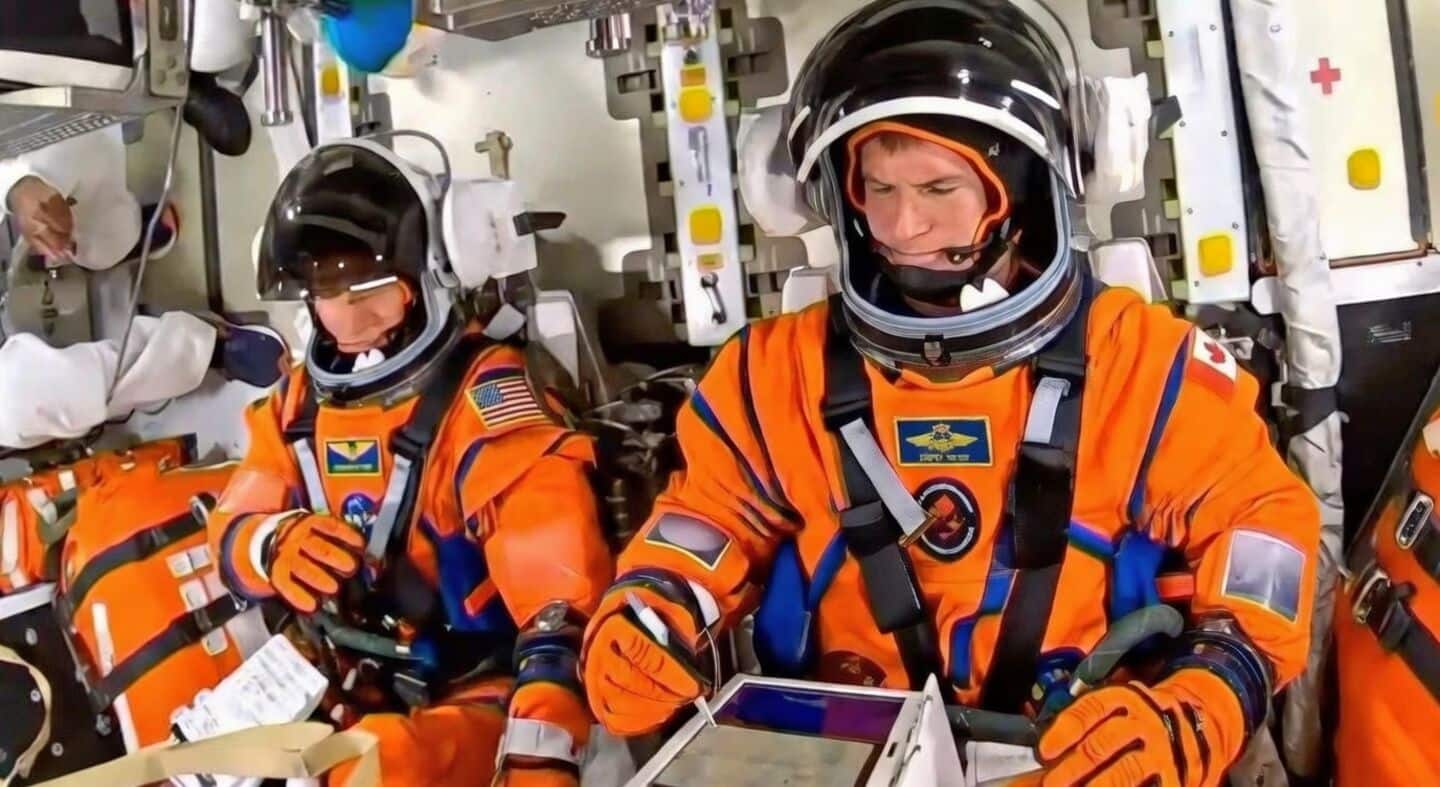
Artemis II is in Earth's orbit: What happens next?
What's the story
NASA's Artemis II mission has been launched into space. The first 48 hours of this groundbreaking journey will be crucial for the crew. From performing a proximity operations test in Earth's orbit to a six-minute engine burn that sets their course toward the Moon, these initial hours are critical. The SLS rocket, a multi-stage launch vehicle, was instrumental in this historic journey.
Launch sequence
How SLS rocket will help Orion reach Moon
The SLS rocket lifted off with two massive white boosters on either side, providing the initial thrust before detaching.
The tall orange core stage then completed the job of pushing the crew out of Earth's atmosphere.
Finally, it placed the Orion capsule and its upper stage into a low Earth orbit about 161km above our planet's surface.
Unlike SpaceX rockets that land back on Earth, the $2 billion worth SLS rocket is destroyed during the mission.
Test details
Proximity operations demonstration
After reaching high Earth orbit, the crew will use the spent Interim Cryogenic Propulsion Stage (ICPS) as a target for a proximity operations demonstration. This is one of the most challenging tests of the entire mission.
Proximity operations, or prox ops, involves carefully flying one spacecraft close to another. It will be vital in future Artemis missions when Orion has to dock with a lunar lander or Gateway space station in lunar orbit.
Sleep phase
Early checkout of the Deep Space Network (DSN)
After about eight and a half hours in space, the astronauts will get a four-hour sleep. They will then wake up to perform another engine burn, placing Orion in the right orbital position for its next maneuver.
An early checkout of the Deep Space Network (DSN), NASA's global network of large radio antennas used to communicate with distant spacecraft, will also be conducted at this time.
Burn significance
Final major engine firing of the mission
The second flight day will see mission specialist Christina Koch prepping Orion for the translunar injection burn.
This final major engine firing of the mission commits the crew to their Moon-bound trajectory.
The six-minute-five-second burn will increase the spacecraft's speed by some 1,448km/h, enough to set Orion on a path around the Moon and back toward a Pacific Ocean splashdown around April 10.