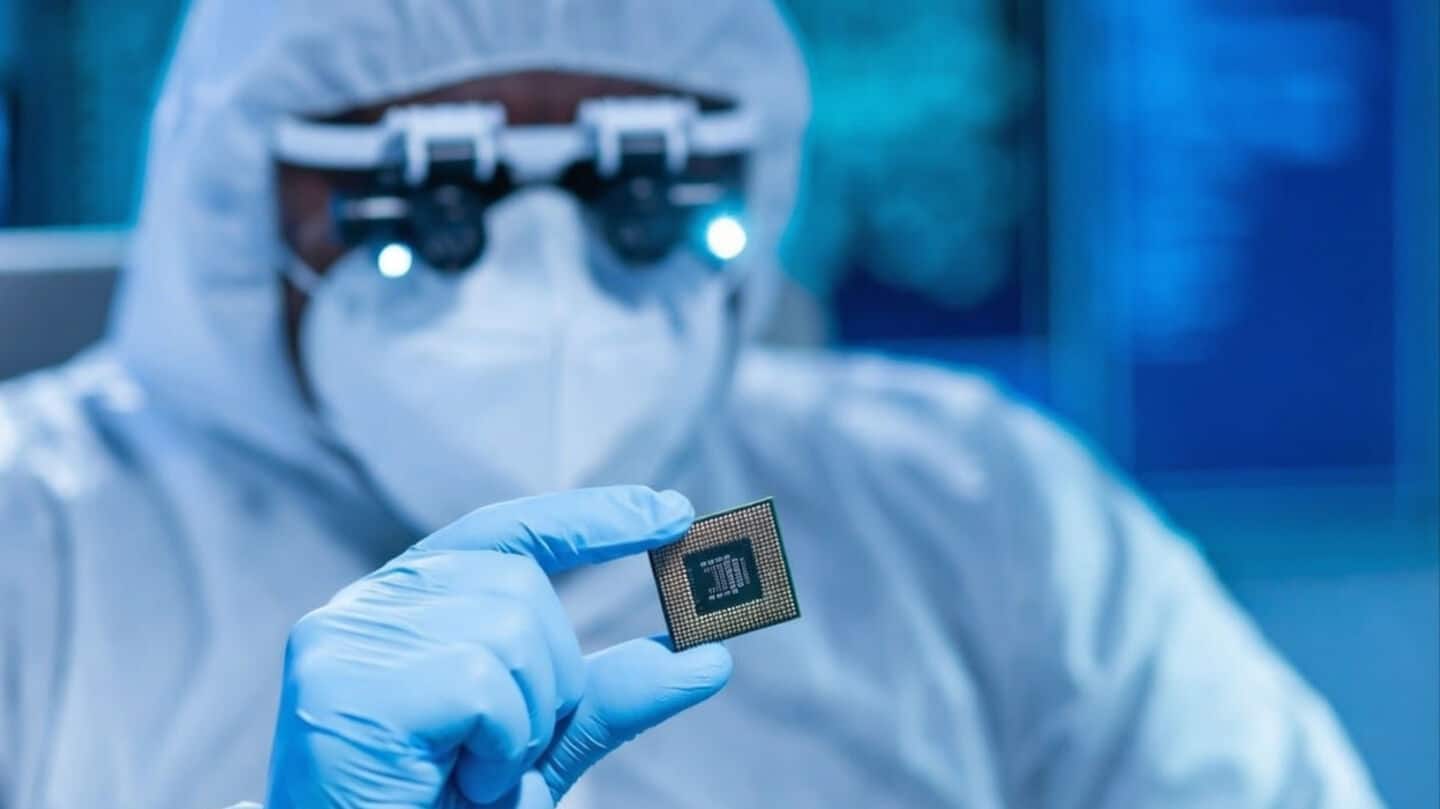
Mass production of 2D chips might soon become a reality
What's the story
In a major breakthrough, Chinese scientists have developed a method to grow two-dimensional (2D) semiconductors at an unprecedented speed, 1,000 times faster growth. The innovation could revolutionize the semiconductor industry and meet the growing demand for high-performance chips. The surging demand for high-performance chips has intensified the search for advanced semiconductor technologies due to the rise of artificial intelligence (AI) and large language models (LLMs).
Technological evolution
Understanding the significance of 2D chips
Moore's Law predicted a doubling of semiconductor capacity every two years. However, as chips get smaller, physical limitations make it harder to improve performance.
This is where the 2D semiconductors come into the picture. They are considered a potential solution for post-Moore chip materials because they allow continued transistor scaling.
Process
The importance of doping in semiconductors
The electrical conductivity of a 2D semiconductor can be modified by introducing small amounts of other elements, a process known as doping.
This can create n-type (negative) and p-type (positive) materials.
While many n-type 2D semiconductors such as molybdenum disulfide and molybdenum diselenide are available, high-performance and stable p-type ones are still rare.
Material scarcity
The challenge of developing sub-5nm node 2D semiconductors
Transistors in a chip need both n-type and p-type materials to work together.
However, the lack of high-performance p-type materials has become a major hurdle for developing sub-5nm node 2D semiconductors.
This challenge is also a hotly contested scientific and technological frontier.
Zhu Mengjian from the National University of Defence Technology highlighted this issue in a report by Science and Technology Daily.