ChatGPT now turns math and science concepts into interactive visuals
What's the story
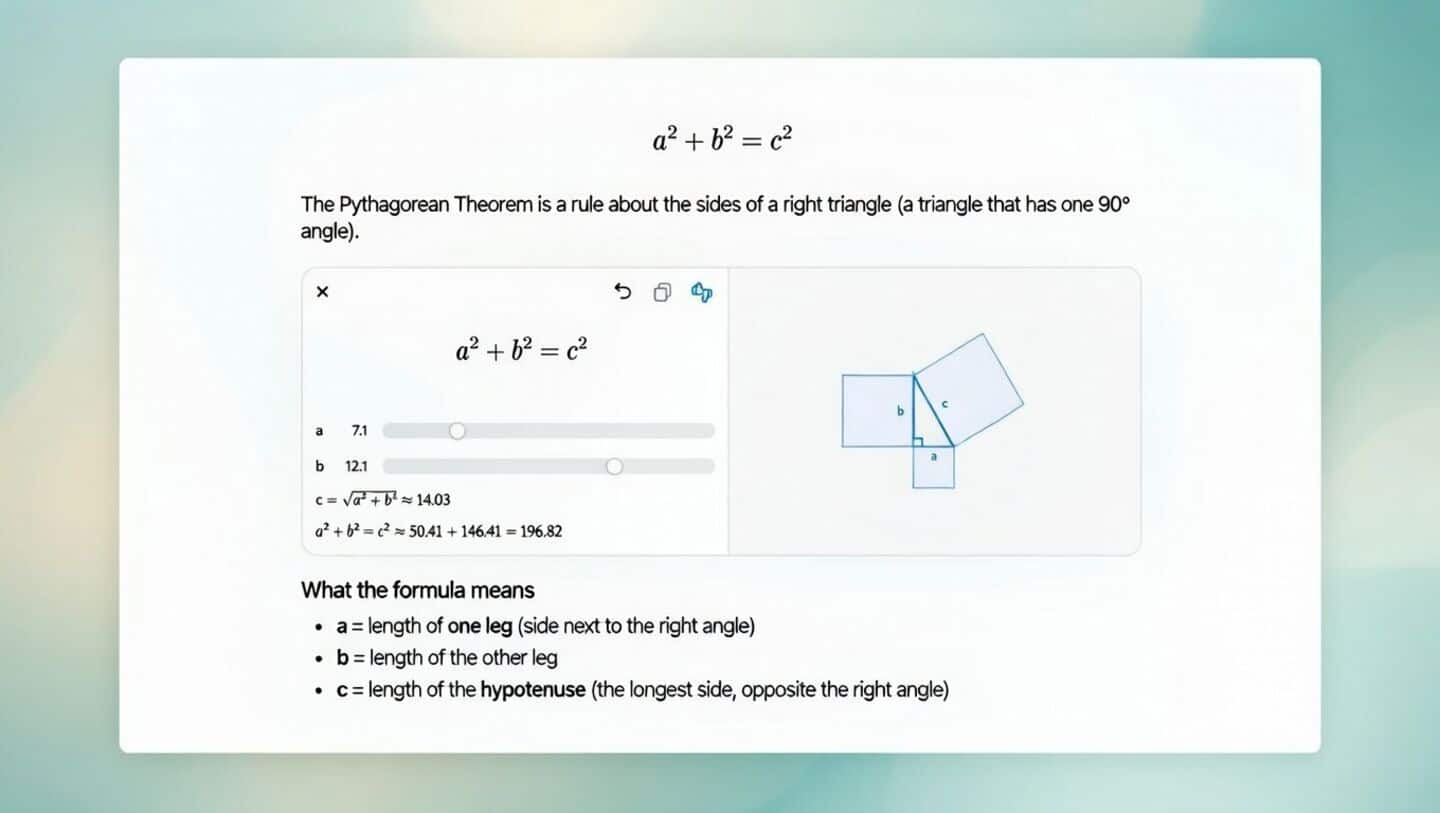
OpenAI has introduced a new feature in ChatGPT: dynamic visual explanations. The innovative capability allows users to see how formulas, variables, and mathematical relationships change in real time. Instead of just reading an explanation or looking at a static diagram, you can now interact directly with the visuals. For instance, when exploring the Pythagorean theorem, you can adjust the lengths of the triangle's sides and watch how it instantly updates.
Topic coverage
Visuals currently cover over 70 math and science topics
The new feature isn't just limited to the Pythagorean theorem. You can ask ChatGPT questions like "What is a lens equation?" or "How can I find the area of a circle?"
The AI will respond with an explanation and an interactive module for you to manipulate.
The visuals currently cover over 70 math and science topics, including Coulomb's law, kinetic energy, linear equations, Ohm's law, and more.
Future plans
OpenAI plans to expand the feature to include more topics
OpenAI has said it plans to expand the feature to include more interactive topics in the future.
The launch of dynamic visual explanations marks a shift in ChatGPT's role from just delivering answers to engaging users with underlying concepts directly.
This could lead to a deeper understanding, depending on how the tool is used.
Educational shift
Over 140M people use ChatGPT weekly for math, science help
The introduction of interactive visuals in ChatGPT comes amid ongoing debates over AI's role in education.
While some educators fear an overreliance on these tools, many teachers and students have already started using them as part of their daily study routines.
According to OpenAI, more than 140 million people use ChatGPT every week for math and science help—subjects that have traditionally posed challenges to learners.