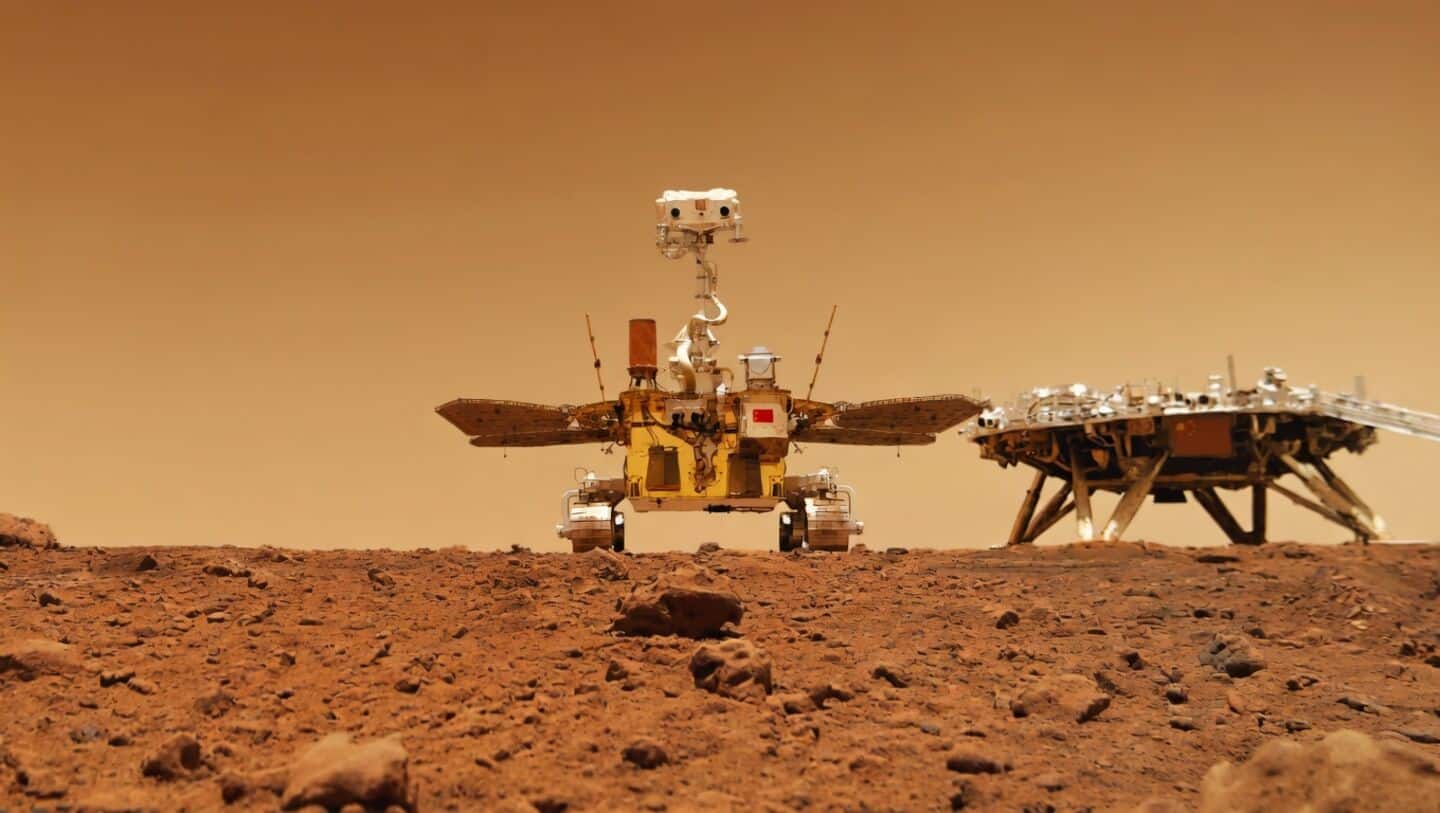
China plans Mars sample return mission by 2031
What's the story
China has reiterated its ambitious plan to bring back samples from Mars. The China National Space Administration (CNSA) said it is on track to launch the Tianwen-3 Mars Sample Return mission around 2028. The mission aims to bring at least 500gm of Martian material back to Earth by 2031. The announcement was made during the opening ceremony of China's 11th Space Day in Chengdu.
Mission details
China's first interplanetary sample return mission
Tianwen-3 will be China's first attempt at interplanetary sample return.
The mission is expected to involve a series of complex operations such as landing on Mars, collecting samples, launching them into Martian orbit with an ascent vehicle, and transferring them to an Earth-return spacecraft.
If successful, these steps would put China in an elite club of nations capable of conducting such interplanetary missions.
Global participation
International collaboration on Tianwen-3 mission
In April 2025, CNSA opened the Tianwen-3 mission to global participation, offering up to 20kg of payload capacity for international partners.
The agency received 28 proposals from around the world. After evaluation based on scientific value, engineering feasibility, mission support and technological readiness, five projects were selected.
While CNSA has not yet revealed full details of these winning proposals, officials have stressed that they will greatly enhance the scientific return of this ambitious mission.
Program hurdles
NASA-ESA Mars Sample Return program faces challenges
Meanwhile, NASA and the European Space Agency are facing challenges with their joint Mars Sample Return (MSR) program.
The initiative has been marred by budget overruns, technical complexities, and delays. This has led both agencies to reconsider mission architecture and timelines.
Despite Perseverance caching scientifically valuable samples on the Martian surface, a clear plan to retrieve them is still in development.
Exploration impact
Implications of successful Tianwen-3 mission
If Tianwen-3 sticks to its schedule, it could be the first mission to bring Martian samples back to Earth.
This would have major implications for planetary science, including the search for ancient microbial life and understanding Mars's geological history.
As the 2028 launch window approaches, Tianwen-3 is set to be a defining moment in this new era of space competition and cooperation.