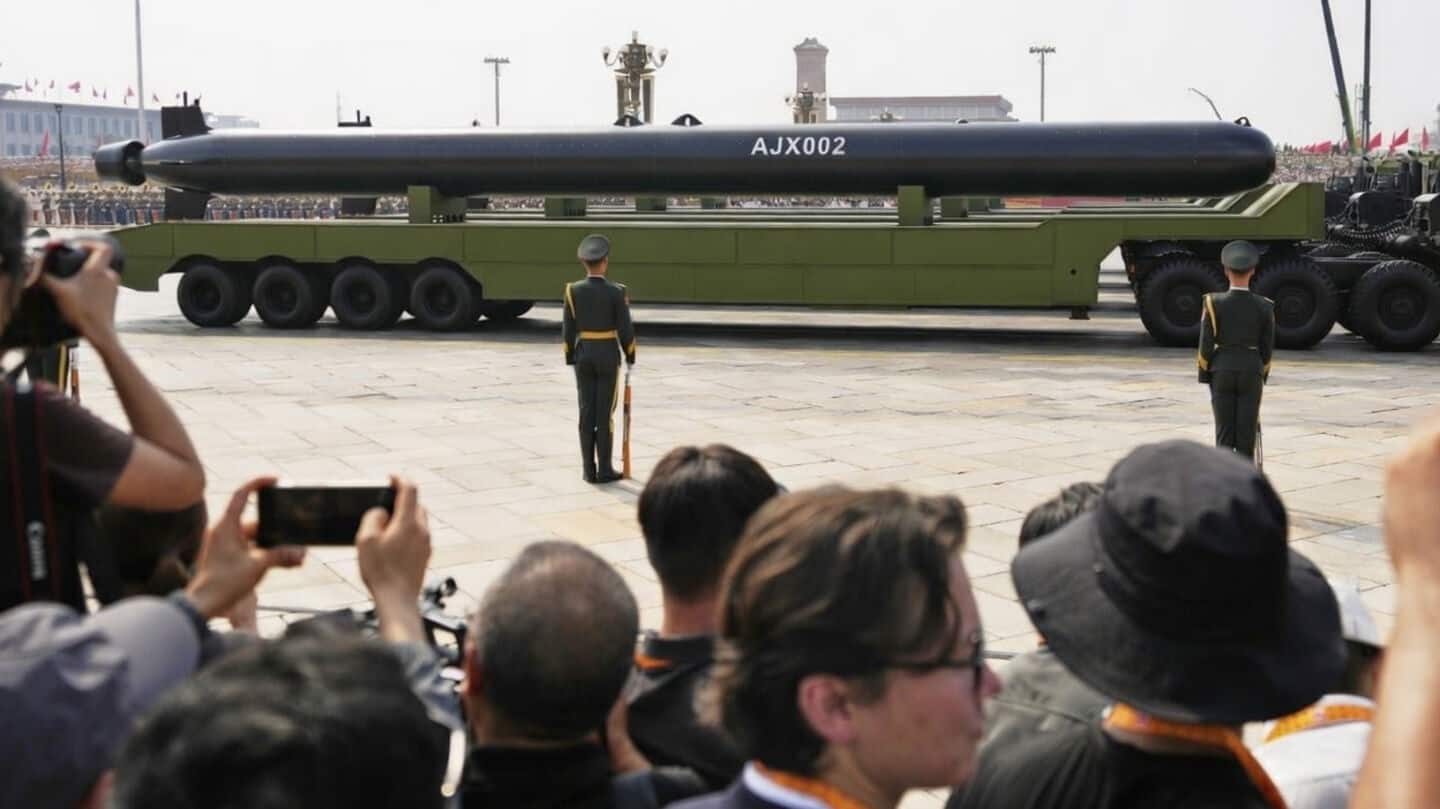
China's gigantic underwater drones will be used for this purpose
What's the story
China's ultra-large unmanned submersibles, the world's largest of their kind, are not intended to target the US West Coast. This was clarified by Yan Zheping, a leading authority on submersibles and Director of Unmanned Systems at Harbin Engineering University's College of Intelligent Systems Science and Engineering. The clarification came in response to concerns raised by US defense experts over potential vulnerabilities along America's West Coast due to these new drones.
Drone classification
World's largest unmanned submersibles
China's unmanned submersibles, which were showcased during a military parade last year, are now the world's largest.
The two models on display (HSU001 and AJX002) are nearly 20m long. Satellite imagery analyzed by Western media also spotted a secret variant longer than 40m at a naval base, sparking global alarm.
These massive vehicles created a new category of drones called extra-extra-large uncrewed underwater vehicles (XXLUUVs), dwarfing America's biggest unmanned underwater vehicle, the 15m "Orca."
Expert warnings
US defense experts issue warnings
The unprecedented size of China's unmanned submersibles has prompted US defense experts to issue dire warnings about possible vulnerabilities along America's West Coast.
Some analysts have even identified Seattle, Oakland, Los Angeles, and the Panama Canal as potential targets for these drones.
However, Yan Zheping's recent peer-reviewed research published last month addresses these concerns by clarifying the strategic purpose of these vessels.
Strategic purpose
Research paper clarifies purpose of vessels
In his paper for the Chinese Journal of Ship Research, Zheping clarified that China's ultra-large models prioritize regional security and near-coast defensive reconnaissance, while also supporting civilian research and environmental monitoring.
This suggests that these deep-sea giants would mainly be used to counter US military operations in possible Taiwan Strait or South China Sea contingencies, instead of conducting trans-Pacific strikes.