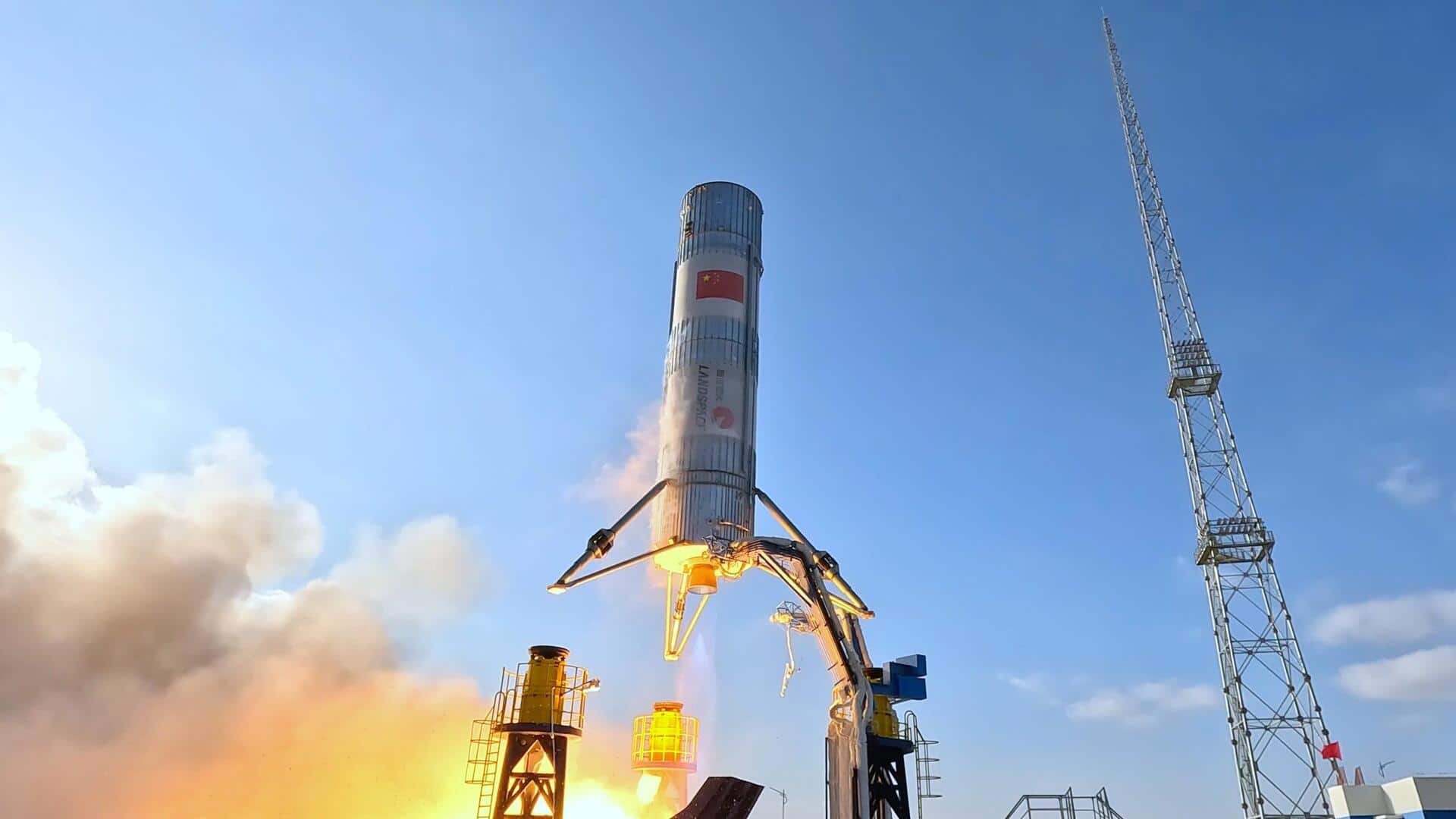
China's reusable private rocket explodes during landing attempt
What's the story
China's LandSpace Technology has achieved a partial victory with its Zhuque-3 rocket's maiden flight from the Jiuquan Satellite Launch Center. The 66-meter methane-fueled vehicle successfully placed a dummy payload into low Earth orbit, despite a dramatic first-stage recovery failure due to explosion. The mission was launched on December 3, 2025, marking China's most ambitious reusable rocket attempt to date.
Mission details
Zhuque-3's ascent and re-entry burns
The Zhuque-3 rocket executed its ascent burn without a hitch, thanks to nine powerful TQ-12A engines. It also performed a re-entry burn that successfully positioned the upper stage for orbital insertion.
These phases were executed smoothly, achieving the mission's primary objective.
However, things took a turn during the critical landing burn some 8.5 minutes after liftoff when the stainless-steel booster caught fire mid-air near the Gobi Desert landing site.
Recovery attempt
LandSpace's goal and pre-flight milestones
Beijing-based LandSpace aimed to achieve China's first orbital-class booster recovery, following in the footsteps of SpaceX's Falcon 9 and Blue Origin's New Glenn. Pre-flight milestones included a static fire of nine engines in June and propellant rehearsals in October.
Launch challenges
Zhuque-3's failure highlights challenges
The failure of Zhuque-3's first-stage recovery highlights the difficulties of China's inland launch dynamics, where boosters fly over land instead of recovering over oceans like other countries.
Despite this setback, the orbital success validates Zhuque-3's design for future Guowang megaconstellation missions.
It also places LandSpace in competition with other companies such as Space Pioneer and its Tianlong-3 rocket.
Tech advancement
China's aggressive push in reusable tech
The flight of Zhuque-3 highlights China's aggressive push in reusable technology, which could potentially reduce costs and challenge US dominance.
The event has sparked a domestic race, with state-backed Long March 12A also eyeing landings.
As debris analysis begins, LandSpace is looking at refining its design for reusability of up to 20 flights per booster.