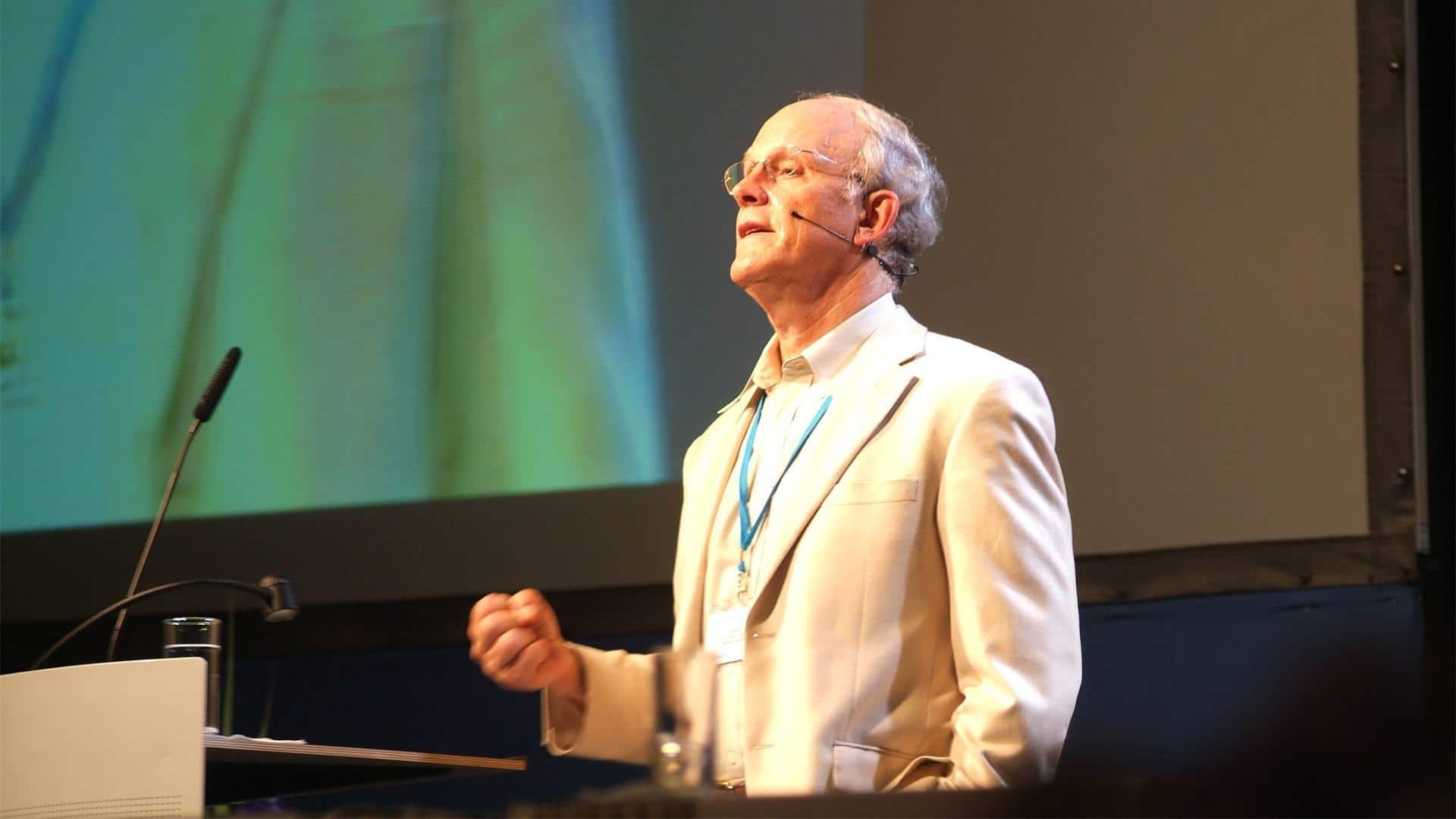
Humanity may not survive 50 years, warns Nobel laureate
What's the story
In a recent interview with Live Science, Nobel laureate David Gross, who won the Special Breakthrough Prize in Fundamental Physics, spoke about the challenges of unifying all fundamental forces. He said that humanity's survival is more dependent on our actions than scientific progress. Theoretical physicist Gross recently received the $3 million prize in honor of a lifetime of physics achievement.
Survival fears
Nuclear war could end civilization in 35 years: Gross
Gross, who has spent decades working on string theories to unify gravity with the other three forces, expressed doubts about humanity's long-term survival.
He said, "Currently I spend part my time trying tell people ... chances living 50 years are very small," stressing that the major barrier to a theory of quantum gravity isn't scientific but rather our limited time on Earth.
He also warned that nuclear war could end civilization in as little as 35 years.
Academic path
Gross helped developed principle of asymptotic freedom
Gross' interest in physics was sparked by a popular science book, The Evolution of Physics, co-authored by Albert Einstein.
He went on to develop the principle of asymptotic freedom with Frank Wilczek and H. David Politzer.
This principle showed that the forces between quarks weaken as they come closer and strengthen as they move apart, forming part of quantum chromodynamics and paving the way for the unification of three fundamental forces in particle physics: strong, weak, and electromagnetic forces.
Theoretical transition
String theories could unify gravity with other 3 forces
After his work on quarks, Gross shifted his focus to string theories that could unify gravity with the other three forces.
He has spent years trying to understand how space-time behaves at short distances and how the universe evolved.
Despite his groundbreaking work, Gross believes that testing these theories is extremely difficult due to the extremely tiny scale.