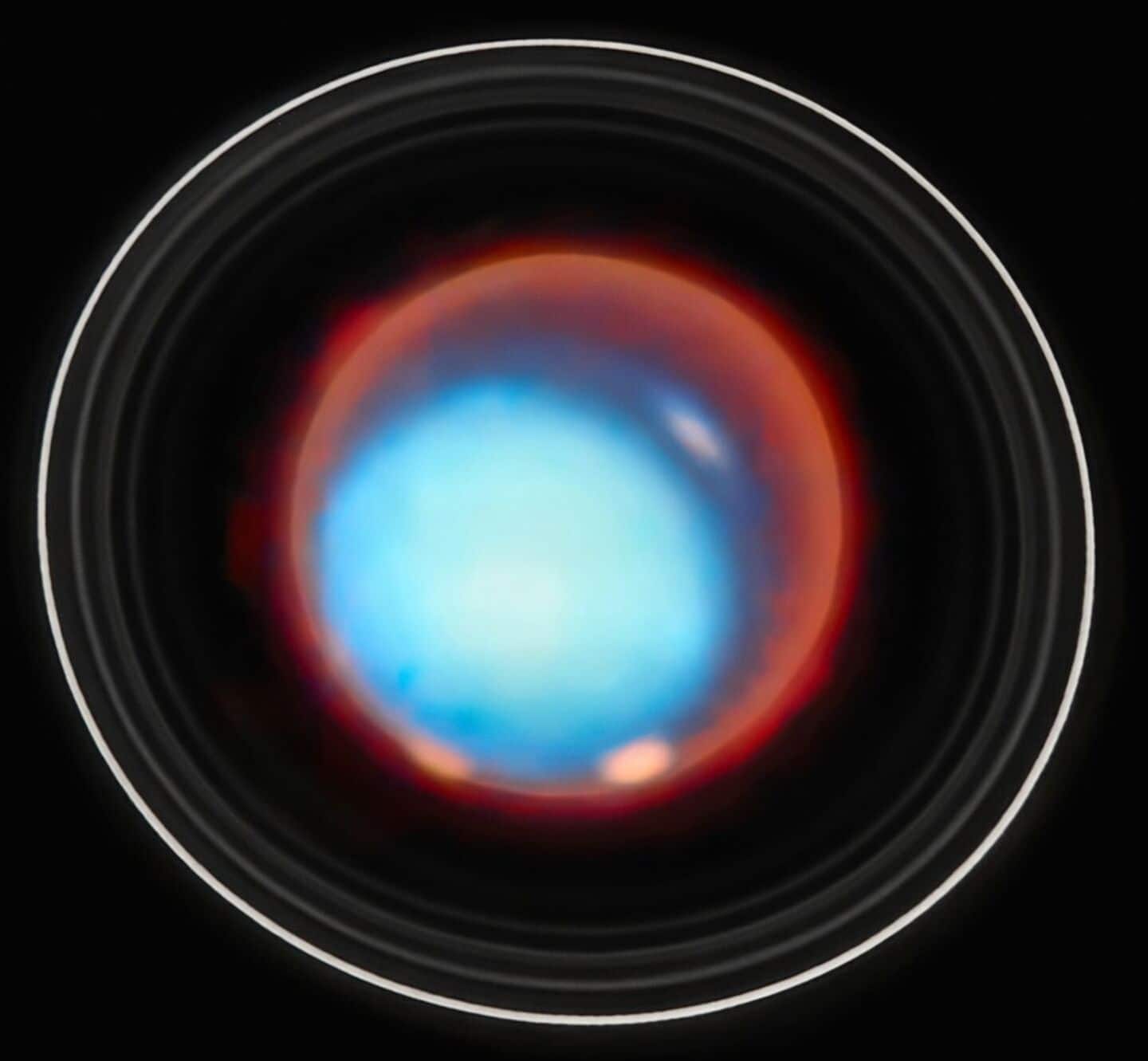
James Webb telescope maps Uranus's upper atmosphere for first time
What's the story
An international team of astronomers has mapped the vertical structure of Uranus's upper atmosphere for the first time. The study was led by Paola Tiranti from Northumbria University in the UK and used data from NASA/ESA/CSA James Webb Space Telescope's NIRSpec instrument. The researchers observed Uranus during nearly a full rotation, revealing temperature and ion density variations in its atmosphere up to 5,000km above cloud tops.
Findings
Temperature and ion density variations
The study found that temperatures peak between 3,000 and 4,000km above Uranus's clouds. Ion densities reach their maximum around 1,000km above the planet's surface.
The data also shows clear longitudinal variations linked to the complex geometry of the planet's magnetic field.
"This is the first time we've been able to see Uranus's upper atmosphere in three dimensions," Tiranti said.
Cooling trend
Upper atmosphere still cooling
Webb's data confirms that Uranus's upper atmosphere is still cooling, a trend that started in the early 1990s.
The team recorded an average temperature of about 426 K (some 150°C), which is lower than what ground-based telescopes or previous spacecraft have recorded.
"By revealing Uranus's vertical structure in such detail, Webb is helping us understand the energy balance of the ice giants," Tiranti said.
Atmospheric anomalies
Auroral bands near magnetic poles
Webb's observations also revealed two bright auroral bands near Uranus's magnetic poles.
A unique depletion in emission and ion density was also observed in part of the region between these two bands, possibly due to transitions in magnetic field lines.
Similar darkened regions have been seen at Jupiter, where the geometry of its magnetic field controls how charged particles travel through the upper atmosphere.