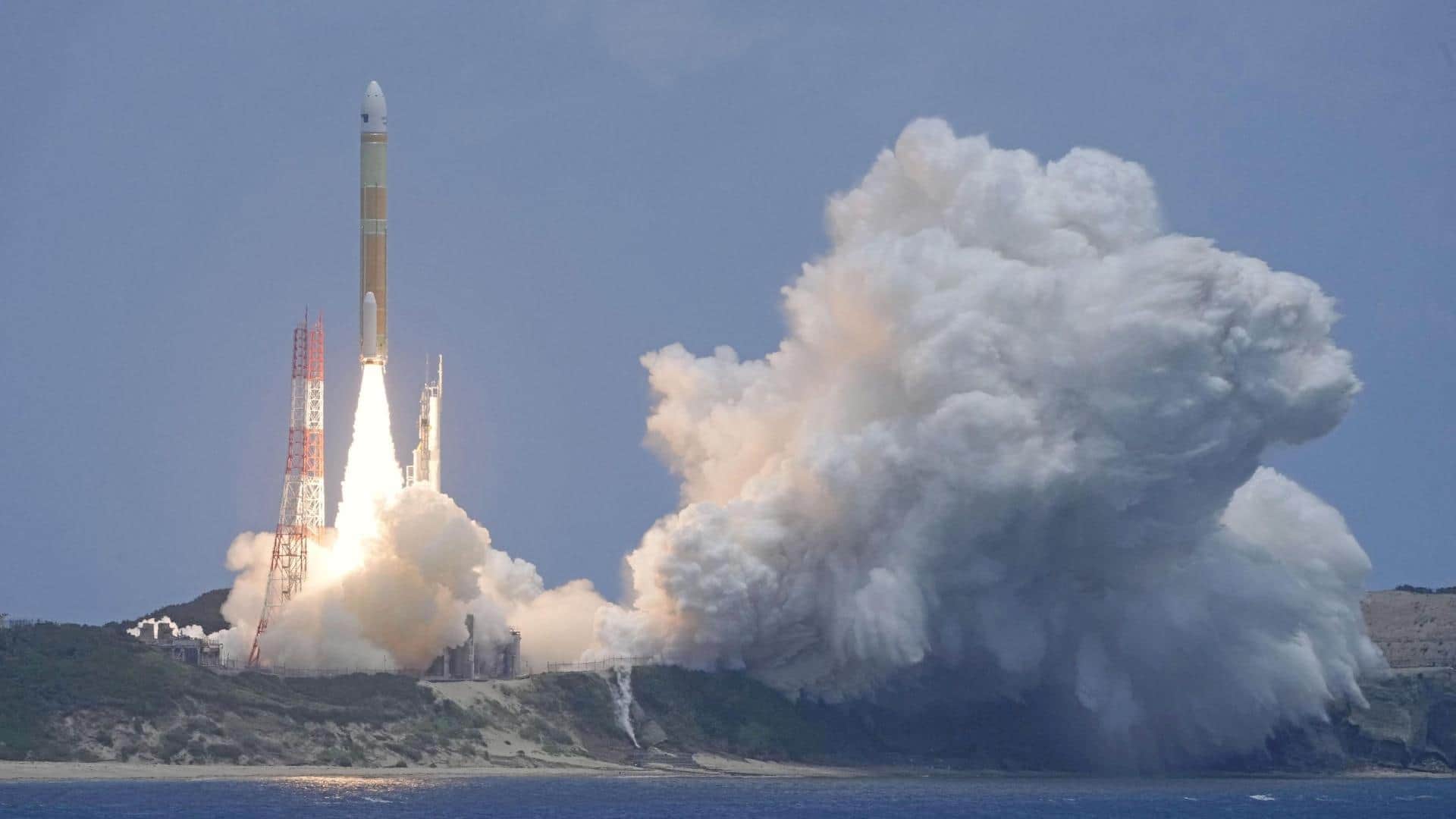
Japan's flagship H3 rocket fails again: What went wrong
What's the story
Japan's latest space mission has ended in failure. The country's flagship H3 rocket lifted off from the Tanegashima Space Center earlier today, carrying the Michibiki 5 navigation satellite (QZS-5). However, the second ignition of the second-stage engine failed to start normally and shut down prematurely. As a result, QZS-5 could not be placed into its planned orbit, and the launch was declared a failure. This was the seventh mission for the H3 rocket and its second failure overall.
Satellite mission
Michibiki 5 satellite's role in Japan's navigation network
The Michibiki 5 satellite was slated to be a part of Japan's homegrown Quasi-Zenith Satellite System (QZSS), a navigation network in geosynchronous orbit.
The system is designed to work with GPS satellites, providing integrated services.
It was hoped that this system would be expanded to other countries in Asia-Oceania regions as well.
Rocket history
H3 rocket's development and previous successes
The two-stage H3 rocket was developed by the Japan Aerospace Exploration Agency (JAXA) and Mitsubishi Heavy Industries. It is the successor to the H-2A, a reliable launcher that served for 25 years before retiring in June.
The H3 had a rocky start with its maiden launch in March 2023 ending in failure. However, it managed to recover with five consecutive successful missions until this recent setback.
Investigation underway
JAXA sets up task force to investigate launch failure
In the wake of this incident, JAXA has formed a task force led by agency chief Hiroshi Yamakawa. The team has been assigned to investigate the Michibiki 5 launch failure.
"We would like to express our deepest apology to many people and entities, particularly those related to the QZS-5," JAXA officials said in their update on Monday morning.