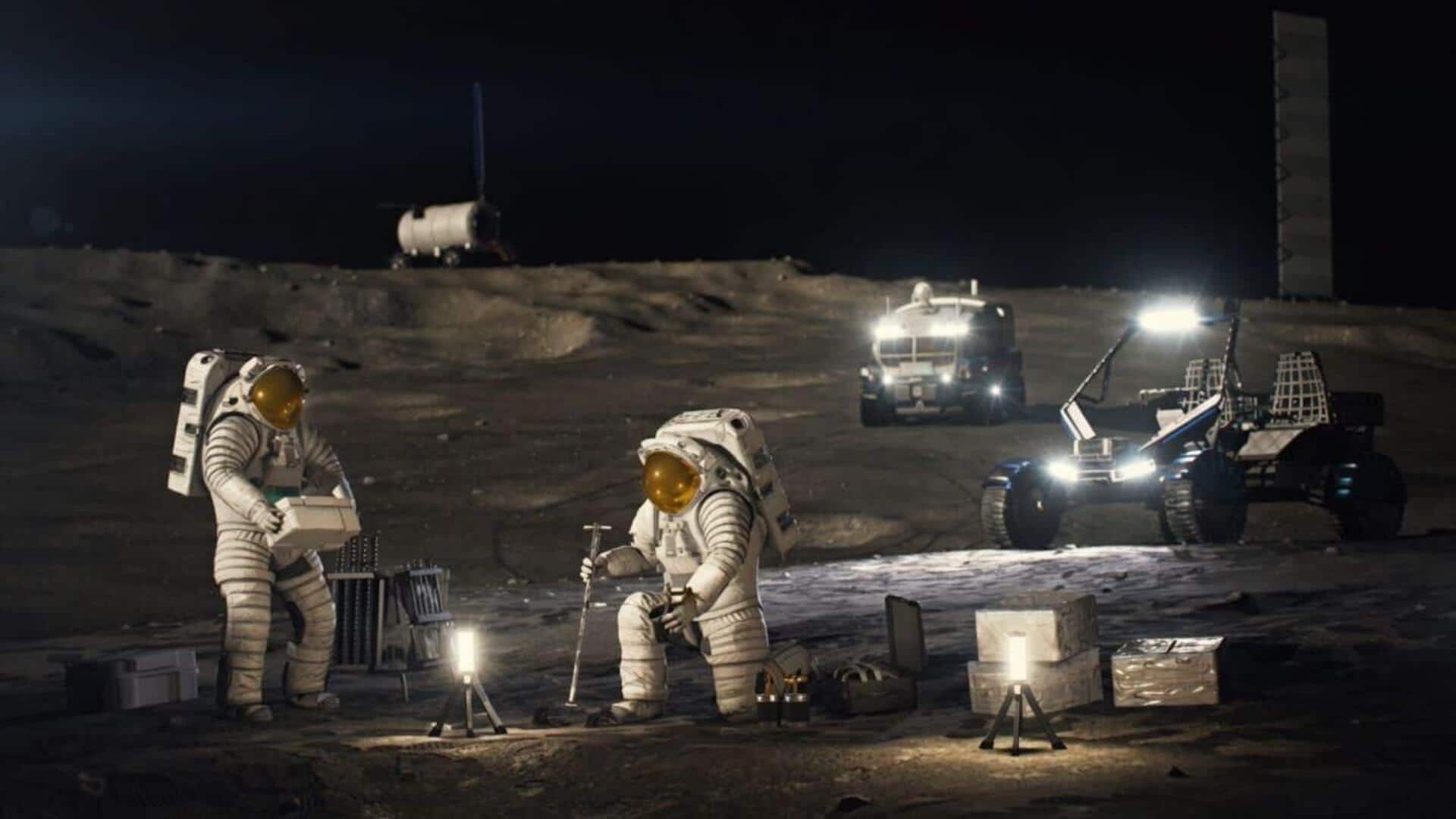
NASA unveils $20B plan to build Moon base
What's the story
NASA has unveiled a $20 billion plan to establish a permanent base on the Moon. The ambitious project will include three missions this year, aimed at delivering equipment and testing technologies. The space agency plans to land astronauts on the lunar surface by 2028, marking humanity's first outpost on another celestial body.
Strategic importance
Moon base will be humanity's first outpost on another world
The Moon base will be a major step in humanity's journey into space. It will serve as a platform for testing technologies and conducting experiments necessary for long-term survival on the lunar surface.
"America is returning to the moon. The Moon Base will be America's and humanity's first outpost on another celestial world," said NASA Administrator Jared Isaacman at a press conference.
Upcoming launch
First mission to deliver equipment and test technologies
The first Moon Base mission is scheduled for September this year. NASA has chosen Blue Origin's Blue Moon Mark 1 Endurance lander for the job.
The mission will deliver equipment such as stereo cameras and a Laser Retroreflective Array to study how thrusters interact with the Moon's surface and help orbiting spacecraft determine their location more accurately using reflected laser light.
Upcoming launch
Second and 3rd mission will also carry payloads
The second Moon Base mission, scheduled for later this year, will deliver over 500kg of cargo on Astrobotic's Griffin lander.
This includes Astrolab's FLIP rover which will help mature mobility systems for future lunar terrain vehicle operations.
The third mission will carry NASA's Lunar Vertex science mission and payloads from the European Space Agency and the Korean Space Agency to study mysterious lunar swirls thought to be linked with magnetic fields beneath the Moon's surface.
Long-term plan
Three phases of NASA's Moon base program
Under the three-phased program, NASA will test technologies and prepare for surface operations over the next three years.
The agency also plans to deliver at least one lunar terrain vehicle for use by astronauts expected to return to the lunar surface in 2028 as part of the Artemis-III mission.
The second phase (2029-2032) will see construction of permanent infrastructure such as a power grid while third phase (from 2032 onward) will focus on scaling up operations for sustained human presence.