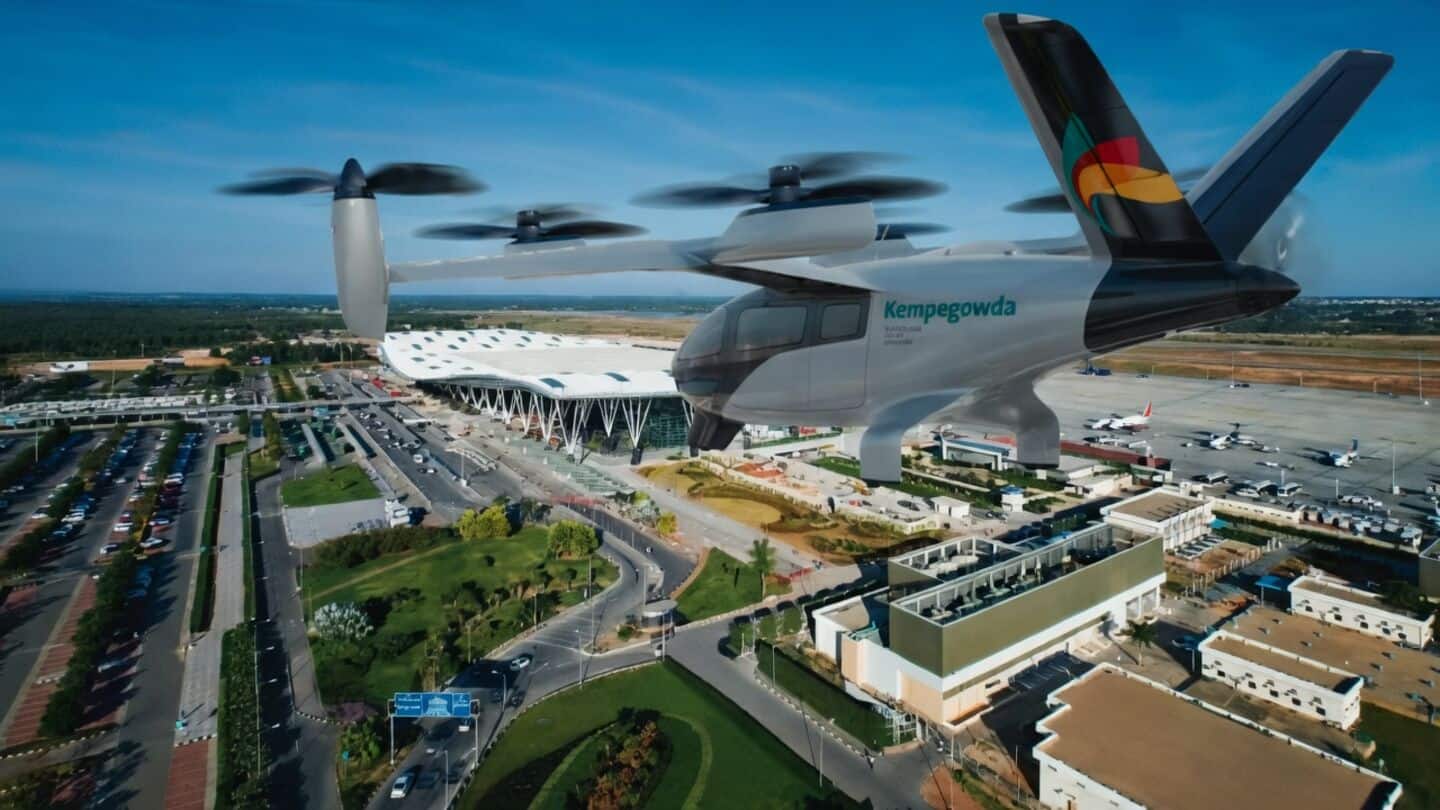
Bengaluru start-up clears key milestone for 2028 air taxi launch
What's the story
Sarla Aviation, an air taxi start-up backed by Accel and Zerodha co-founder Nikhil Kamath, has successfully completed the flight test campaign of its electric aircraft Sylla. The successful testing of Sylla 1.0 marks a major milestone in Sarla Aviation's journey toward launching its full-fledged air taxi for regional and urban air mobility, Shunya, in 2028. The company said that the aircraft lifted off straight from the ground and hovered under its own closed-loop control during the tests.
Aircraft details
'Flying Sylla is the moment a thousand simulations become real'
Sarla Aviation described Sylla 1.0 as a half-scale technology demonstrator built to validate aircraft-level and system-level integration under real operating conditions.
The company successfully evaluated the interaction between the aircraft's electric propulsion system, battery architecture, distributed propulsion, flight-control algorithms, airframe, and landing gear as a fully integrated aircraft throughout this program.
"Flying Sylla is the moment a thousand simulations become real," said Rakesh Gaonkar, co-founder and CTO at Sarla Aviation.
Program achievements
Program completed full-stack ground testing per airworthiness regulations
The Sylla program is the first in India to build and fly a 700kg-class electric aircraft capable of vertical take-off.
It also flew a 400-volt electric powertrain architecture and demonstrated a distributed-propulsion wing system for the first time in the country.
The program has also completed full-stack ground testing, per airworthiness regulations, making it a pioneer in this aspect as well.
Next steps
Sarla Aviation has started work on Sylla 2.0
Sarla Aviation revealed that Sylla 1.0 went from design to flight in under 12 months, a pace few eVTOL programs globally have matched.
The successful completion of the Sylla 1.0 campaign marks the start of Sarla Aviation's next phase of flight testing.
The company has started work on Sylla 2.0, an upgraded technology demonstrator that incorporates engineering learnings from the current program into its design and development process.