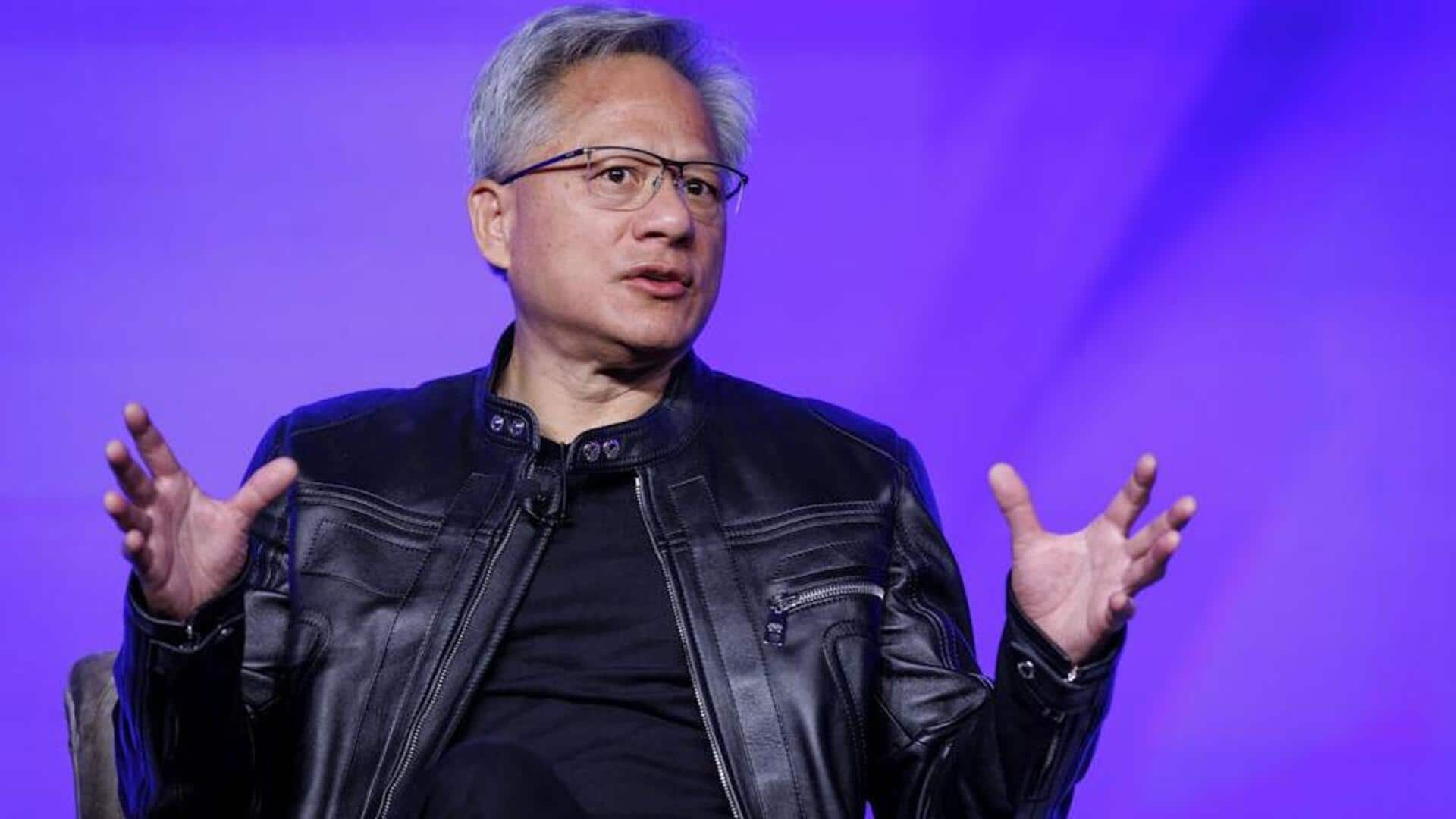
English may become the most powerful programming language: NVIDIA CEO
What's the story
NVIDIA CEO Jensen Huang has said that English could be the most powerful programming language of the future. He made this prediction while discussing the rapid evolution of artificial intelligence (AI) and its impact on human-computer interaction. Huang's comments come as generative AI tools are already allowing users to build apps, automate tasks, and create digital products using natural language prompts instead of structured code.
Shift in interaction
AI revolutionizing human-computer interaction
Huang emphasized that AI systems are revolutionizing our interactions with computers, making traditional coding skills less necessary.
He said that programming is moving from syntax-heavy languages to intent-based interaction.
Instead of writing lines of code in languages like C++ or Python, users can now describe their requirements in plain English and let AI systems generate the desired output.
Simplified debugging
Debugging could become simpler with AI
Huang also hinted that debugging could become simpler with the advent of AI.
Instead of manually finding bugs in code, users might just have to tell AI systems to fix the output.
This conversational loop, he said, could make software development more accessible.
His comments highlight the growing use of AI coding assistants and large language models that can create scripts, apps, and workflows from prompts.
Future of coding
Traditional programming languages won't become obsolete
Huang's comments don't mean that traditional programming languages like C++ and Python will become obsolete.
These languages still power operating systems, apps, and AI infrastructure.
However, the interface layer between humans and machines could increasingly rely on natural language.
For developers, this shift could mean a focus on clearly defining problems and effectively guiding AI systems instead of writing syntax-heavy code.
Expanded access
Opening software creation to non-technical users
For companies, this shift could open up software creation to non-technical users.
These individuals may be able to prototype tools, automate business processes, or analyze data without formal coding knowledge.
As AI capabilities continue to grow, the focus will not be on which programming language is the most powerful but how humans will instruct machines.
In this context, Huang's statement highlights a larger shift from coding commands to expressing intent.