Why is the gravitational constant, or big G, so mysterious
What's the story
For over 225 years, scientists have been trying to measure the gravitational constant, or Big G. The fundamental constant defines how strongly two masses attract each other anywhere in the universe. Despite its importance in physics and cosmology, researchers have not been able to agree on a precise measurement of Big G. The latest attempt at this quest has only deepened the mystery.
Experimental challenges
The latest attempt to measure Big G
The latest attempt to measure Big G spanned over a decade, starting in 2016.
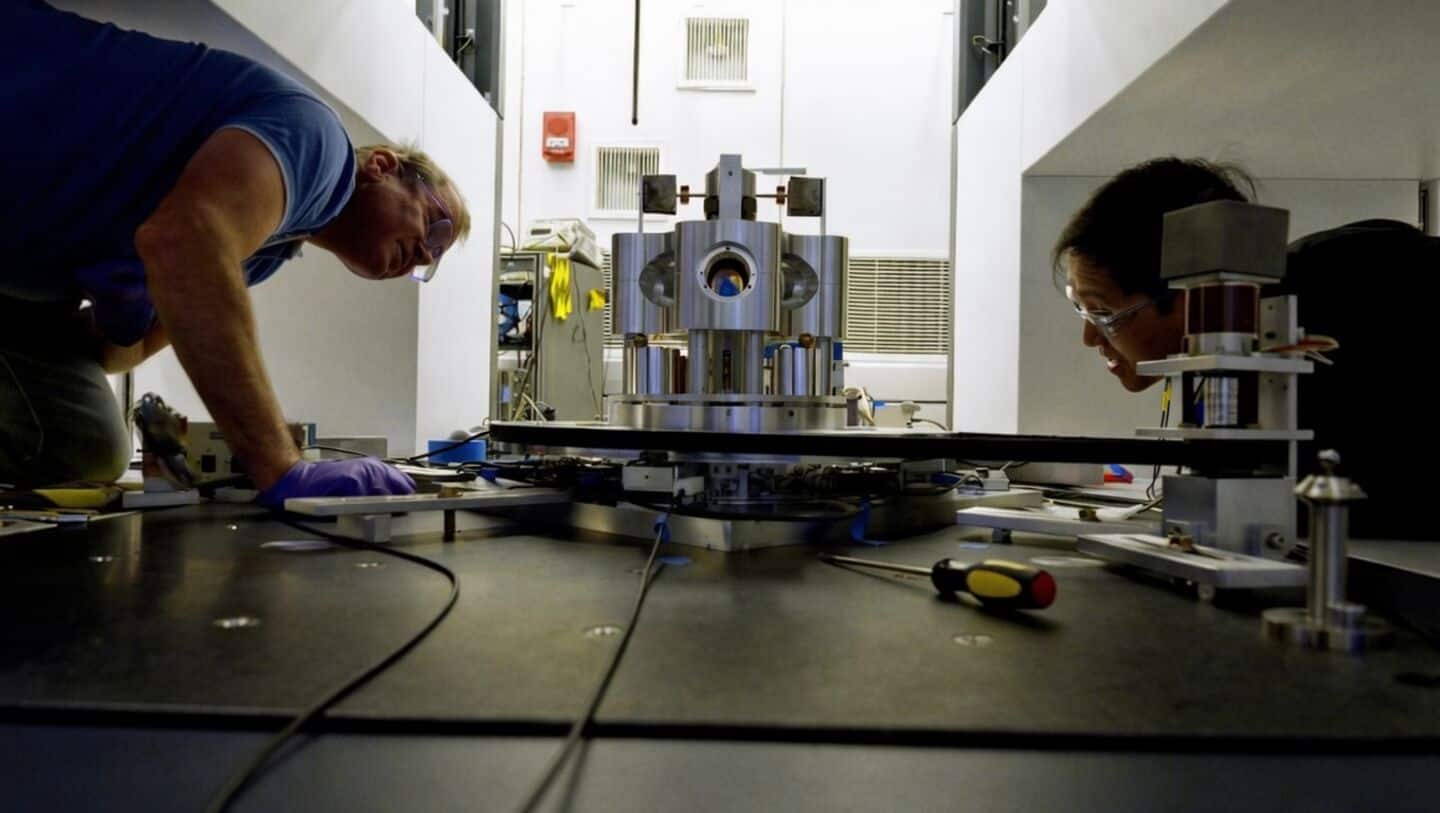
Conducted by Stephan Schlamminger, a physicist at the National Institute of Standards and Technology in Gaithersburg, Maryland, the experiment used a sensitive device called a torsion balance.
This instrument detects tiny forces by measuring the twisting angle or torsion of metal masses suspended on thin fibers in a vacuum.
Replication effort
A decade-long quest ends with a whimper
Schlamminger's team sought to replicate an earlier experiment by the International Bureau of Weights and Measures in Sevres, France.
They hoped that if they could independently reproduce the same results, it would help resolve the mystery surrounding Big G's exact value.
However, their measured value of Big G was 6.67387x10^-11 cubic meters per kilogram per second squared, which is 0.0235% lower than what was previously recorded and contradicts the CODATA figure.
Metrology implications
The importance of metrology
The inconsistency in Big G's measurement is a major concern for metrologists, scientists who specialize in measurements.
Schlamminger explained that if a watch runs 22 parts per million (ppm) late, it would make the year 12 minutes too long.
He stressed the importance of metrology in establishing trust in science, the economy, and trade.
Despite the challenges, Schlamminger hopes young researchers won't be discouraged from pursuing Big G's elusive value.
Measurement difficulties
Why is measuring gravity so difficult?
Christian Rothleitner, a physicist at Germany's National Metrology Institute, explained that measuring gravity is difficult because it's a relatively weak force.
He said that while we perceive it as strong due to the effort needed to lift objects on Earth, it's actually weaker than other fundamental forces like electromagnetic or nuclear forces.
This makes laboratory experiments challenging as small masses only generate small gravitational forces, and ensuring accurate measurements from intended masses is extremely difficult.
Unveiling results
A secret offset number was used to avoid bias
To avoid any personal bias, a colleague who wasn't involved in the work added a random offset number to the masses.
This was kept in a secret envelope hidden from Schlamminger until the work was complete.
The envelope with the secret number was opened on a conference stage in July 2024, revealing that their measured value of Big G was slightly lower than previous measurements.