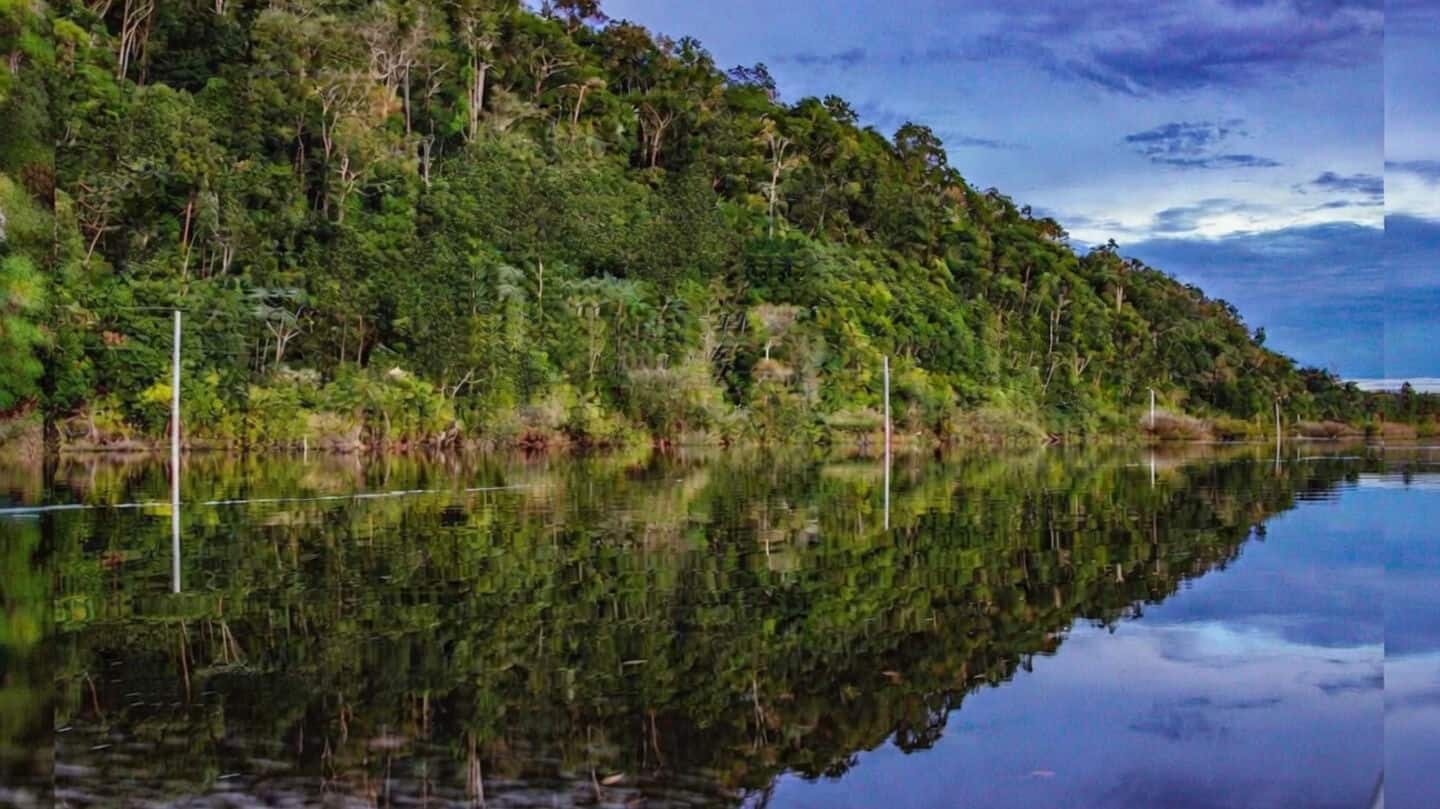
'Lungs of the world' dangerously close to collapse, study warns
What's the story
The Amazon rainforest, often dubbed the "lungs of the world," is on a dangerous path to a point of no return. A new study published in Nature warns that if deforestation continues, large parts of this vital tropical rainforest could turn into dry savannah at just 1.5-1.9°C global warming levels. The research was conducted by scientists at the Potsdam Institute for Climate Impact Research (PIK).
Rain cycle disruption
Amazon's moisture recycling system under threat
The study highlights a dangerous link between deforestation and climate change.
It notes that Amazon trees don't just absorb carbon but also generate their own rain.
Almost half of the region's rainfall comes from moisture recycled by the forest itself.
However, when trees are cut down, this important feedback loop is disrupted, drying out the air and making the remaining forest more susceptible to drought, fire, and collapse.
Capacity loss
Tipping point nearing
The study found that 17-18% of the Amazon has already been lost.
It warns that if deforestation reaches 22-28% along with a temperature rise of 1.5-1.9°C, the forest could lose its self-sustaining capacity over large areas.
Without further deforestation, this tipping point would increase to a much higher 3.7-4°C of warming.
"We are pushing the Amazon far less resilient than we previously anticipated," said lead author Nico Wunderling from PIK.
Rainfall impact
Impact on agriculture and economy
The Amazon rainforest affects rainfall patterns across much of South America.
A significant decline in moisture recycling could severely impact agricultural regions from southern Brazil to Bolivia, Paraguay, and Argentina's Rio de la Plata basin.
This would threaten food production, hydropower generation, and water security for millions.
Brazil, Colombia, Ecuador, Bolivia and Peru get around 70% of their gross national product from sectors that are highly sensitive to reduced rainfall such as agribusiness and hydropower.
Toll assessment
Ecological consequences
The collapse of the Amazon rainforest would have a devastating ecological and human toll.
Millions of indigenous people, including isolated tribes, call the Amazon home. Many species that exist nowhere else on Earth could go extinct.
Plus, carbon released from a collapsing forest could accelerate global warming in a vicious cycle.
Changes in the South American monsoon could even affect weather patterns as far away as the Tibetan Plateau.
Urgent call
Urgent action needed
Professor Carlos Nobre, who first warned about an Amazon "tipping point" decades ago, stressed the urgency of these new findings.
He said, "Deforestation has reached 17-18% of the Amazon forest and global warming is about to reach 1.5°C by 2030."
Johan Rockstrom, Director of PIK and co-author of the study, echoed this sentiment saying that continued deforestation undermines stability but these changes are not inevitable.