Ukraine war data is now being used to train AI
What's the story
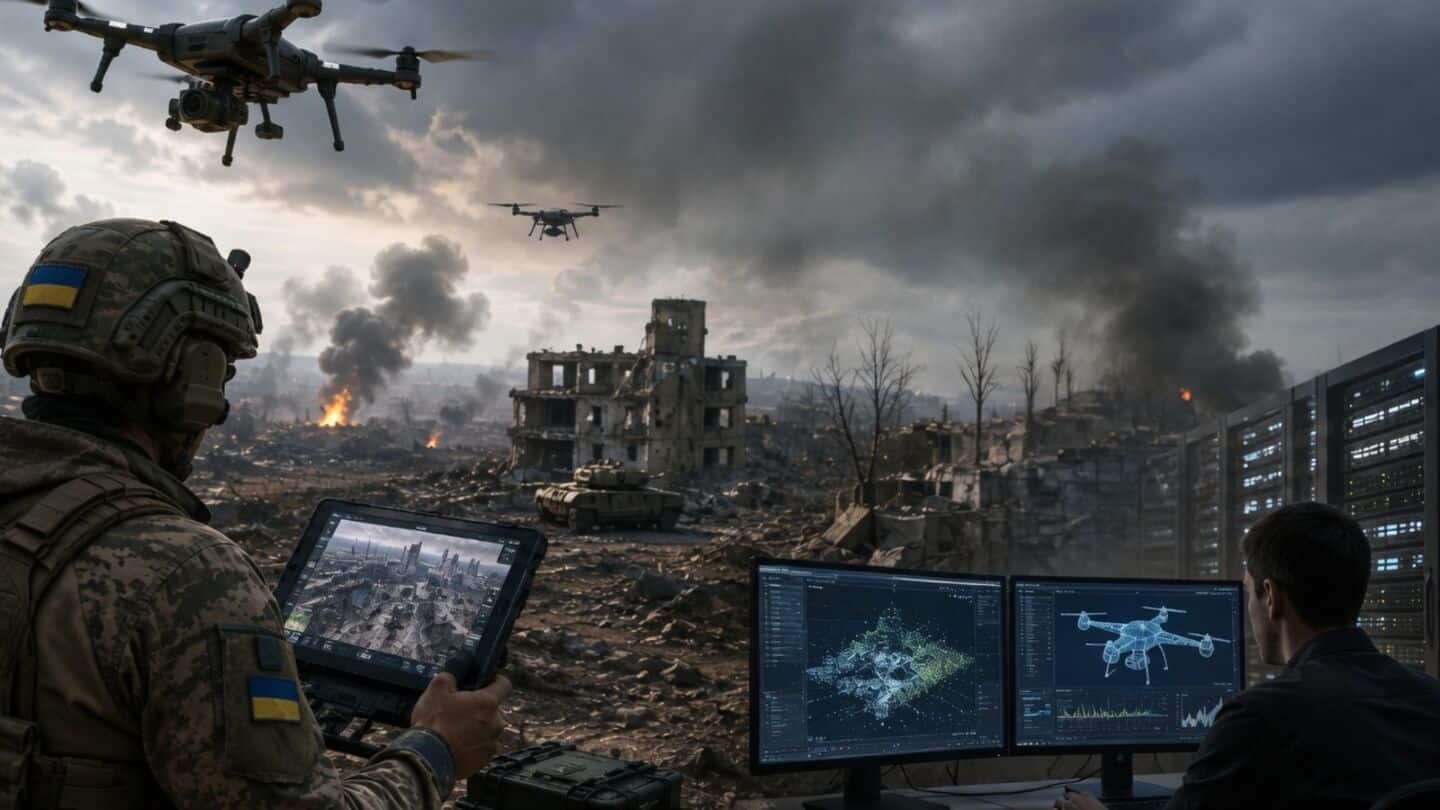
The ongoing conflict between Ukraine and Russia is producing a new resource, battlefield data. This information, collected from drone flights, is being used to train artificial intelligence (AI) systems. The MIT Technology Review reports that Ukraine's Ministry of Defence announced plans in January to share millions of data points gathered during tens of thousands of drone flights with military contractors and commercial companies.
Data sharing
UK gaining access to battlefield data through defense partnership
The UK government gained access to this valuable data, thanks to a new defense partnership with Ukraine.
This agreement allows British universities and companies to work with battlefield data via Ukraine's AI Avengers Labs.
The platform hosts millions of frames captured from cameras and infrared sensors on the battlefield, making it a treasure trove for training AI systems.
Data value
Data from real-world experiences
The unpredictable nature of war creates situations that are hard to replicate in controlled environments. This makes battlefield data extremely valuable for defense companies.
It provides a level of machine experience that labs can't easily replicate, making it an ideal source for developing more robust autonomous systems.
US-based Enabled Intelligence has already made over half a million hours of Ukrainian drone footage available for AI training, with potential applications in military and commercial systems.
Data transfer
Data's potential beyond the battlefield
The use of battlefield data for AI training is part of a larger trend where civilian technology is adapted for warfare.
The information generated on the battlefield can eventually be used in civilian industries.
For example, drones operating in Ukraine have generated data from signal-jammed environments. Some technologies trained using such conditions are already being applied in agriculture, including systems used to map and survey fields where conventional connectivity is limited.
Data concerns
Ethical concerns and lack of regulation
Despite Ukraine's efforts to control access to its battlefield datasets, there is no wider regulatory framework governing what happens after that information is absorbed into AI models.
The data can contain images, locations, and sensor records involving soldiers, civilians, and people caught in attacks.
This raises questions about consent from these individuals for their experiences being turned into training material for products that could be developed and sold years later.
Market ambiguity
Need for stricter controls on data access
Tracking the movement of information in conventional datasets can be tricky. But with battlefield data, it becomes nearly impossible to trace where specific information went after being incorporated into an AI system.
The MIT Technology Review argues that this type of data shouldn't be treated like ordinary commercial material.
Governments granting access could instead treat it more like a controlled weapons transfer, tracking its origin, licensing users, and restricting onward sharing.