Why RGB TVs are next big thing in home entertainment
What's the story
The latest innovation in television technology is RGB LED backlighting, which was first revealed at CES 2025. The tech promises to revolutionize the way we experience colors on our screens. Major brands like Samsung, LG, TCL, and Hisense have already shown their plans to adopt this new tech. Sony has also teased an upcoming TV model using this technology but has only revealed prototypes so far.
Tech breakdown
Understanding the technology behind RGB TVs
RGB LED TVs are similar to other mini-LED TVs, but with a key difference: the LEDs aren't just one color.
Each mini-LED has red, green, and blue elements that can combine them to shine in the right color for that part of the screen.
This means a wider range of colors can be created by the TV, promising over 100% DCI-P3 color gamut coverage for HDR movies and TV shows.
Product launch
Samsung's Micro RGB TV plans
Samsung had already launched a 115-inch RGB model in August. The company plans to launch three more models: the high-end MR95H, a mid-tier MR90H, and the most affordable MR85H.
These TVs will cover 100% of the BT.2020 color gamut and come with a new Micro RGB AI Engine Pro image processor for enhanced performance.
Some models will also feature Samsung's Glare Free screen coating for reduced reflections in bright rooms.
Upcoming models
LG's micro RGB TV plans
LG has announced its high-end 'Micro RGB evo' model, the MRGB95. It promises 100% BT.2020 color coverage and Adobe RGB color support, but is only available in larger sizes - 75, 86, and 100-inch.
The TV will use LG's most advanced processor to date, Alpha 11 Gen 3, and run webOS26 smart TV software.
Two more models are reportedly in the works: MRGB9M and MRGB85.
Market entry
Hisense and TCL's RGB MiniLED TV plans
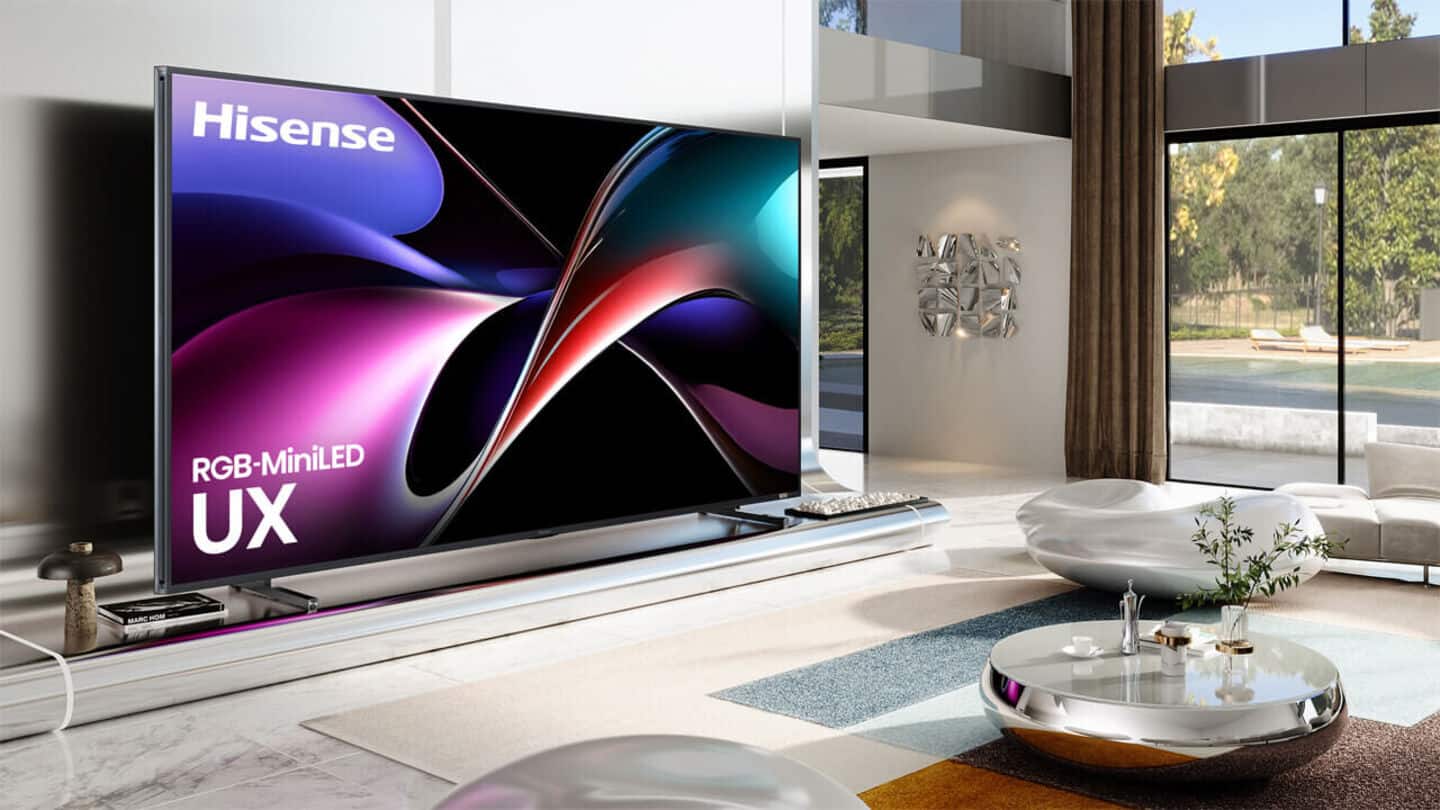
Hisense has unveiled its first RGB MiniLED line-up, the E8S Pro, in China. The TVs come in sizes and boasts over 6,000 nits of peak HDR brightness.
TCL has also unveiled two models for China: Q10M Ultra and Q9M. The Q10M will be available from 85 to 115-inch while the Q9M will come from 65 to 98-inch.
The Q10M Ultra promises up to a staggering 9,000 nits of brightness, while the Q9M is expected to reach around 2,000 nits.