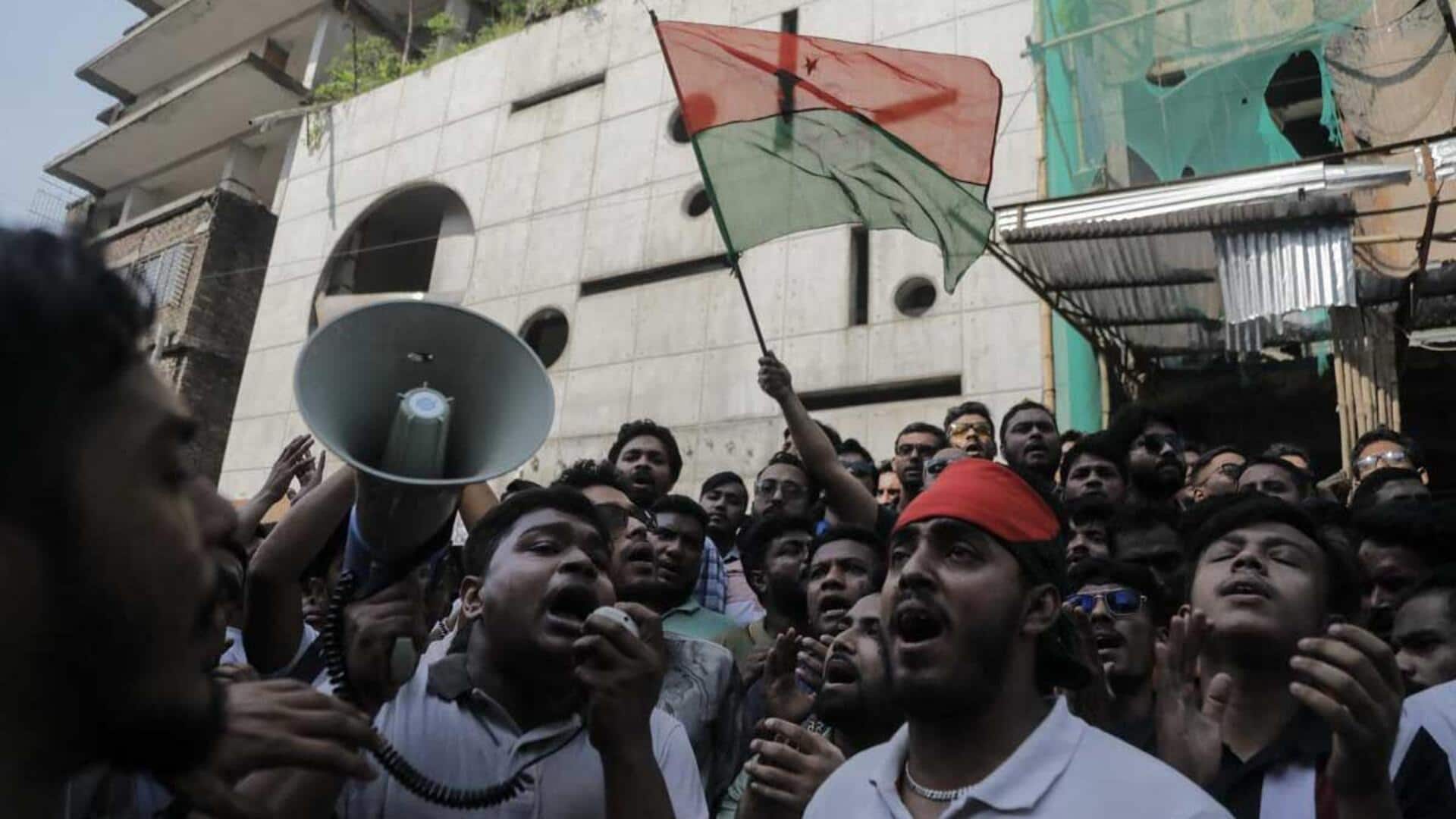
'Relentless violence': 116 minorities killed in 7 months in Bangladesh
What's the story
A recent report by the Human Rights Congress for Bangladesh Minorities (HRCBM) has revealed that at least 116 members of minority communities were killed in Bangladesh between June 6, 2025, and January 5, 2026. The violence was not limited to specific areas but was widespread across all eight administrative divisions and at least 45 districts. The report highlights a "relentless" nationwide surge in violence during the period coinciding with the formation of Muhammad Yunus's interim government.
Historical context
Report highlights historical pattern of violence
The HRCBM report places the recent spike in violence against minorities in Bangladesh within a broader historical context.
It argues that such violence is part of a long-standing pattern that dates back nearly eight decades.
The cycle of violence includes communal riots in 1946 and major outbreaks in 1989, 1990, 2001, 2004, 2012, 2015, and more recently in 2025.
Violence breakdown
Majority of killings attributed to targeted murders
The report also provides a detailed breakdown of the killings.
Targeted murders accounted for 48.3% of the deaths, while mob lynchings made up 10.3%.
Suspicious or unexplained deaths and those linked to broader violence also accounted for 12.9% each.
Killings in custody or by police forces stood at 6.9%, with army or state forces responsible for another 8.6%.
Structural violence
Report highlights systemic discrimination, demographic change
The HRCBM report argues that these killings are not random criminal acts but "structural" violence stemming from systemic discrimination and long-term demographic changes.
It notes that minorities made up about 30% of Bangladesh's population in 1946, a figure that fell to under 9% by 2020.
This decline is seen as evidence of large-scale crimes targeting entire communities over generations.
Violence nature
Mob lynchings and state agency involvement documented
The report also documents the nature of violence, with victims often singled out after facing threats or social pressure.
Mob lynchings frequently followed unverified accusations of theft or blasphemy.
One such incident was the December 2025 lynching of Dipu Chandra Das over an allegation of blasphemy.
The report alleges police often fail to intervene in time, reinforcing perceptions that mob violence is tacitly tolerated.
Justice system
Report flags weaknesses in justice system
The HRCBM report also highlights serious weaknesses in the justice system.
It claims police are often reluctant to register cases or conduct thorough investigations due to political interference and selective law enforcement.
This has created a climate of near-total impunity for perpetrators of violence against minorities.
Beyond statistics, the report emphasizes the human toll of such violence, leaving many families without financial support and deepening social and economic marginalization.